#191 | Kelly Grace | Travis Price Architects | Why We Need to Stop Building Bigger and Start Building Better
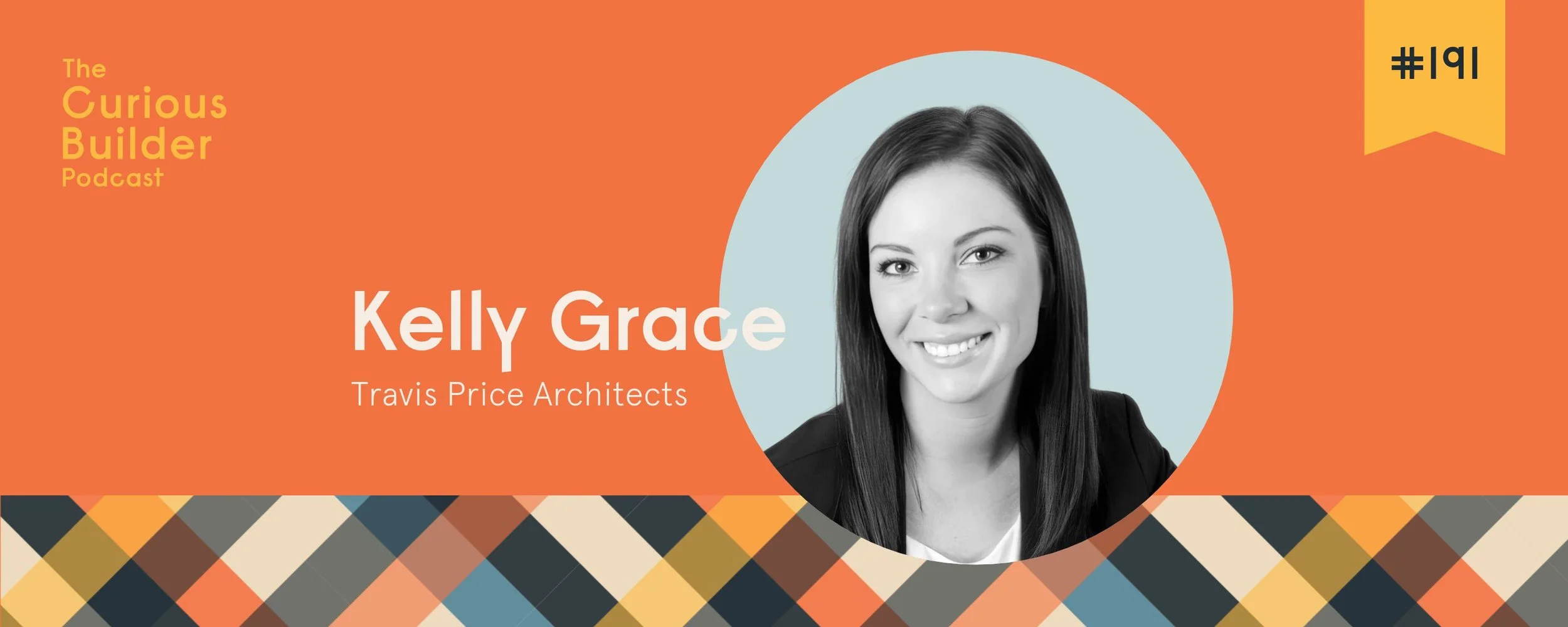
Kelly Grace of Travis Price Architects joins Mark for a conversation about why the future of luxury homes might be smaller, healthier, and a whole lot more intentional. They explore natural materials, long-term durability, circadian lighting, healthy building envelopes, and why spending more upfront can save money over the life of a home. Plus, Kelly shares hard-earned lessons from her years in construction about managing risk, having uncomfortable client conversations, and why documenting everything is a lot cheaper than going to court.
Listen to the full episode:



About Kelly Grace
Kelly Grace is the Managing Principal of Travis Price Architects, an award-winning Washington, D.C. firm known for its philosophy of Metaphorical Modernism — where architecture is rooted in nature, myth, and the “spirit of place.” A graduate of The Catholic University of America with both her bachelor’s and master’s in architecture, Kelly has spent more than fourteen years bringing that philosophy to life through projects that honor ecology, culture, and emotion in equal measure. Her approach bridges sustainability with storytelling, designing buildings that feel alive in their context and timeless in their character.
Resources:
-
Kelly Grace 00:05
As you get older, right, you just become more comfortable in what you have to say and how you say it, and and just saying the hard things, having the hard conversations. I lay it all out. We talk about the finances. I don't skirt around things. I think people need to hear it: the good, the bad, the ugly. You know, don't always make it feel like sunshine and rainbows when it's not.
Mark D. Williams 00:28
Today, McCarthy's Builder. We had Kelly Grace back on. She was a returning guest from episode 146, and she has the Non Toxic Architect Channel. And I really wanted to talk to her after we had completed Misahou's. Just talk a little bit about materiality, thought process. Also, I forgot that she was a in construction for 15 years and owned a GC company, and then became an architect. So really, her knowledge. We talk a lot about the healthy balance of what each field needs to know about the other, so that they both can respect each other and also elevate what they do for the client experience. We talk a little bit about the litigious nature of the world that we work in and that we live in, and how to navigate clients with communication and expectations. And then towards the end of the episode, we talk a lot about best practices, what kind of our standards are, and really just things you should be aware of as you're building a home for your clients. Without further ado, here's Kelly Grace. Welcome to the Curious Builder Podcast. I'm Mark Williams, your host. Today we've got a two-time returning guest, Kelly Grace, on from Travis Price Architects out on the East Coast. Hey, Kelly, how are you?
Kelly Grace 01:32
Hey, Mark, I'm great. How are you? Ah, it's awesome. It's coming back.
Mark D. Williams 01:36
Yeah, for the audience, if you haven't listened, it's episode 146, and we dove into Kelly, and it was interesting, Kelly, because I was laughing before we started hitting record. Is that you and I both? I think had a similar deal. As I looked at my calendar this morning, I'm like, I have a podcast with Kelly. I'm like, in my mind, because I'm a very forgetful person. I never forget people's faces, but names are. And I was like, wait a minute, I've already interviewed this person, and like sometimes I have people through our portal when they when they register to be a guest, like they entered in, but then I'll move the date on them, and I'm like, wait, did I just forget to move the date? Because we obviously had the podcast anyway, so I quick completely changed the notes because I do remember we had such a great conversation, and it was before I was done with Misahous, and I had told you it was like I would love to bring you on in the fourth quarter, which we're pretty darn close to, and just talk about lessons learned around the wellness space because you brought up a bunch of things about like EMF and dark rooms and things that I was just finding out about because I didn't start that way with Mesa, but we ended with a lot more knowledge than I thought. And so I thought today's episode would be talking a little bit about the industry, we'll talk a lot about wellness, what you're seeing in architecture, and we'll just it'll be a bit of a variety show, as they like to say.
Kelly Grace 02:48
Perfect, let's do it. Love it. I
Mark D. Williams 02:50
actually want to talk first because you're in D.C., correct? And you had brought up in a previous episode about how you work in a very litigious community, and something that's been on my mind lately is, and I think we live in a litigious world, honestly. But you are at the epicenter of what I assume litigious behavior looks like. How has that changed your perception of risk as an architect, and how has it changed your perception of your risk as just a professional in your industry?
Kelly Grace 03:20
Yeah, sure. It always boils down to contracts, right? And I think I touched on this a little bit before, but I had our one and only lawsuit ever, which I think had me talking about this in the last episode, where the drawings are our contract at the end of the day, unless a builder spec book is absolutely written into our AIA contract, then it's not included. But typically, we push that aside. Like, thank you, but the drawing supersedes any other spec book we create, and then usually the bid breakdown and whatever cost estimating that goes into it. If it's not in the fine print in those plans, you're kind of screwed in a lawsuit, right? And so, I think the biggest thing for us now, especially for me in the past three years, is I really like bringing on envelope consultants. I didn't used to love them in my dance, but now I'm like I. That's all they do. They study the envelope. They study how materials are compatible, how the glues are compatible? How they freeze thaw? That's literally all they do. Stick to what you're good at. I think I have a very good knowledge of materials and details, of course. But why get a playbook? Let's let them review our work. So what's happened as of late is we'll bring down our architectural fee a little bit to make sure the client can bring these folks on, and we tell the client that from the jump. Listen, you want these guys? They're going to be looking over all of our details and being our redliners, which we don't typically have someone redlining us. So that's been something that I just think helps overall make sure you have more eyes on. What potentially are lawsuits, which is typically water intrusion, right? There's not a lot else that comes from maybe some other things. I
Mark D. Williams 05:08
think that's I think that's phenomenal. Do out of curiosity, do you know Mark Laliberte out of construction instruction? He's out of Arizona, but he his office is out of Colorado. The reason I bring him up, I've never heard him describe himself as an envelope specialist, but I mean he has literally a lab set up. It's called construction instruction. It was really to go after builders, and then you. We're going to bring actually. We're going to work with another builder in our curious collective from another state, and we are going to bring our HVAC, our framer, our plumber, cider, roofer, and then our project management team to basically meet and train that old adage "you're only as good as your weakest link" is obviously a true statement. But even if, as you as the architect or as me as the GC, like I'm not on site every day, depending on my project manager. But even even my project manager knew everything. You could have the framer, and even the framer you hire might know everything. Which none of these things are actually true. We don't know anything. The point is, like the laborer, the guy actually doing the work, the guy cutting a hole in the side of your sheeting. Does that guy know? Because he is usually not the highest guy in the totem pole, and that's not a negative or a positive. It's just a thing. I think that's why systems, belts and suspenders, all these approaches work so well. And you're right. I think that's where the builder and the architect relationship is so important. That there's so there are times where the architect needs us to save the day for them, and there are many times where the builder needs the architect to be like, "Hey, but where does the water go?" You're like, "Oh, that's a great question. I don't know. Let's figure it out." I think that's why you need open-minded relationships, and while always say I'll pick a relationship over a reputation because actually I've never said that before, but I like the way that prompts. It's like that's actually really that's a great bumper sticker, actually. But think about it. Like I depend I depend so much on the collaboration of the people I work with, and it's a better build. That's why, as much as architects try to spec every single thing, I had one architect say, "If I drew every detail and everything, the plan would never be permit ready." We're talking 1000s of pages; it would never get there. So, what we're gonna? And this was them telling their client why you pay for construction administration. Because I have a lot of clients are like, I'm tired of paying the architect, blah blah blah blah blah, and I'm like, no, guys, if you came to us because you want their work, you want us to build it, they need to be. You don't fire the quarterback in the fourth quarter with two minutes to go on the line. Oh yeah, we'll see you later. We're like, what? We got a game to win here, people. But people ask us all the time. I'm sure you get pushback of, oh, can we stop paying the GC to do this, that, or another thing?
Kelly Grace 07:42
Yeah, 100%. To take it a step further, we mandate with our clients that they have to hire us for construction admin. Like, there's no other way. We have to, yeah, we have to be on the project for CA. But even then, we work all over the country. But it could be in Washington, three miles away, or it could be in Washington State. At the end of the day, the architects only still able to view so much, right? Usually, the CA portion of our contract is we come around when payment applications happen once a month is our mandatory. Can we make it twice a month? Usually, but that's about the range of how much we actually get boots on the ground. So, going back to litigious, unfortunately, another player in the game I feel like that clients have to bring on more often than not now is their own third-party inspector. Not by hired by the builder, not hired by us, but hired by them to look after their best interests, especially when it comes to all these healthy home things we talk about. The building code is not set up to protect us from so many different things, especially I'm thinking a water intrusion and moisture and condensation. Who's looking at the joints on your zip tape? Who's making sure those are overlapped right? Who's making sure that the studs were dry before you packed it with insulation and put drywall on? What's the moisture rating on those? None of that is code. Having had my own construction company for the past 15 years and being a part of that, I wish we did more of that just for our own protection. Thank goodness, knock on wood, we never had any like massive callbacks or big issues. But the more and more the web stirs up, the more and more other people's issues with mold and just big failures from the wall assembly, and I just think, like I said, a lot of these guys just don't know the science behind the building system, right? Like, how do they know all of these things? Hopefully, they read the manual on how to install said product correctly, but somebody's got to look after that, and it's not usually the architect to make sure all those steps are really checked.
Mark D. Williams 09:46
When you're saying that, that's really the job of the GC and the project manager. Everything you just said is falls under my purview. Obviously, we pay the framing company and the siding company to let's say seal the zip tape or seal the penetrations, but obviously. As the owner of the company, I am not on site every single day. That's why I have a project manager. That's their job. Most projects, you don't have someone sitting there 24/7 babysitting. They usually stop in the morning, get everyone going. Might stop, have a few more meetings. In the typical world of normal construction, it seems like they're probably managing two to three jobs, and I think that's just part of education. Even if you do everything correctly, here's the thing: you're still going to miss stuff because nobody's perfect. And so that's why I think this redundant system is really important. And obviously, training up your subs, training up partners. We probably work with the same people 80, 90% of the time. It's not that I'm not open to working with new people. To me, I've always kind of said it takes about three jobs before everything is kind of really humming along, and they kind of understand us, and we understand them. But I think that's true of designers and architects. I tell my architecture partners once I work with them, I said I want to work on three homes with you. If we nail this out of the park, great. But that doesn't mean I'm going to nail every. Maybe we just got lucky, and I and I hope that's the case. But I want to prove to you. I think I heard a quote a while ago that I really like. That don't judge me my by my best. Don't judge me by my worst. Judge me by what I do consistently over time. What if your first job was a failure? We had a situation on Misahoos where we tried a new person, which is not the home you want to try a new person on, and it went awful, so bad. But we they saw it through. We I was happy with the end product. The end product ended up getting there, but it was a painful process. It was like you got on a steamer ship to cross the Atlantic and you end up in a rowboat, and it was a lot of work. But we got there. Oh man! And but now they're on house number two, and I sat down with them and I said, I can't say this on a podcast and not live it. I said I will do three homes with you, but I you won't make it to the third one if the second one is as bad as the first one because the first one was terrible. This one better be a lot better. This should not be a surprise. Like I'm looking you in the eye. I want you to tell me, Mark. I can do this. I want to do this. I understand the expectations. I think that's fair. I would want that them to do that to me. I hate when people just ghost people when they're like, "Oh, we had a bad experience. We're going to write them off." Bad stuff sometimes happens. You just got to figure it out, and so we'll see.
Kelly Grace 12:18
You're spot on. Having, like I said, had our own construction company and myself personally being in charge of my subcontractors' contracts with us as the GC. That was my that was my department. I was really making sure that the the comments in the architectural plans were landing in the subcontractor notes on what they're supposed to do, and that's something I've ramped up more in our firm as instructions more to the builder, and honestly, it saves the builder in a lot of ways. But window leak testing is one that I keep like raising the flag about. But which subcontractor in your arsenal is actually doing the test, and who's going to stand behind it? Hopefully, the window installer, of course. Is it? Are they doing their own water test, or is the GC coming behind, or is it now a third-party person that I bring? I have the client bring in because the builder. A lot of these builders don't test their windows; they just install them and pray that.
Mark D. Williams 13:11
I honestly have never heard of anybody testing a window after it's done. I didn't know that was a something anybody even did.
Kelly Grace 13:18
100%, and it's funny. I was just at the. Is this a commercial application
Mark D. Williams 13:21
or residential?
Kelly Grace 13:23
Residential. Really? I was just at the build show in Orlando in February, and I was listening to Jake Bruton talking about his putting in his own personal windows on his house. I would consider Jake Bruton expert level builder, right? And he's putting in, I think he said, 36 windows that he personally put in. Seven of them failed the water leak test. So we're human, right? It's not a knock on anybody. It's just let's figure this out while we're open. This is just something to protect everybody along the way because the last thing you want to do is come back and be ripping out finishes, right? There's a real formal way to do it where you bring out the system with the pistons and it's very calculated and it creates the perfect storm. You could go that route. A third-party person would hire that said route. Of course, it's probably quadruple the cost if you just simulate a rainstorm. I'm not saying with a garden hose power wash it, but come from above. You can do your modified version. I still push clients to get the more professional version, right? If they really want to have it done right and document it window by window. But now we're running that into our drawings. Builders GC shall verify every single window via video, a water test, and it's annoying. But it's really if builders, again, it's that team approach, right? We're not doing this just for our own sake. We want our building to last, just like you want the one you built to last.
Mark D. Williams 14:46
It's funny, I've literally never heard of that. However, I'm already in my mind. I put a note on the back of my notes to ask my team about it because I'm wondering, like, how to market it, how to talk about it. Is the juice worth this worth the squeeze, as they say? Our homes have. So many windows on them, but I'm thinking literally it's only a day from a time standpoint. It's not terrible. I assume you're doing it before siding goes on too.
Kelly Grace 15:08
Before siding, so your windows taped up. Yeah, windows are
Mark D. Williams 15:11
taped up. We're lucky. Our window company Pella does their own install here in Minnesota, so it works out great. We like it because they have a lifetime warranty. But also, if there's any issue, they own the install and they own the window, so I love that. I love that safety factor. But I'm going to talk about that because, especially if you don't have to do the third party, the massive pressure and some of the sites can be really hard to get into with equipment. But
Kelly Grace 15:31
if it
Mark D. Williams 15:32
was a ladder and a hose, and do your best, if you're really trying to find the big stuff, I've never, knock on wood, I've never really had one. We've had sashes fail, of course, and they just get replaced or things like that. But that's that's a okay. All right. Well, look at that. That's a. I'm definitely gonna have to follow up on that. This episode is brought to you by Pella Windows and Doors. I've used Pella for 21 years as the exclusive window company on every one of my builds. When people ask me who I trust for windows and doors, it's Pella. Every time, their craftsmanship, their innovation, the top-tier service make them a no-brainer for any custom home builder or designer who demand the best. Whether you're designing something bold or building something with timeless elegance, Pella has you covered. They're also the only window company that has a lifetime warranty on all of their windows. I've gotten to know all their people at Pella Corporate as well as locally here at Pella Northland. I'm proud to call them our partners and our friends. Visit pella.com to learn more and connect with your local reps today. Also, for more information, you can listen to episode one where I interview their founders, as well as episode 109 where we talk about the innovation at Pella. I have a couple questions I want to go down on this road, but going back to the original question about the litigious clients, what do you think? I think the the best thing we can do. You mentioned the contract in your drawings are your contract. I would actually say one step further. If we have to depend on a contract to protect us or a plan to protect us, I'm not saying they can't, but man, it just gets expensive. I think the real line of defense is our judgment call. Do we want to work for these people? And I think it's hard for business owners because we also realize that we have to keep the motor running. We've got to take on business, and not every client is going to be your best friend, and that's fine. It's hard to walk away from projects, and it's hard when your gut says this is a bad fit. But you, as an owner, you're like, if I ran from every person that was a bad fit, I wouldn't have any business. It's like how you've been in this business for a long time on both sides, design and construction. How do you manage who's a good fit for you, so that you avoid having to have a litigious situation from the beginning.
Kelly Grace 17:48
It's tough. It's really tough because everyone seems so wonderful in the beginning, right? You have your spidey sense about you, and you realize compatibility from the get. I don't think we've ever turned down a client. Maybe it's just nicer than that. It's more like, okay, our fee is really high on this one, and we're gonna. There's no way they're gonna choose us, or something like that. But it's tough. And like I said, Washington, if it's not your client, it's the client, the neighbor of your client that's now coming after you because of something ridiculous, and that's that happens a lot in the city because property lines are so close and they're right on top of each other, I think your gut reaction is a real thing. Like when you feel something that's off, but money talks, and that's the hardest part. And I'm like, ah, I don't know what to say.
Mark D. Williams 18:34
No, I think that's fair. I was hoping for a silver bullet that we could all just fix our lives with, but that's fine. What have you learned about communication and setting expectations that maybe earlier in your career you didn't do or you learned from that you do now.
Kelly Grace 18:50
I think as you get older, you just become more comfortable in what you have to say and how you say it, and just saying the hard things, having the hard conversations. I'm very good at that. I just I lay it all out. We talk about the finances. I don't skirt around things. I think people need to hear it, and they need to hear the good, the bad, the ugly. Don't always make it feel like sunshine and rainbows when it's not. Give it to people straight, and don't bullshit. And just being so honest in your convictions. I've always been a very honest person, but I feel like if you keep things straight and honest, you could always go back to what you know. You remember what you said because there's no changing. It's it is what it was, and I just think you have to document everything, unfortunately, which is a big bummer. But following up in an email with what you said in a call, just to make sure, because that's that whole CIA thing that's super annoying. But you kind of have to. That's
Mark D. Williams 19:42
that's so fun. I'm literally smiling so this big because you're literally speaking my language. Because I've often said I have a terrible memory in many things. I often forget what I say. But have you ever done this where you? It's almost like when the client tells you what you said, you know of what they're telling you is true because you know you're. Own voice really well. I know myself extremely well. I've had many times, 99% of the time, when the client says, "Hey, Mark, you said you would pay for this, or you said this." I'm like, "Okay, did I?" In my mind, I'm like, "Did I? Did I?" Yeah, that sounds like something I would have said. I'll be like, "Okay, yep, I believe that. I'll honor that. I'll take care of that." Recently, this is the only reason I'm bringing up is recently. I won't go into the whole story. I've done a podcast on it where we had to fire a framer halfway through a build, which I've never done in my career before. And I called the client before I did it and told them what we were doing. He said, "Go for it." I usually am pretty good about a follow up email, but somehow something got missed, or we didn't have AI notes for it. But what I agreed to and what he thought I agreed to was totally different. I agreed to waive my GC fee, but any delta in cost is still a cost to the job. And six months go by, he approved the change order to hire the new framer. But then, by the blue, he's like, "You know what? I really think you should have paid for all of that." And I was like, "Why do you say that?" He's like, "When we were talking eight months ago or six months ago, you said this," and I was like, "That doesn't sound like me. I don't. I was very respectful. I said, "Do you have anything that I wrote you, or any AI notes, or anything that can corroborate that?" Because I got to be honest with you, that just doesn't sound like something I would say. And neither one of us had it. So at the end of the day, I had to make a judgment call to keep the client. He was super a great client. They've been super happy. So at the end of the day, I found a way to make them happy, but it was like one of those things. Like it didn't sound like me, and so anyway, you were in a very unique situation to, or to just the fact that you were builder and now you're an architect. That relationship is so fascinating to me. As a builder, if you were a builder, what do you wish architects knew about builders, and vice versa. What do you wish builders knew about architects in the way that the other party would respect each other more? Because I feel like, unfortunately, good relationships they work through this. But there's this this conception that builders. I've heard so many builders or framers say, "Oh, an architect draws stuff that isn't possible. It defies the laws of gravity. Blah blah blah. I'm surprised they even know what gravity is. And then you have architects that are like, "Oh, this this guy, he's just." But it's like both parties come at it with the wrong stereotype in mind, and they're not. This is a stereotype. I mean, this hasn't been my personal experience, but I've heard it enough as a stereotype that you realize it exists out there. So you've been both. You are both. What do you think the other party should know about the other party so that it was more synergistic for the client and really for their relationships?
Kelly Grace 22:30
My first years out of college, when I worked for a construction company that was not mine, was a Capitol Hill builder, and we were building all of these different architects' projects. Really, the first time I had been in meetings with different architects, different drawing plans, building different sets of houses, and I just remember so many of the architects being so pretentious. I'm like, God, you're annoying. I'm never gonna be like that. I don't even want to talk to you. You're so belittling of the builder and the project manager, like as if we don't know anything. I just hated it. I'm like I just have this disdain for you right now. And I'm a people person. I love communicating and having good relationships like you. And I just I knew from that moment that I would never be that architect that comes onto the job site holier than thou and my nose up and I'm gonna show you my details. Just very above everybody. That's not how a successful job gets done. You need to be boots on the ground, figuring things out with the guys. What are the questions? Like you said, you can't draw everything. We try our darnest to draw a ton. There's nothing that bugs me more when a builder doesn't call me to ask me a question on how something will be done. They just do it themselves because they want it to be faster. I'm like, you don't understand. It's not faster. I would pick up my phone in 10 seconds. I'll have a sketch and send you an answer. It might not be that quick, but very quickly before you go building it. Then I have to have you rip it out because you didn't check. It's that open communication is obviously a big part of it. I wish architects knew how hard it was to build a home, and they make it seem so easy to move this, do that. Hello, and then it costs money. They don't think all of this costs money and has, and I think that's when you become a really good architect when you can actually talk costs with the builder and then relay that to the owner to sell that back with them that make sure it's not just the builder pumping numbers at the owner and the architect be like this is what it is. It's the architect having the wherewithal to know what the numbers are and to know how difficult a task is and to fight for the builder on why numbers are that way. I think that just takes a lot of experience and then again just communicating that back to the client, and then with builders, the vice versa is funny because builders like I did the first job, like kind of foo foo architect. How do you make that relationship better? It's a good question. It's a tricky one because there's so many levels of architects, right? I'm a soup to nuts architect where the details. Are done. I think there's so many architects that don't draw details. And then if I were a framer, I'd be pissed too because I'm like, where your what do you how do you mean to build this? You just did this, and I'm supposed to figure it out. That's tricky because it always comes down to the owner didn't pay for a good enough architect to draw details that well.
Mark D. Williams 25:18
A lot of problems come down to value statements. The example I told you. The reason we had that framer that we had to fire was because we picked the low bid, and it never in my career has the low bid ever worked out ever. It's undefeated in time. Death, taxes, and the low bid. They always win. They always bite you. And so, but the thing was, is the homeowner had put extreme pressure on us to lower the price of the home, and we came to them and said, "There's a framer that can do it. That's lower, but I want you to know we're not going to credit you. We had, as I recall, I know it's six months ago, 2030 grand lower than the other bid. I said we can take it; it's a win. But I said I'm not crediting it to you now because if we have to fire him, we are going to need this money to hire someone else. And not only and not only did we need that money because it actually exceeded it, and yet it's funny. I've also you mentioned before about taking notes very rarely, and this is not different client now. I'm thinking about. Turns out, if you've been built for 22 years, you have lots of stories. But the one that comes to mind now is: Have you ever had a client that doesn't honor their own word.
Kelly Grace 26:22
Yeah, the one lawsuit we got into. Yeah,
Mark D. Williams 26:24
that's my one. I have a lawsuit right now. Our same deal, not right now, but one from several years ago where we have a video of. I just was being funny about it, just doing a social media video. I took a video of the client saying that they agreed with a stain color, and then that night the painter stayed late. They stained it the next morning. Homeowner comes in, throws a huge fit. We were coerced into the stain color. First of all, where in the history of the world has anyone been coerced into a stain color? My goodness, this isn't James Bond. And I'm like, I literally have a video of you going, "Yep, this is the vid. This is the stain." And they wouldn't honor their own word, and from that point on, I told my team. I said, "Whatever we can do to get away and done." And it was it was hard. It was the hardest. It was terrible. You can't just walk off a job as a builder. This wasn't meant to be a comparison thing. But we had a designer once that left a project because the way the client treated him, and they have the ability to do it because you can continue to design, architects not as easy, but it's still easier than a builder. Because a builder, if we walk away from a job, oh wow, it is a monstrous thing. You're leaving yourself open for massive litigation. But honestly, it's not in the best interest of the client either to fire a GC. It's kind of like going back to the sailing analogy that I said earlier: If you're going halfway across the Atlantic, you're like, "Yo, we're gonna pick in a new boat, a new driver." I'm like, "What? This is crazy!" It's like you like you're at sea. You got to kind of figure it out.
Kelly Grace 27:52
It's so true. The first construction job I had on Capitol Hill, the owner of that company was also a Secret Service agent, so it was really funny. He just had a complete distrust of everybody and everything. So I don't know where he learned it from, but when we would show stain samples, he would make clients sign the back of the piece of the wood with the stain sample on. You've signed that. You signed that. It was always like,
Mark D. Williams 28:15
my word,
Kelly Grace 28:15
that was his mo. But he must have gotten burned big time at some point. But it, as crazy as that was. Going back to like that guy saying, "I never yes to that." Well, yes, you did right here, and you hate to be like that because it feels a little like nanny nanny boo boo. But like, we have to document these things because it costs stuff. It costs money.
Mark D. Williams 28:36
Let's talk a little bit about health and wellness in architecture. What are you seeing right now? We talked a little bit about this last time, and now I have a lot more experience having done it. A lot of these things at Misus. What do you want to see? Because I feel like what we want shows up earlier than what a client wants. Do you think that's fair?
Kelly Grace 28:52
Yeah, for sure. So
Mark D. Williams 28:53
how are you leading these conversations? You were telling me last time a little bit about EMF, a live show, magnetic fields, and dark rooms and things like that, and I think this is true of being a good architectural designer too. I think there's certain designs you probably gravitated to, or sometimes the client just doesn't want it. And you're like, there's a part as a creator you want to show them maybe something they haven't seen before. So there's always that challenge where people want to show you a picture as an architect and be like, do this, and you're like, hey, I'm a creator. I can design anything you want. Like, how about we design your get that whole concept? But I actually think it's somewhat relevant to the wellness space because wellness means different things to different people. How are you taking the things that you're interested in and presenting them in a palatable way to your clients so that they can implement them into your jobs?
Kelly Grace 29:39
Yeah, I think it's twofold. I think there's the building science side, the building design. Which, the more and more I peel the onion of healthy homes, the more and more I go back to geometry and physics. We're a very modern architecture firm. We've done a lot of flat roofs. We've done a lot of parapet construction, mostly. Of those are driven by city design, right? Those are usually because we have to go up straight in a row home style, or like people want roof decks. The site usually dictates that. But when we have land, we do big roofs and overhangs and really fun stuff from a health side of the building. What can we do to eliminate again going back to leaks, which is so not glamorous. But how can we really make our building safe using geometry and physics with our design? How can we make this roof overhang really serve the building to keep this building dry in case our water, our windows leak? And like, how can we have extra layers in our design? We push our windows deep into our openings, not hold them flush to the sheathing. Different techniques. I think just one layer over here that's just smart architecture. Doesn't really have to do with so much healthy, but it's making sure the building works for years and years to come, right? And I think that checks a big box. And when people come to us, they already know we're modern. They already know the architecture is cool. There's not a lot of convincing in that side. I think we're just really sharpening our pencils to really hone in on getting making sure water's not part of it and ramping up the building science side and how we're insulating and how we're wrapping the building is different today than it was three years ago. If you saw that piece that just came out in the Wall Street Journal about the builder who was who would rather ramped up, he ramped up his insurance policies to not have to pay for mold, like going back to fix mold, rather than changing his building practices to have less moldy homes. He just ramped up his insurance policy to cover them later. It's a big issue.
Mark D. Williams 31:40
I feel like that's a metaphor for health policies in the country. You, that's so funny. I just came to be like, wait a minute. You, if you exercise three times, three times a week, ate healthy food, what are healthcare costs? Forget prevention.
Kelly Grace 31:53
Let's just fix it on the back end. Yeah. Oh my word. Throw medication at it. Prescriptions. I know. That's exactly what it, and that's honestly that's what made the shift for me into this whole world. Was it started with food, and then it started with products on my kids, and then clothing, and then it finally went into my buildings. But it took all of that almost 12 years of chipping away at being healthier in all those avenues, and then just in the past three years, really ramping up the building side. So I think there's that side that we don't really explicitly talk too much of the client about, right? If they want to talk about it for sure, we talk about how and why we built the envelope design. That's one thing, but then I think there's the next layer of health, which is building finishes, the interiors, which we definitely are very vocal about and care a lot about, right? About how our building looks.
Mark D. Williams 32:46
We're happy to announce our latest sponsor, Real Wood Floors. What made them to be an ideal partner is the fact that they align so well with our high-end custom homes. They're located in 25 cities across the country. They're probably pretty close to you. And what really drew me to them is the fact that they're vertically integrated. So many times when you're dealing with wood floor, you know, procuring it from different companies, having it go through middlemen, you're either short material, it's the wrong material, and so we are looking forward to leveling up that and buying direct. The other thing that I really love is their floor made perfect match. I can't tell you how many times I've had a beautiful wood floor, but the vents don't match. Or I love the wood floor, but it doesn't match my treads and risers. Knowing that they can perfectly match that is something I'm really excited about. Go check them out at realwoodfloor.com and sign up for an RW Pro account. Tell them you heard about them from the Curious Builder.
Kelly Grace 33:41
We've always been natural architects, so that was really easy for us to segue into healthy because we never allowed LVP or plastic countertops, like all of these fake phony things. Just that's when we're like the foofy architect. Yeah, hell no. Well,
Mark D. Williams 33:58
it's funny you say that because we talked about this last in your previous one about the container homes that you had built in simplicity, I think there's something to be said about that. But natural materials is a huge one. I didn't realize it at the time. I picked natural materials because I like the way it makes me feel. I like the fact that it's natural. It's in nature. I love nature. But then understanding that there's a lot of longevity reasons. I had a guy, Ian from another across industry. He does what's called biomimicry for the audience. Is basically he points out the window. His name is Michael Wright. He goes, look outside. He goes, that's $6 billion or 6 billion years of R and D. He's like, don't you think we should use it a little bit? He had these great examples of using the fin of an orca whale to design the blades of a wind turbine, and I was like, "Oh, that's so cool!" But anyway, I think a big part about cost, and a lot of people have not historically picked a lot of natural materials. Think about natural stone versus like porcelain or LVT or some of these other examples. They perceive natural materials as something that takes more maintenance. But what they're not factoring in is the life cycle and the lifetime effect of said product. And I think that middle generation, really my generation, your generation, there was a lot of concepts about I want it, but I don't want to do any maintenance to it. Here's a newsflash for you: there's nothing in this world that doesn't take some maintenance. Name me one thing: relationships, love, hate, every single thing on the planet. I'm using metaphors, but they're all they still take fuel. If you want to keep loving something, you got to keep fueling it. If you want to hate something forever, you got to feed that hate. If you want to build a house, you got to maintain it. If you got a car, you got to put gas in it. I can't think of anything that doesn't require some sort of, you know, fuel source. I mean, I'm just coming off the top here, but if you can think of something, let me know. And so, if that's the case, then really what we're talking about is time. And so, we recently convinced a client; he is older, so he is running out of time. We got him to go thermally modified wood versus a synthetic product on the outside of a siding, and the way we got there is we said, at 20 years, this product will have paid for itself. It was an $83,000 upgrade over whatever product the client or the architect had specked, and we said we really like this. The architect loved it, but they originally had chosen something different because the financial team said it had to be a lower price, so they were trying to honor the. And this is where sometimes you have to push back. Sometimes clients don't always know the best. In fact, they often don't. And it's all we can do is educate them on their options and then let them choose. And of course, we have our biases. Of course, we wanted this similarly modified. What? Of course, the architect wanted. So we, of course, are coming up with a scenario and a way to make this digestible, but guess what? At year 21, this product is now cheaper than it would have been if you factor in maintenance. Is where I'm getting at with this, and so I think that's us as professionals, builder and architect, using our expertise to present the message in a different way. And then at the end of the day, if the client wants to do something adverse to that, fine. At least we've done our best to try to do our best.
Kelly Grace 37:02
100%. We would much rather be a lean and mean house that's smaller and make sure the materials are high quality and durable. If you look at all of our buildings, they're mostly metal exteriors: copper, aluminum, corten steel, stainless. We really push for a metal outside because we just think it's the most genius material you could possibly use from a longevity standpoint. There's no maintenance besides lightly washing every now and then. And same thing, going back to the health discussion. If a client comes to us and they really want 5,000 square feet, but the house won't be that great in their budget. Let's just say their budget only allowed for a 5,000 square foot house. That was just we couldn't get a lot of the health upgrades. We couldn't get a lot of the up upgraded systems. I would convince them to go down to 4000, and I would say we will change your space to make it just as amazing. You don't need 1000 square feet, and that's where I think a really good architect has to know construction numbers. We're pricing as we're drawing, and I don't think a lot of people are doing that. And we're lucky because we had our own construction company, so we were able to really be good at that along the way. When it comes back to convincing or talking to clients, like I think your question was about these little health upgrades. Like I said, there's the envelope side, and then there's just the next layer of materials, which we just talked about: natural materials and durability of materials. Then's the next layer of like biohacking, right? The health layer of like the wellness of what people are upgrading all over today is their like spa side of their house, which I push for heavily too. You're gonna use it if it's in your fingertips. That sauna in your gym, having a gym, having red light, like all of these extras we have to talk about too. So that's the layers of health, and then then the whole electrical EMF side is another layer. But I think a lot of that we just right now we're just designing into our work, like having a kill switch in a bedroom. It's just part of the electrical plan at this point. We don't even really talk about it too much. Architects are meant to protect the health, safety, and welfare of the people, and it's something we take on as we're doing. It's just like we put a smoke detector in your bedroom. We have a kill switch at your bedroom too.
Mark D. Williams 39:06
I heard something. It's funny you say that because I think I was just having a branding discussion with what we're doing with Misahoos, and one of the conversations we had is how much of these practices that we've developed and have adopted will we just be our status quo. We don't even talk about to the client because that's just how we build. And then there's always an element of choice. I won't build a house anymore without external insulation on it anymore. And we're in a we're in a higher climate. We're in climate zone five and six here. I don't know what's what are you guys probably three four or
Kelly Grace 39:35
A B.
Mark D. Williams 39:35
Yeah, we're going to continue to evolve products that help us do that. I believe it's going to be in Minnesota where we have one of the hardest energy codes based on our climate, and so we have benefited, I think, from that. Just being in a cold climate, I think Canada, obviously being even further north, they've been using, they've been doing external insulation for decades. They're like, oh man, you guys are way behind the times. But I think a couple things will help us. Sometimes you. Have to face hard things in order to do good things. We are in a major economic crunch, and I'm feeling unfortunately. I like to be a positive light, but I'm getting a lot of vibes of what it felt like in 2007 and 2008 in terms of we're in a couple of wars. We've got high energy prices. We've got inflation. Just not a lot of good news other than the Curious Builder podcast, which is always delivering good news. Where I'm going with this is, I think people will build smaller homes because costs have just skyrocketed. I heard a stat the other day that since COVID, costs have doubled, and in the last two years, I've seen a 25% whole house increase. Are you seeing those in your market as well?
Kelly Grace 40:36
Completely, and it's hard for us because we're usually the beginning of the chain here when we hire the clients, come to us usually first to get the house going, and we're trying to predict their pricing to set the size of the house and all these things from the jump. When the numbers keep increasing, we look like the a holes because we're like, wow.
Mark D. Williams 40:54
In your defense, you're the first one in the door. What's that old saying? The first one through the window gets cut. I think that's why I'm a big fan of building the team in our market in the Midwest, they typically come to builders first. We'll have an interview with one or two architect, one or two designers, and now we have a team. And our team always is very unified. Obviously, the architect and I are talking back and forth when we do the price test. We'll do a closed doors meeting with pricing with the architect before we reveal it to the client of just saying, "Hey, here's where pricing came back in. Where do you see some opportunities to present to them? Because you better have options B, C, and D ready to roll. Because no one likes the first price test. It's not pleasant. It's not fun for us either. It's not fun for you as the architects. It's not fun for us. Nobody enjoys it. Like that's the low point of the project every time.
Kelly Grace 41:37
Really is. Yeah.
Mark D. Williams 41:38
I think the happy accident of all of this is people will build smaller homes that are more thoughtful because I think one of the benefits that Europe has had is they've been more landlocked than the U.S. and their energy costs have been high for decades. Triple pane windows, thoughtful generational design, and one of the cons, and it's a cultural issue. I don't even know if we'll solve it in my lifetime, honestly. Is that the average American lives in their house nine to 11 years somewhere in that range. That's not very long. That example I gave before, like it didn't make sense till year 20. But if you start looking at a house in 30 years, 40 years, 50 years, like whoa, yeah, cost modeling changes a ton. It might be expensive today, but it's a no-brainer if you look a little bit further down the road, and I think that's a cultural thing. Do you agree with that statement?
Kelly Grace 42:27
I do, 100%. And I also think the more and more we talk to clients, and the more just the world today, I think people are more about experiences and enjoying life than ever. And I think COVID really helped push that for people, right? And I think that's where the conversation of durability and getting people away from all this home maintenance, not to mention just fixing things, restaining, repainting, touching up. There's all that. Then you take it to the outside, and a lot of people are just putting in a big grass lawn, and like, who wants to mow their grass all day. This is so archaic. This literally so. This was like back in Britain. You were you were rich if you had a lawn service with clipping. It's so silly. I get a patch of dirt and grass for your kids to play, right? But other than that, cover this land with ground cover and don't ever mow it. Think about ways that you can live on the land lightly, and that's something we always push for. How can you have the easiest life and not have all this stuff to take care of, and just stuff in general? And I think that's a big conversation we have with clients too, when they just have a lot of chachkeys and like stick they want to store. Talk about nervous system overload if you're surrounded by all this. So, and that's a bigger health topic too. It all goes back to just making sure people have the space to live.
Mark D. Williams 43:45
One thing I've never thought of until you just said it. So I think architects, as a positive stereotype, every I've never heard an architect say, "I want less windows," unless they're a passive house architect, because they're always like more natural light. And I think what we've always been aware of, and I shouldn't say always, but architects in general are very well aware of how windows and natural light make you feel. It also looks amazing. But more than that, it's the how does the light come into the home? And where I'm going with this is lighting. I think is a sneaky. You know this because I'm preaching to the choir here. But I think it's up to us as builders and architects to talk more about how important our electrical lighting is for homes because artificial lighting the average person spends I heard something like 80% of their life indoors and the majority of that time is not always lit with natural light so therefore how is it being lit and I had someone in recently I did DMF cans at, and that's a brand name for those that don't know what it is. And so they, it's not as high as like Ketra, which is another brand name where it follows the circadian rhythm of the sun, but it's still a really, it goes warm dim. And one thing that we lost with all the energy around incandescent light bulbs that we used to have to now these LEDs is the. And from our phones to the lights that now are in all our kids' schools, that we've seen huge drop-offs in test scores because of the way the lighting. And this guy was genius. He said, "Flick your phone on your Apple phone to slow mo and take a picture of your lights. And if you see flickering, he goes, 'That's what your brain is receiving.' And so the point is, like with Misahoos, that was really my first house to try to combat because I didn't have a client. I was designing the house in a way that would slow me down, and I wanted to use it as an experiment. And it's a very calming. What does that environment feel like? But going back to wellness, this natural light, the environment that we live in, shockingly, when we talk about it in those terms, like there are, I guarantee, if you close your eyes and you pictured a home that you liked or you visited or a friend's house, like yes, the people in it are still the most important thing because they make you feel welcome. But there are certain environments that you just felt like this feels comfortable, this feels like home, or this house makes me feel super uncomfortable. I don't want to go back, and I bet if you went and audited again, I bet a large part of it is lighting.
Kelly Grace 46:05
Yeah, preaching to the converted for sure over here. I prefer that people don't turn a light bulb on until nighttime, and even then, it's very limited. I loathe the homes full of recessed cans; they're usually just all over the place and in your eye. Something we've always done forever is just not seeing a light bulb. And again, I think that's just good architecture. Up lighting, bathing wood ceilings, just not seeing light bulbs. I do love incandescents more. LED is starting to get there with this better technology. Obviously, flicker free is here, but even still, we're just I think barely getting there. That have LED that have the UV spectrum of the sun, the full UV spectrum, the red, which is missing from for the all of the LEDs in the past. We're just now getting there where I think they're getting some of that red spectrum, but I don't even think it's as an incandescent or as the sun. I don't know that it's 100% there. But again, going back to just regulating your nervous system in general, big windows looking out to landscapes is going to regulate you very nicely, right? And even if you have a lot where you don't have a landscape to look at, create something. Plant a beautiful tree. Make an espalier rose wall. Do something so that you can bring these pieces of nature into the house, to the viewing parts out. Create those relationships that are indoor, outdoor. Whether it's big sliders, what bring people out onto the deck to get their actual, real circadian rhythm. You can fake it and put in circadian lights. Okay, sure, but really it comes down to like how you are, how you interact with the sun on a daily basis. Are you getting out in the morning personally? It's nothing to do with a house. Are you stepping outside of your house? Has the architect created a place where you can just very nicely, serendipitously walk out and and sit there and get the morning sun on your face while you're having a cup of coffee while you're stretching, in the end of the day, is my are my windows designed in a way and the house light designed in a way that I'm gonna I'm gonna start to taper down because I personally I hate the red lights. I love red light therapy, but red lights at the end of the day in my in my house I'm like I don't even like the I don't want to look I'd rather have the light off and just have a candle at this point as the sun goes down, so does the house, and so unless you're still cooking dinner, which hopefully you're not at that time of night.
Mark D. Williams 48:29
Obviously, in the northern climates, we're further north than you. It gets a lot darker a lot sooner. But that being said, I heard something really fascinating yesterday. My bodywork guy just because we're going for a race, we were just talking. I was doing some stuff, and I just asked him. I'm going camping next week from when we're recording this, and we go up to the Boundary Waters, which is a lake chain on the border of Canada, and we'll camp for four or five days. And I've gotten a lot of my ideas from boot camp and sauna camp that I do through the Curious Builders. You're away from phones, you're sitting around a fire. It's therapy. It's talking. And he said, "Do you know that the best way to reattach your circadian rhythm to your lifestyle?" And I was like, "No." He's like, "It's camping." I said, "Why?" He's like, "Because when you're camping, because I just mentioned I'm a really early riser and I go to bed really early, way earlier than all my friends." And but I said, "When you're camping, it's like once the the sun goes down at 6o'clock, you're on the fire till eight. You can only look at the fire for so many hours, and you're like, "Well, what else are we gonna do?" So you end up going to bed pretty early, like 730, 8o'clock at night. Which guess what? You wake up pretty early too. But you wait, you basically wake up. You go to bed when the sun goes down. You wake up when the sun goes up, and you're sleeping on the ground. He goes, "You just you're doing three things to reset your circadian rhythm. You're grounded because you're literally sleeping on the ground, and then two, you're reframing your brain. He talked about overstimulation. It could be from a race where your nervous system is all shattered, or you could be stressed at work. I'd never thought about it. I always feel really re-energized when I go hiking or campy because I just like nature. But I didn't know that there was actual physical things that were happening to me. I just thought it was. Just being in a stress-free environment, which you are, but it turns out that like Mother Earth, as we like to call her, nature has a powerful resetting tool in it, and is like a lot of people have renamed stuff and done some pretty silly stuff. But the core of it is not wrong, which is just get outside.
Kelly Grace 50:18
That's the dumbest. That's exactly when you go down these health journeys and these non-tox cycles, I mean, I make fun of my name in a sense too, because nothing's perfectly non-tox. But you end up ending back at the basics, and I just I keep going back to that's why I say physics and geometry, going back to the basics of something, the root of it, and it usually goes back to nature. Like you said, biomimicry. How does it work in nature? Let's follow that path, and I think so. A lot of this has nothing to do with buildings, but habits. And can we help create those habits as a designer for folks and bring them into the fold? Because a lot of people don't even know this stuff yet.
Mark D. Williams 50:52
Part of it is changing it. Suggesting stuff to your spouse doesn't always go over real well, but sometimes someone else needs to say it. But for the last year and a half, I've kept my phone in the kitchen. So at night, I put I plug in my phone and I don't look at it again. I found that I was just I was doom scrolling for no reason. And like I'm like a lot of Americans, but I'm more aware of it now. So now I take active steps against it. But it's funny when you own it, man, you notice other people that don't. I'm still struggling with like any husband. How do I bring up to my wife that she spends too much time on her phone in a way that will be received properly? And so, anyway, if you have any tips, I'm all ears.
Kelly Grace 51:31
Walk by her phone and start talking into it. Circadian rhythms, and start listening. I'll tell you what
Mark D. Williams 51:37
I will. That was like a joke that went years ago.
Kelly Grace 51:40
Cancer.
Mark D. Williams 51:41
Yeah. Okay. Good call. All right. I'm on it. When she's taking a shower, I'm just gonna start. That's
Kelly Grace 51:46
yeah. I funny because I'm in the same camp. My husband goes to bed with his earpods in, looking at the phone, and I'm like, it's not even worth me trying not to at this point because you're just blasting me over here, and I've got the baby monitor. I've got all these things that I have to still track, but yes, getting that out of your bedroom is key. And one of the things you'll see on my page that I talk about a lot is like people are always saying, "Where do I start in this whole healthy home thing? Like, where can I tackle?" I'm like, "Your bedroom. Go to the place where you spend 30% of your life and hit it. Make the air clean in that room. If you don't have built-in systems, at least bring in a filter. Get rid of that foam mattress that you have. That cheap piece of polyurethane that's blasting you with chemicals at night, making you sweat your butt off. And then a lot of people. It's so funny. They have a foam mattress, right? This big block of literally polyurethane, and then they spend 1000s of dollars on a sleep eight number mattress cover, right? That's tracking their sleep and their cycles and making them hot and cold and all this stuff. And I'm like, do you know all of that pulse is happening all night in you, just for you to know if you slept well or not, and to heat and cool you? But they're heating and cooling you because you're sleeping on polyurethane. Go back to the roots of nature and things that breathe. Get a wool mattress, a latex mattress, organic cotton mattress, and sleep on things that are real. And you won't be a sweat ball at night. It's just going back to tackle your bedroom. Get that thing figured out. That's that's
Mark D. Williams 53:15
really good advice. You know, I was thinking about water. We put the Naya filtration system in Misau's, and it was one of only four in the country at the time. I think I don't even think they're publicly available just yet. I think they're I think Pentair owns them, and you haven't heard of it? I'll send you the link. It's Pentair. I'll send you a dedicated deal. It's amazing. It's a whole house RO filtration system, but it's 85% efficient. So it's not three to one like most of them, but here's the magic: it actually remineralizes your water and balances it automatically. Because, as you know, RO leaches all the good stuff out too. And then, essentially, I didn't realize this, but if the water is coming into your body at a negative pH balance, it actually draws minerals out of your body. It's a little bit like sodium. If you have too much salt, it actually draws the water out of your cells. I guess balance is probably the biggest thing. It's like, what does that mean for every person? And maybe some, maybe we've tuned some people out here with all this talk. But I think it's important, and I love your advice. It's very practical. What you eat and what you drink is super important. How you move. I'm a huge fan of movement. But I like your idea of the owner suite. I actually wrote down three things. I don't even know what kind of mattress we're sleeping on. I've had it for a long time. I'm guessing it's due. My wife just bought me a new pillow. Actually, I hate it. Last night was the first time I used it, and I was like, she's like, this is the latest rage. It's a cooling pillow, and I was like, this is uncomfortable. I don't like it.
Kelly Grace 54:38
Oh my!
Mark D. Williams 54:39
I don't like it. I was like, I want my down pillow back.
Kelly Grace 54:42
Funny because my husband, he, I swear to God, he would have a sweat angel on the sheets because of how much he would sweat in our years ago, and so he bought the latest rage of the chili pad that all the health. Yeah, we've all seen that. Which is this big machine? It looks like a. Pack machine next to your bed and it's pumping water and it's this is crazy and it's on his side of the bed and he's still sweating and I'm like ah and that was way back when we didn't have a natural bed but now we do but on to take it a step further this is how far we've gotten we sleep on alpaca alpaca fur is what we lay on now you'll never sweat again in your entire.
Mark D. Williams 55:23
Look at this is fascinating. So do you have sheets over the alpaca wool, or like how are you?
Kelly Grace 55:28
So used to. Now we're in an alpaca sandwich, which is top and bottom around us. We have normal sheets on the pillow, and the the blanket doesn't come all the way to the pillowcases. It kind of stops shoulder height, so I'm not breathing in fur at my head height. But from shoulders to feet is fur, and then the fur blanket. Once you go alpaca, you'll never go.
Mark D. Williams 55:51
This is amazing. And then talk
Kelly Grace 55:53
about and then another just real quick layer of woo woo potentially, but not really. I fully believe in woo woo. There's a thing about frequencies of materials. It's an actual the energy of materials is a thing, and fur and linen are one of the highest, 5000 hertz, right? So they're speaking to our bodies and actually improving our cellular biology, whereas polyester and some of these man-made products are actually negative in the frequencies of materials. So, I think fur and alpaca and linen is 5000, and then organic cotton jumps down 1000. I have a whole chart of it that I've read before, but this is next layer of health, right? When you start to get down to it, but it's again simplifying too. I
Mark D. Williams 56:37
didn't realize that after this podcast, my next search engine was going to be alpaca blankets. Oh, my
Kelly Grace 56:42
page! I have a whole place that you can get them in Peru. It's amazing.
Mark D. Williams 56:47
Amen. Amen. I'll even. Who knows? I might even send this whole episode of Brave Enough to my wife and just tell her, "Hey, there's some things that Kelly brought up," and then she'll listen. I guess she's going to listen to me telling this right now, but she's going to listen to the earlier part about her putting her phone away in the downstairs, she's always complaining about how poorly she sleeps, and I'm always talking about how well I sleep. So maybe at some point it'll dawn on her that it might be her phone, right? Litting sitting next to her
Kelly Grace 57:11
phone, or if it's people that wear these whoops or aura rings to bed, I'm like, you're constantly pulsing to give you a sleep number score, and it's but it's tanking your magnesium, which you need to sleep and like all of these things because your body needs full rest. So, anyway, the trail is deep. But
Mark D. Williams 57:29
the trail is deep. Thank you for your time and for the audience for tuning in. As always, it's a wild ride with a curious builder and Kelly Grace. But I hope you're here for it because that's good stuff. We'll have everything in your show notes if people want to tune back to episode 146. We've talked a little bit more about your architecture firm, but I enjoyed it. And as always, thanks for coming
Kelly Grace 57:46
on. Awesome! Thanks so much, Mark. This was really fun. All right,
Mark D. Williams 57:49
we'll catch you later. Appreciate it. Thanks for tuning in to Curious Builder Podcast. If you like this episode, do us a favor: share it with three other business owners. The best way that we can spread what we're doing is by word of mouth, and with your help, we can continue to help other curious builders expand their business. Please share it with your friends, like and review online. And thanks again for tuning in.
This episode is sponsored by: