Episode #119 | Losers are Winners | Faith, Failure, and Second Chances
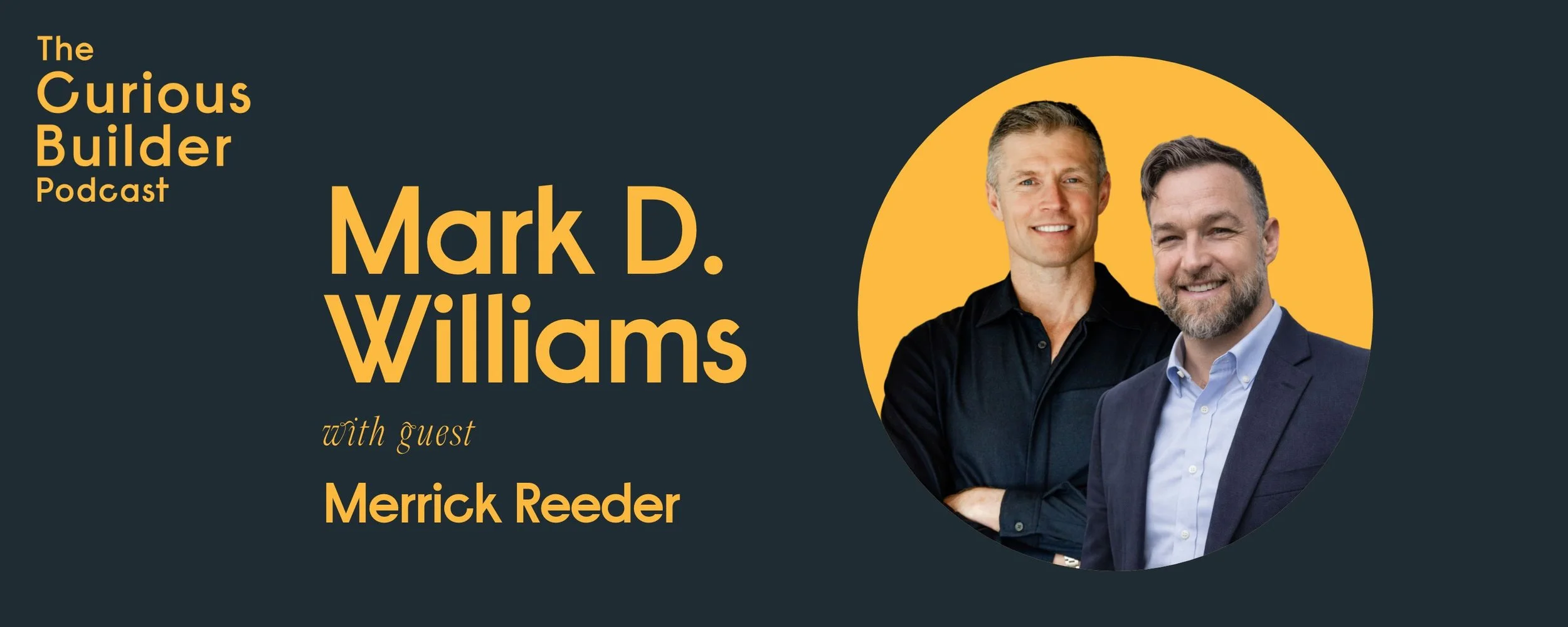
For years, Merrick Reeder was building a business while struggling to be fully present for the people who mattered most. He opens up to Mark about addiction, sobriety, faith, divorce, and the difficult journey of rebuilding his life and his company from the ground up. This is a reminder that success isn't much of a success if your business owns you, and that sometimes the biggest turnaround has nothing to do with the bottom line.


About The Curious Builder

The host of the Curious Builder Posdast is Mark D. Williams, the founder of Mark D. Williams Custom Homes Inc. They are an award-winning Twin Cities-based home builder, creating quality custom homes and remodels — one-of-a-kind dream homes of all styles and scopes. Whether you’re looking to reimagine your current space or start fresh with a new construction, we build homes that reflect how you live your everyday life.
Support the Show:
-
Merrick Reeder 00:05
It's still my vision. It's just now I have the tools, I have the experience, I have the executive skill set, and the I've made enough mistakes that I can peacefully, calmly run a $1.6 million company.
Mark D. Williams 00:33
Welcome to Curious Builder Podcast. I'm Mark Williams, the host. Today we're joined in studio with America Reader. We've got two companies here. We've got Timeless as well as Stay on the Rails podcast, a new podcast that's launching here in Minnesota. Welcome to the show.
Speaker 1 00:44
Hey, thank you.
Mark D. Williams 00:45
Glad to be here. So, give us the little, give us the 411 on your construction company, and then at the end we'll talk a little bit about your new podcast you're launching, and then in the middle we'll kind of go to our losers or winners scenarios, like basically like all of us. What have we learned from our mistakes and how we've become better because of them.
Speaker 1 01:03
Yeah. So my my business is timeless. So we do we work on turn of the century homes, general contractors. We do remodeling, large scale exterior renovations. We also just do a lot of fixing rotten wood and scraping lead paint and dealing with you know old knob and tube wiring, getting more into insurance work on those older homes. But that's kind of my whole career I've built around that. So I'd
Mark D. Williams 01:32
love to have you back on to hear the full story about that. There's not that many full restoration companies, or am I wrong in that?
Speaker 1 01:39
I mean, it's it's a at least now that I'm getting into the insurance world, there's a huge gap. Nobody knows or wants to deal with plaster and in that whole realm or knob and tube wiring. These different nuances of these older homes. So
Mark D. Williams 01:56
correct me if I'm wrong. We're going to go to here a little bit. When you have knob and tube, I mean, I've certainly ripped out a lot of knob and tube. We had one in Lake the Isles where you know full house remodels, those types of things. We had ones where they had the old gas lines, you know, because they had gas lanterns that turn of the century. Yeah. Now you see those coming back in some of the high end luxury homes for like outside carriage house lights and things like that. Can you, to what extent, can you keep knob and tube? I thought from an electrical standpoint, you'd have to, you'd have to take it out and update it. Is that not true?
Speaker 1 02:23
Yeah, we. Well, I mean, usually when it's an insurance claim, it's all got to come out, and we got to put modern wiring to bring that space up to code. But you know, a lot of times we're not going to wire an entire house. So you know, our electrician, my whole team has been working on these older homes with me for years, so you know he knows how to put in a box, get that circuit grounded, and tie into that old wiring. You know, you don't necessarily have to. You can't go in and tear it all out all the time.
Mark D. Williams 02:57
Oh no, I 100% understand that. How? So let's get into it. I mean, you must have seen. So how long have you had your company?
Speaker 1 03:04
Well, Timeless is brand new this year. Okay, is my third contracting company.
Mark D. Williams 03:08
Okay. So and what? Tell me the story. What were the first two?
Speaker 1 03:11
The first one was my first real company was Reader Home Restorations.
Mark D. Williams 03:16
Yep.
Speaker 1 03:16
And yeah, I built that. Me and my ex-wife built that one, or she was, you know, she just helped me with that. I was raising young kids. I didn't know how much to charge. I was just kind of thrust into this, and I, I built this freight train of a business that wasn't making any money.
Mark D. Williams 03:36
Sure, common story for Contractors of America.
Speaker 1 03:40
Yeah. So, and I learned a lot. I mean, timeless really is reader home restorations, but dialed in. Yeah, yeah.
Mark D. Williams 03:49
What was it about? I mean, maybe this is part of it. I mean, it's your story to share. What was it about the first company that maybe led or inspired some of the practices that you make now at Timeless?
Speaker 1 04:03
I mean, it's you look back and you are the same person, even though your life might look different outwardly. You know, I look back to a kid. You know, I still saw the world through the same eyes. I was still me. So that's kind of the way I look at reader home restorations, and now timeless. It's the same thing. It's still my vision. It's just now I have the tools, I have the experience, I have the executive skill set, and the I've made enough mistakes that I can peacefully, calmly run a $1.6 million company year one. Right, have time to go to this podcast and you know go to the Cambria plant yesterday.
Mark D. Williams 04:52
Yeah, I mean it's those things that you learn. It's funny because when you're in the trenches, you don't really real. All you see is digging, and you see the dirt, and you don't see the end. And then when you get. Of it, you realize how far I guess in this analogy, how far you've dug and what you've accomplished. I mean, looking back, what are some notable failures that have led to the evolution of who you are today as a business owner? Oh,
Speaker 1 05:18
I mean, I'm I'm kind of the I'm the type of guy that's got to make a mistake about three times, you know. I make it once, I'm like, "Oh, that was bad." I make it again, and I'm like, "I should really learn from this." And then, you know, hopefully, I figure it out at that point.
Mark D. Williams 05:35
Yeah.
Speaker 1 05:36
I mean, so many. I think. I think my biggest mistakes are, or my biggest shortcomings are like in my entire life. You know, the the progression of my life really aligns with with business. It's all one thing. Having faith without that foundation, it was hard to have things stand on that. The you know the sobriety piece is part of my story, you know it's like yeah I could I could run this company but if I can't remember what's happening or I'm waking up not dialed in, it's not going to be successful. So I look back at. So I think those are the the big boulders. You know I could go into little
Mark D. Williams 06:18
yeah no
Speaker 1 06:19
little mistakes I'd made like
Mark D. Williams 06:21
boulders are huge,
Speaker 1 06:22
you know. So that's the way I see it. You know, I wasn't, I wasn't sober. I didn't have God in my life. That's. I mean, those are pretty
Mark D. Williams 06:30
big boulders. I mean, right? Yeah. I mean, you look back at you know, you say the same person, but I mean, I didn't know you back then. I just met you five minutes ago. But I mean, ultimately, I one thing I've been talking a lot on the podcast lately is I think the evolution of who we are as people, and people talk about midlife crisis and things like that. And there's a bunch of generic things that we apply to that, whether it's pop culture, movies, or whatever, just life. But I think what it is, it's I think we just evolve. I think we we are no longer the builder, the entrepreneur, the person because life isn't static; we it's constantly changing, and so I think the people that sort of get stuck are either can't evolve, or I mean, you do kind of break the window sometimes on the way to building a a clear vision for your future. To use this analogy, right? Yeah, yeah. What when you look back now, do you have some grace with yourself? I mean, how do you look back, or how does it inspire you today, so that you that you don't either make those mistakes, or you say, "Hey, this is what I've implemented, and to be a better business owner, better person today."
Speaker 1 07:31
So yeah, I you know I have some things that I regret, but I don't really I don't have guilt or shame because you know as a as a follower of Christ, I've been forgiven for those sins, and I've I've had a I've had the slate wiped clean, so I get to move forward. Now I have a fresh start. You know, I do wish I hadn't abused chemicals so much because, you know, my my body and my brain aren't what they would be if I'd taken better care of myself. But you know, it's all part of the the scars you were talking about earlier before we started. You know, those are those are valuable too. I mean, a lot of what I learned from business, I learned from being on the streets and living a totally like a living a nomadic life back in my 20s, so it's hard to regret them fully.
Mark D. Williams 08:32
Well, I mean, I agree. If I could enter that part of the story, it's simply that that wherever you are today, no one can redo their journey to where they are, and who's to know what your life would be without that? And it's kind of just almost accepting whatever it was. And there's good, there's bad. But also, I was thinking about even from terms of mentorship. Have you gotten to the point yet where I've heard this before in careers that there's the learn, earn, and return phase of business? But my joke is, is I miss the earning phase. I learned, and I'm returning. I mean, this podcast, the collectives that we have, are a form of education. It's getting people together to compress time, so that we can all be better entrepreneurs, and we can be better versions of ourselves for our families, for our lives, for our clients. Make more money. All those things are possible, but they're only possible through education. Some a lot of it is self-education. I guess where I'm going with this is: Have you gotten to the point yet where you know you've either used it or harnessed it? I feel like a lot of people that I've had on the podcast that have had, particularly substance abuse, you know, they've gotten into point of either mentorship or that there's a a fuel source there in helping other people. Where are you at in that part of the journey.
Speaker 1 09:41
Yeah, I'm very close to that. I think that's a lot what the you know stay on the rails ecosystem is. You know, with the podcast, with teaching people about how to use AI on their business. There's a consulting piece to that. I think in my so I think that's I've been getting my house finished. I restored a 1930 Tudor in Minneapolis from the ground up in during a at the beginning of the divorce.
Mark D. Williams 10:17
Yeah,
Speaker 1 10:18
and you know the finding God was like a rock. That was like a explosion in my life.
Mark D. Williams 10:26
So, I mean, if you don't mind, I mean, a lot of people ask, and how did that come about?
Speaker 1 10:31
Okay, so I was, so I'd I'd quit alcohol and hard drugs many years ago, probably 12 years ago, marijuana was actually my. I had a hard time shaking that one because it didn't have the same level of consequences. I wasn't waking up in a jail cell or, you know, crashing a car or, you know, making terrible decisions. But I was spiritually dead. I was not fully present. My relationships with my kids weren't great because I was I wasn't fully present. They were, you know, I loved them and I took care of them. And as a, you know, as a man, I protected, provided, and presided. The presiding piece wasn't actually there, so I was protecting them and providing for them. But I wasn't presiding over my family. I wasn't teaching them discipline. I wasn't showing them stability. I wasn't showing them. I didn't have the. What's the word? I just didn't have the confidence to just really be consistent. We
Mark D. Williams 11:46
had tell me if this resonates with you. We had a gentleman on who had a similar experience. He got to the point where he almost took his own life, and he talked about this stage that a lot of entrepreneurs get to, where we confuse proximity with presence. He said, "I was with my family, but I wasn't with my family."
Speaker 1 12:06
Yep, absolutely. And
Mark D. Williams 12:07
that's I got goosebumps on my arms right now because I mean, me too, actually. And it's not it's not cold in this room, and so I mean, I I think there's been many times I've sat at. I think this is very relatable to anyone who's owned a business. I mean, I've sat at my dinner table. You know, you've got something on your mind, and your your you know my third grader is telling me a story about school, and I've got the 1000 yard stare. My wife is like, "Mark, did you hear anything that they said?" And you're like, "What? You're just you're not there. You're there, but you're not there." I think it's that's very common, unfortunately, and it's I think it's conversations like this, and it's reminders of our spouses and of our kids, and having some grace with yourself too. I mean, we're not perfect, and we have to learn from that.
Speaker 1 12:47
So, I mean, what happened was I I got to I hit bottom again for the 1,000th time, where I'm like, I got to be done with this drug, and I called a friend who is a guy I look up to. I mean, he he runs a $10 million construction company. He's been sober for a long time. He's was a mentor of mine, and you know now we're close friends as well. I called him and I was like, I got to be done. This I am done, and he believed me. You know, even though I've called him about that a bunch of times, but this time he was like, "Okay, I want you to go to this church over here." And I figure I'm going to a AA meeting with bad coffee in a church basement, and I go to this church, and it's this recovery based church, and it all just clicked, and I was like, everything just kind of came to the that point, and I'm like, I'm gonna, this is, I'm gonna, I'm gonna check, I'm gonna check this out. I'm gonna get serious about looking into this because I can feel it, and I know there's something there, and I can't deny it, you know. And then that that's kind of where it all started. And then within six months, I was within two months, I had closed down Reader Home Restorations, and I kept my laborer, and him and I went around and finished all of the remodeling projects that we had. I actually made the most money that I'd made in years, and so we went out, put on the tool belt again, which I hadn't done in a long time, and we got all the jobs done. I got a divorce. This was like I found Christ, and it was like a 180. Closed down the business, got you know, which I loved. I mean, the business was like my pride and joy, and yep, got a divorce, and then I was baptized that spring, and gave my life to God. So now that's kind of the top. Now I have a new foundation.
Mark D. Williams 15:04
This episode is brought to you by Pella Windows and Doors. I've used Pella for 21 years as the exclusive window company on every one of my builds. When people ask me who I trust for windows and doors, it's Pella every time. Their craftsmanship, their innovation, the top-tier service make them a no-brainer for any custom home builder or designer who demand the best. Whether you're designing something bold or building something with timeless elegance, Pella has you covered. They're also the only window company that has a lifetime warranty on all of their windows. I've gotten to know all their people at Pella Corporate as well as locally here at Pella Northland. I'm proud to call them our partners and our friends, visit pella.com to learn more and connect with your local reps today. Also, for more information, you can listen to episode one where I interview their founders, as well as episode 109, where we talk about the innovation at Pella.
Speaker 1 15:55
So another a cool part of that story is that I when I closed down the business and I got the divorce. I had all this time, and I I went and my my friend that I'd called when I was in that desperation place. I was like, I'm closing down my company, and he's like, I got a spot over here. So then all of a sudden, I'm in executive role running a a production department for a you know a giant roofing company thrust into this thing and like you know it did that for a few months and then it you know it just wasn't a good fit they kind of they changed some things I'm sure it had something to do with me and how I fit into that, you know, and then I had I just went and did handyman jobs for close to a year, and I worked for about four or five hours a day, and I spent the rest of the time remodeling my house and spending time with my kids to kind of help them through the divorce. Yeah, how
Mark D. Williams 17:01
old were your kids, or are they
Speaker 1 17:02
now? They're my daughter's 19. I have another daughter who is 17, and then a son who's 13.
Mark D. Williams 17:12
Yeah, yeah, yeah. I mean, I can't imagine you're going through all this. They're going through all this. I mean, this is quite the this is quite the ordeal is the wrong word. I mean journey. I mean the evolution of,
Speaker 1 17:24
and then now, yeah, my kids might disagree to me day with me day to day, but you know I have, there you know I have a peaceful home that is has God as a foundation, and I get to be that dad now. That back when I was using, I couldn't be because I was just emotionally immature. I was absent.
Mark D. Williams 17:52
Yep.
Speaker 1 17:53
So it's it's pretty it's pretty amazing what God has done in my life.
Mark D. Williams 17:57
100%. I mean, it's beautiful. I love hearing this. How? What made you? How did you know when it was time to then start timeless? What led to that? So,
Speaker 1 18:07
so after all this was done, yeah, you know, and I'm an entrepreneur at heart. Yeah, clearly, like you know, being a handyman was a bridge. I didn't. It was great, you know, and I had the clients. It was easy to keep just me busy, And so then, you know, that next spring, I'm like, I'm ready to go. So I partnered with a friend, and we started New Leaf Restorations, which was, you know, I had him doing operations. Super capable guy. He could go out there and build stuff. Spoke the language where I could be like, use construction terms. It's amazing that he even understands what I'm talking about because I'm like, oh, on the back side of the house, up in the soffit, you know, on the on the whatever, you know, using just terminology that nobody would understand, he like gets it every time. Sure, and we've worked together for a long time, so we partnered up and gave it a shot and had a successful year. Broke over that million dollar threshold
Mark D. Williams 19:18
for the
Speaker 1 19:18
first time, which was really, which is really cool.
Mark D. Williams 19:22
Yeah, it's a big deal.
Speaker 1 19:23
And then learned a lot. Got me into a full time CEO role for the first time because it was like anything in the field that's you, anything in the office that's me. So I started developing standard operating procedures and found my assistant, who's now my chief administrator at Timeless. Yeah, and yeah, we're just we're just killing it now. Like with all that knowledge, we looked back. We got together at my house the other day, and it was like thinking about hanging checks on the. Yeah, we'd get together every Friday. And we'd run payroll like no no help. Neither of us really were accountants or anything. And we'd write all the checks and get all the certificates together for the audits and do all of that with no help. So now we look back with timeless. It's like a real organization. We have an accounting company that does that kind of thing, and
Mark D. Williams 20:23
I mean the journey to learn something. I think everyone learns at a different rate. Mike Weaver is a friend of the show. He's been on a number of times. He talks about time compression, and you know other people. I mean it's it's somewhat spiritual actually as well. But like you know business, it it takes. I've been in business for 22 years. I'm a far different operator the last five six years than I was the previous 18. But I have to be gracious with myself that the first 18 weren't a loss. It's not like I wasn't good or that I that it's just that you don't know what you didn't know. And like all you can say is like, did you learn from it? And are you better? And like hopefully the answer is yes. And but I think we all mature and grow at different rates. There are some people that are in business for four or five years, and they're light years ahead of me. And there's no jealousy in that. I'm super excited that that for them. I think everyone's journey is honestly a little bit their own. And the way I think of it spiritually is like it's sort of remarkable that this thing of time compression that you know the way, and we don't need to dive into it all right now because we don't have enough time for it. But like, you know, your biggest rock, your foundation with God. Like, some people have it in the beginning of their life, rediscover it, leave it, come back to it. Some people find it later. Like, but in some ways, it doesn't matter because God's grace. It everyone's journey with God in this case is their own, and anyone who's a Christian that believes it is just excited for that person's revelation and that person. And if someone fails or doesn't fail, it doesn't really matter. Even like Peter, when you read in the Bible, right when he denied Christ three times, like he felt, I guarantee he feels way worse about it than we would feel about it, but as someone who would have compassion towards him in that situation, all that you really care about is that when he came back, that Jesus was. He's like, no, I want you to feed my lambs, feed my sheep, feed my lamb. Like he got Jesus's first thing was to help remind him to encourage him, and that's all any of us can do. I think in life and in business, it's a big part of this podcast for me. Is I love hearing people's stories because I find it encouraging. But I also want to encourage the person sitting across on the other mic or people listening to this that I don't even know who they are. I don't know who this message will reach. You know where they're at. Maybe they were. You know where you were 10 years ago. I don't know. Maybe and we just don't know. It's like that little drop in the pond. You don't know how that ripple effect affects other people, and you know, all we can try to be is a little light. It's actually one of the most common prayers I have with my kids before I drop them off for school. Is you know, just be a light because that's all any of us can hopefully do is reflect the light that's in
Speaker 1 22:54
us. Yeah, we actually. That's I was I pray every night. My son lives with me full time, and we pray every night before bed, and we were talking, and that was part of my prayer last night. Was about the lamp stand. You don't put, you know, you don't put the lamp, you don't hide it away. You put it up on the lamp stand so that everybody can see. So I was trying to encourage my son through sharing that because I mean we want to be examples in the world, shine our bright, shine our lights bright.
Mark D. Williams 23:27
Awesome! Thank you, thank you for sharing that. Yeah, let's let's close this episode with let's talk a little bit about Stay on the Rails podcast. So it's airing; it hasn't started yet. Is that right? Yeah, it
Speaker 1 23:37
hasn't started yet. So this is this is my upcoming project here, or it's in development. I mean, really, the main thing, and these are all support timeless technologies, is really what I'm building. So, you know, staying on the rails is what I'm developing. You know, rails for my that AI can actually ride on because you know you ask AI, you're going to different output every single time. So I'm building everything in the background so that I get consistent outputs, so that I can create an estimate on chat on my way home from the estimate. All the photos go in the transcript goes in, and by the time I get home, I review it and I can click send. I can do a $50,000 remodeling proposal
Mark D. Williams 24:32
in the time it took you from in a speed, right? I mean, you met with them. Yeah, you're using Otter or Chat or whatever you're using to capture the notes. Yeah, dumping it into it, and then you're establishing what a blueprint or a filter to filter it onto your brand, your logos, whatever. Yep. And then by the time you come back, it's already basically waiting for you to review.
Speaker 1 24:50
Yep. And it even it even you know I can even say you know what does my company charge for this in the past? It has you know access to all of the information from the past. So, it'll push back on me too. As far as like, it'll say, "Hey, you're not hitting your 30% margin on here because the flooring company charges this much," and then you know have the entire thing built out around timeless, and that's really a proving ground for a licensable system.
Mark D. Williams 25:21
Yeah.
Speaker 1 25:21
So then, you know, basically, timeless will get pulled out of it, and we can put in Bob's plumbing, right, with his paper invoices and his son, so that they can just they can make their lives easier.
Mark D. Williams 25:35
I I love that you said this. This is a future conversation for sure. But I think AI dominates the headlines for a lot of reasons, some good, some bad. But what you just said is, I personally, my belief is AI is a tool. To me, it's no different than a a knife, a hammer, pneumatic. When you left the hammer for a pneumatic gun, it might have been considered radical. But think of how much faster you can frame with a pneumatic gun, right? Or whatever, whatever technology. To me, is no different than a car, a horse, or you know, a gun, a musket. I mean, they're all just tools. How we use them determines whether it's good, bad, all those other things. But what you just said there is, I think it's going to make a lot of people more profitable, which hopefully will allow people to have more stability, because profit's not a dirty word. Profit allows you to put food on the table for you not to be stressed out for you to hire a controller to for you to be able to hire people to help you you know run your business so that you can be home with your family. I mean, a lot of that's what I when I hear what you say. I mean, am I? I mean, what is am I wrong?
Speaker 1 26:36
Everything that I've built was because of the pain of me sitting on the couch doing estimates and invoices instead of spending time with my family because I had to do that to keep the business from going off the rails. I had to take the phone call whenever I could take it. I had to take every job that came in, and it was really painful. And I was living this one dimensional life that was just I was owned by my business, so reader home restorations, new leaf restorations, timeless, timeless technologies. All of that is to because I know and you know that everybody in the trades goes through that and has that has that pull. Yeah. So let me run through the the yeah please so um so the podcast you know is you know having conversations about craft business lessons learned you know new like using modern business tools like AI like methodologies things like that, and then you know the contrast between that and for me, you know, I'm working on historic homes. That's that's what Timeless does. So, you know, having people on there, interesting people from Steve the plumber all the way up to the guy that's running the $10 million company, and then you know I'm doing a like a master class, which is going to be basically teaching people how to build, you know, to build a master prompt, to go through the stages that they need so they can actually use AI as a tool. Because I think a lot of people, most people, are still stuck in chat. They're not like building systems and processes and comparing documents side to side that would take three hours in seconds, things like that. Teaching people how to do that, and then you know there'd be a consulting layer for that also, and then essentially having the licensable software. We're gonna. We're planning on having our first operator kind of as a test run this year.
Mark D. Williams 28:48
That's amazing. I mean, again, I love that term, compressed time. I mean, one thing that AI does incredibly well is compressed time. I mean, look how fast it allowed you to turn around that estimate to that client, but no different than you creating this entire system and playbook and systems. You know, if if you had done this 510 years ago, it take you a year months. I mean, how long would it take to create? I mean, it's a. I mean, I
Speaker 1 29:12
would need a team of people, and there's never enough time to work on it. And then the ideas come and they go because by the time you execute on it, you've already learned so much that you can't, and you've you've got other priorities. So, like what I'm building right now is what I was building on the couch with proposal templates, with red lettering, and filling out a form in the truck so that my ex-wife could fill in the gaps and send the estimate. You know, now it's on the drive home.
Mark D. Williams 29:47
Yeah, I mean it's amazing. We'll have everything tagged in the show notes. Thank you very much for coming in and sharing your story and being so open. And if people want to reach out to you, which platform would you like them to reach out to you?
Speaker 1 29:57
Oh, okay. So yeah, we'd like you to reach out. To us, if you direct message Rails, you join us or follow us on
Mark D. Williams 30:07
timeless Minnesota. Timeless
Speaker 1 30:08
Minnesota DM Rails, and then we're gonna everyone that reaches out is gonna get a free workbook on how to build a master prompt, which is kind of the gateway of getting into using using AI effectively, and then also entered in to win a free virtual seat in our Keeping AI on the Rails Masterclass, which we're charging $400 a person for. So first class is january 29.
Mark D. Williams 30:37
Perfect. We'll have it in the show notes as well because we can just get this to our producer, so that won't be a problem. That'll be right in the Instagram prompt as well. Thanks for coming in. I appreciate
Speaker 1 30:45
it. Yeah, thanks for having me.
Mark D. Williams 30:47
All right, guys, thanks for tuning into another episode of the Curious Builder Podcast. Thursdays are losers are winners, or we share stories of difficult things, as you've just heard. Or Mondays are deep dives on companies and their origin stories. If you enjoyed this episode, please share it with three of your friends, or three other owners, or with anyone you want. The way we expand the show is by word of mouth, and the way you share it helps us a lot. So, thanks again for tuning in. Thanks for tuning in to the Curious Builder podcast. If you like this episode, do us a favor: share it with three other business owners. The best way that we can spread what we're doing is by word of mouth, and with your help, we can continue to help other curious builders expand their business. Please share it with your friends, like and review online, and thanks again for tuning in.
This episode is sponsored by: