Episode #120 | Losers are Winners | Building People, Not Just Homes
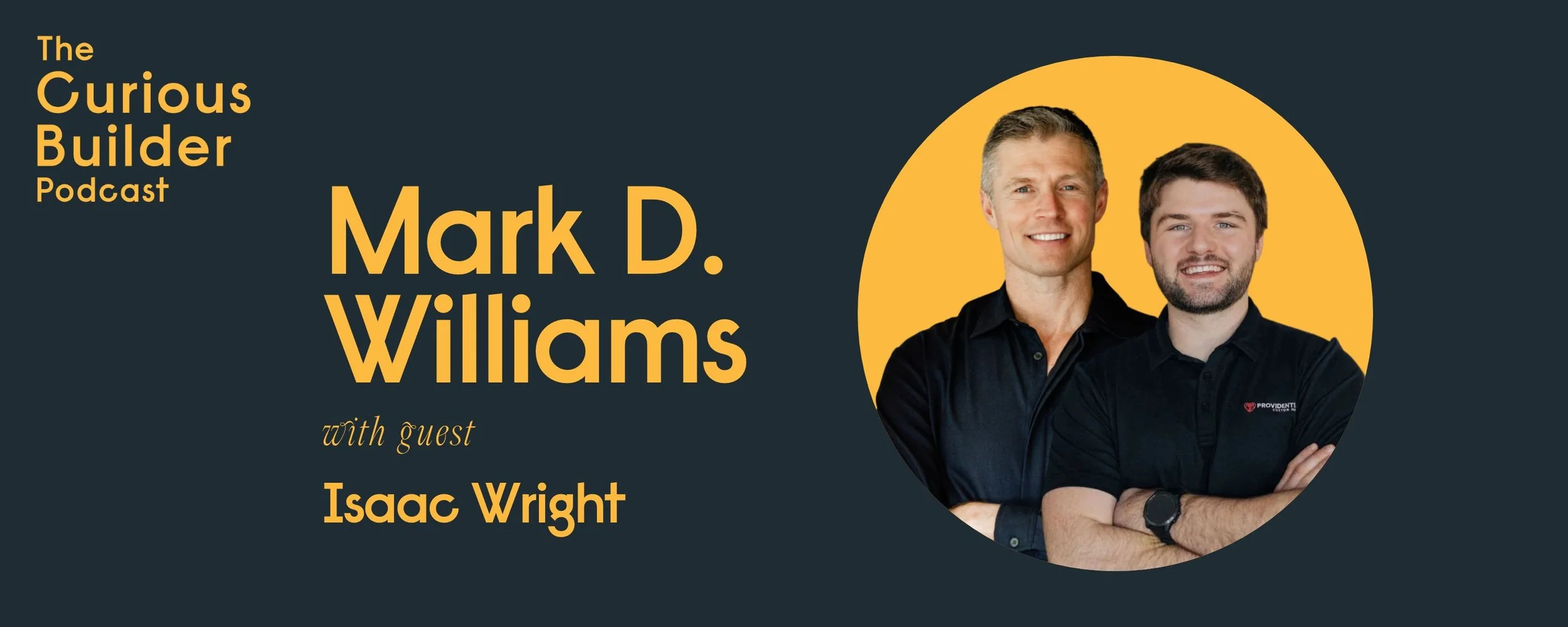
Growing up in a family building business might teach you how to build a house, but it doesn't necessarily teach you how to run the company. Isaac Wright of Providential Custom Homes shares what surprised him most when he stepped into ownership, from cash flow surprises to the pressure of keeping a team moving and clients happy. Mark and Isaac also talk about modernizing a family business, learning from mistakes, and why being the boss is a whole different job than you thought it was. Funny how nobody puts that in the job description.


About The Curious Builder

The host of the Curious Builder Posdast is Mark D. Williams, the founder of Mark D. Williams Custom Homes Inc. They are an award-winning Twin Cities-based home builder, creating quality custom homes and remodels — one-of-a-kind dream homes of all styles and scopes. Whether you’re looking to reimagine your current space or start fresh with a new construction, we build homes that reflect how you live your everyday life.
Support the Show:
-
Isaac Wright 00:05
I had no idea what it's like to. I had an inkling, but it's like you don't know until you get in the big middle of it and actually process. So that's the biggest thing that I have learned just over the past couple years of like, oh, running a business and thinking you know how to run a business are two totally different things.
Mark D. Williams 00:30
Welcome to Curious Builder Podcast. I'm Mark Williams, your host. Today we're back for our Thursdays losers or winners. We're going down to Texas, Dallas, Fort Worth. We've got one of our Curious Builder ambassadors. We've got Isaac Wright with Providential. What's up, buddy?
Isaac Wright 00:42
What's going on, Mark? Thanks for having me.
Mark D. Williams 00:44
Yeah, absolutely. Good to see you. You too. Well, before we dive into it, we got to get a little report. You and I don't, I don't get to chat with the ambassadors as much as I would love to. Where everyone's so busy, and now as we go state to state, so you had, I think you've just had the one in Dallas Fort Worth, right? Your collective a month ago.
Isaac Wright 01:00
Yeah, our next one's coming up november 6, and so, but yeah, the first one was so good. You know, you and I talked; it felt like the biggest impact I could make on getting people there was just honestly texting people, reaching out to local builders, phone calls, posted some stuff on social media. But like, you don't realize how many local guys you have saved in your phone, and how close knit you all are until it's like you bring them all together in one room, and you're like, "Wow, like this is a good group of dudes." Like, and we had some. We actually had one lady named Brooke in there, who drove up from. She usually goes down to the Austin one, and because she's over in East Texas, actually closer for her to drive to the Dallas one. And she's like, "Oh, Dallas, it is." Like, where she's like, "You." guys knock the socks off of them. So I don't know. Austin's, I'm sure, is amazing. But I was like, I was like, I didn't know how the first one was going to go. She had great feedback, so I was like, okay, that's a win. So yeah, it was great.
Mark D. Williams 01:53
I think I think one thing I've learned about it, you know, it's everyone is so busy, and one of the reasons why we put the four dates out a year, and we're trying to create a coalition of people that sign up for the year. Unfortunately, we still haven't cracked the code. A lot of people sign up per session, and half the group signs up for the year. The whole point is getting it on your schedule. So often, as you and I know, I mean, you want to talk to owners. You want to have that. It used to be like, hey, let's have coffee. But we're so busy. I mean, it's fine to still have coffee. It's more intimate, but it's one to one, and like to quote our buddy Mike Weaver, he loves to compress time. The best way to compress time is get it on your schedule, plan it out for the year, and get 30 people, 30 owners together. I mean, the amount of information that is shared is incredibly helpful to my business personally, as well as obviously seeing the builders help each other. It's it's pretty remarkable.
Isaac Wright 02:42
Yeah, I mean, there's nothing there's nothing else in our local builder community that's causing people to interact and have conversations like that. And you never know how people are going to be the first time doing that if they are going to want to interact and want to actually press into the conversation. But it seemed like everybody was actually gaining something out of it. I got a lot of text messages after, and yeah, if you can plan ahead, get it on the calendar, book around it. It's and honestly, like what I've been telling people is, it's such an easy thing. Just being a few hours, anybody can carve out a few hours in on a Friday morning. I know for me, like that's always my easiest time. And for most of the guys I've talked to, it's like Friday mornings, a few hours, so easy. We can get there and then hit our jobs after, or get back and hash out emails or whatever it is. And so, it's not a whole day event. It's not a multi day event. It's just like a jam packed few hours. And I think that alone is is helping people get engaged more because it's an easy guess. And so, it turned out great.
Mark D. Williams 03:37
I love it. We could talk about that, but that's not why people are turning in. We want losers or winners. So you've been a bit how many years have you been in business?
Isaac Wright 03:45
I'm not going to stake claim to the business. My dad paved the way, and he's he started. He was got became self employed in 1978. So we're talking 48 years now, coming up on 50 years here in a couple years. He'll be 70 years old in 2028, and so I grew up in it. And my technically, I'm sixth generation of just home building being passed down in the family.
Mark D. Williams 04:11
Wow!
Isaac Wright 04:12
Second generation of a company being passed down to me and my brother and my family, and it's amazing. But you've got to, you know, you got to want to be in this business, to be in it, and my dad was very clear with just the whole family. Like, if you don't want to be here, I don't want you to be here. Like, I want you to be able to go pursue your own thing. And early on, he was always asking me, like, are you doing this because I'm doing it, or are you doing it because you want to do it? Because I started working for him when I was as soon as I could drive, 16 years old. I'm out there mowing yards and sweeping floors and picking up lumber, just like doing all the grunt work. And I just wanted to be a part of what Dad was doing at first. But then, as I got older, went into college, got a construction management degree, really started understanding the whole business. I was like, "Oh no, I actually really like this, and I can see my the way my brain works is a very systematic.". Oriented, and so I just put the pedal to the metal on that. And thankfully, I'm at where I'm at. My dad and I are partners now, and he's still extremely involved. We're both work our tails off. We're a small team, 15 people, but it's he's got his thing, and I'm he's focusing on. I've got my thing. So, 1978 to 2026, we're talking 48 years now, but we're actually just the entity that my dad and I own. It's fresh. 2026 is year one. All that work that he paved the way for himself for many years, we kept that in a different company. He kept that in a different company, and we just started from ground zero with a brand new company. It was easier that way, and so it's a although it's a a name that's been around for a long time, sometimes it feels like we're starting a brand new company because it's just it's a whole lot of new stuff getting the staff shifted over and all the things.
Mark D. Williams 05:50
I mean, sometimes it's exciting too. I mean, you've got some, you know, it's kind of your thing, the transition. As any dad, you'd want your kid to be really excited, and it's still your thing. But you know, watching your kid kind of take that hand off has got to be pretty special for your dad. So here's my question for you: two two questions. One is, is there any failures that you observed as a son of your dad's business that you either saw him learn from or that you are going to learn from? That'll be my first one.
Isaac Wright 06:19
Yeah, yeah. So many. I mean, not necessarily failures. I'm sure he could point things out, but I'm like, I'd say you don't know what you don't know, is how I'd put it. And I came in from with a fresh perspective that he had never really heard in a long time. I spent a lot of time listening to people like you, Brad Levitt, Matt Reisinger, Nick Schiffer. Like early on, like 2018, 2019 time, 2020, like I was just in the weeds on podcasts, YouTube videos. Like I was bringing all this stuff to him, and he's just like, "Sounds great. How do we do it?" And I'm like, "I don't know, but we're gonna figure it out." And so it was very much like a. I felt like we could do things better, and I brought things to him. He's open-minded, but it was also very much on my plate to figure out how do we implement that process, how do we implement that system, and so it was just the old school way of doing things before I came on. It was a lot of paper, a lot of Excel spreadsheets, no project management software, no adaptive, like no. I mean, a lot of that stuff didn't exist either, but some of it did, and they just they hadn't adopted any of it. So now we're at a place where we're very streamlined, running on all those platforms. Client experience is top of mind, and there are processes that we have in place to make sure the client has a great experience with communication, updates, documentation that we're giving to the clients. Like it is very much dialed in, and I'd say as a team we have gotten there. But before, it's like he didn't even know that we should be doing those things. He just thought, well, this is the way you do it, and it's worked. It's great. And so when I kind of started really pushing that, it was like, okay, somebody else is doing it. I don't know how to get there. How do we get there? And together, being able to get to that that place we are now.
Mark D. Williams 08:03
Yeah, I mean that's amazing. I like that. What have you learned? So the second question on lessons learned. What have you learned in the last 24 months in terms of? I think failure, by the way, is a oversimplified term of basically a setback or a mistake or you know what what is something that you today are a lot better at because you failed at it earlier on in your career.
Isaac Wright 08:25
I think you put myself. You just rewind a year and a half ago where I saw this transition coming of me stepping into ownership, but my dad still had partner. Partner wanted to be bought out. He wanted to retire. I thought I knew what it was like to be an owner, I thought I was like I can do that. Can't be that hard, right? Like I'm I'm very system as a process oriented. Like feel like I've helped the company a lot. Like I see a lot of what my dad's working on. I feel like I can handle all that just fine. And you, I was highly mistaken. Once you finally get into it and you realize like what it takes to run a business and the stresses of running that business, the day-to-day operations, the controller coming to you on a new company, going like, "Hey, we got all this money tied up in a spec home. We don't have a whole lot of money in the bank account. Where are we going to get it from to pay the team this week? We can't draw on a whole lot of jobs because all these jobs are stuck in permitting. We can't. It's just like, ah, I've never had to think about that. And it's like, okay, that's part of running a business. Like you just have to process all that. And it's like, I did. I had no idea what it's like to. I had an inkling, but it's like you don't know until you get in the big middle of it and actually process. So that's the biggest thing that I have learned just over the past couple years of like, oh, running a business and thinking you know how to run a business are two totally different things.
Mark D. Williams 09:48
I mean, I think that's I think that's pretty well said. Amen. How have you looked at clients differently or subcontractors differently now that you're an owner?
Isaac Wright 09:59
Value I value that partnership and that relationship so much more because I I realize how hard it is to get one new client and so I have really pushed just everybody myself to focus on the client experience focus on the trade interactions as one of the things we say all the times we're building people, not just building homes. We're building people, and we're doing that through building homes. What that means is like we're impacting every single person who lays a hand on the project: the the banker, the tile guy, the framer. Like every single person, we get to impact, and the customer, and then eventually us and our team. And so pressing into that and pressing into like, it's hard to get one new client, like especially now. Like it's, I mean, you're trying to sell Misahas, and it's like we've got a couple spec homes. They're just sitting. Like it is just hard right now, and it's like, wow, that one new client. I should be so grateful and make sure that I'm taking care of that person all the way through, it's not just like a oh sweet another job more money you know another house like it is a completely different perspective change because you realize just owning the company and realizing like wow that one new client impacts the whole company which impacts the whole team and puts food on the table for everybody it's like wow we really need to take care of that, and the main objective is that they finish the project so happy that they're wanting to tell other people about it because that's ultimately how we're going to get new clients. Is that positive word of mouth feedback? Yeah, through social media, through the website, through model homes, whatever. But really caring for that one client and holding on to that. And I'll kind of get into a little story that, like, I'd say is like a a failure and a win. The whole point of losers are winners, but that's kind of where I feel like on that question.
Mark D. Williams 11:58
This episode is brought to you by Pella Windows and Doors. I've used Pella for 21 years as the exclusive window company on every one of my builds. When people ask me who I trust for windows and doors, it's Pella every time. Their craftsmanship, their innovation, the top-tier service make them a no-brainer for any custom home builder or designer who demand the best. Whether you're designing something bold or building something with timeless elegance, Pella has you covered. They're also the only window company that has a lifetime warranty on all of their windows. I've gotten to know all their people at Pella Corporate as well as locally here at Pella Northland. I'm proud to call them our partners and our friends. Visit pella.com to learn more and connect with your local reps today. Also, for more information, you can listen to episode one where I interview their founders, as well as episode 109, where we talk about the innovation at Pella. I mean, I think that's amazing. I was going to follow up some questions, but let's go with your story because I think that'll be better. We
Isaac Wright 12:55
just finished a project. We did this client came to us. They had already designed a home with another architect. They were actually engaged with another builder. Had some issues. Went to city council. Home got shut down. They ended up just kind of bailing, choosing one of our properties that we had for sale, scrapping everything. We redesigned their home. Did all their interior design. We're in-house design build, and so we just started from scratch. Amazing experience. We really kind of brought the the life of the project back. Like they were so down at the beginning, and kind of were able to to bring them back. This is their last home, older couple. They built several homes, and so we knew, like, wow, what an opportunity is, and how grateful should we be that they came back to us, and we got to kind of bring this whole thing back to life, so great design process. We go through a great build process. This could have been if we didn't keep them updated, if we didn't document things well, if we didn't communicate well. This could have been one of those clients like they. If we didn't do our best, we would have gotten another side of them that we didn't see all the way through construction, like it was a very positive experience all the way through. Well, you're getting to the end, long process. Clients got furniture coming. They've got deadlines they're trying to hit. They're trying to get out of their old house. All the things, and you know we have a final process of trying to get things done. And we're our big thing is like clients don't move in with punch out still left. Like there's no punch out left. That is that
Mark D. Williams 14:26
is contractor coalition like holy grail right there.
Isaac Wright 14:31
Do not like this is a this is a staple of providential and all the builders that we're surrounded with contract coalition groups every like all those guys, they have the same mindset, and this is not something new. This is we've my dad's implemented this from the beginning. Do not move people in with punch out still left. Once you move in, warranty starts. Punch out's done. Well, I guess through pressure, through trying to get the job done, make the client happy, that. Process did not get done as well as it could have, and there were still a few things left. And that client turned in from being a great client to one who was extremely frustrated, rightfully so, because there was still punch out to be left, and like punch out that should have been done. Project manager knows it. We had it. We sat down, had a conversation about it, but and the client was so angry. I mean, just like saying things along the lines of that you know all their hopes and dreams of being in this home and this whole experience have kind of just you know it's all been ruined by this last two weeks of like having all this punch out. And it's like, man, so hard to hear that whether it's true or not, it's so hard to hear that because you felt like as a team you just worked your tail off to give that client a great experience, and you ended it with the client upset at you. Right, and so we're this is several weeks ago. This has all happened. We're in the middle of it. Clients upset, sending us nasty emails. Guys got to get on site. And yes, could I be really upset with the project manager? On one hand, 100%, he knows that he shouldn't have done that. And so, as a team, we come together, me, him, my dad, and we're like, "All right, we are where we are. How do we get out of it? And how do we get the client happy?" And so, like, we're going to the job site together, building detailed spreadsheets for the client, like detailed schedules on like this is when the stuff is going to get done. These guys are showing up here, and the project managers are sat on the project until every single little thing was done. And at the end, clients hugging us, they're happy, everything's calmed down. But it was like that right there is why we don't leave punch out left. It was kind of like a we've had that principle for a really long time, but it was like a firsthand of experience as to why we never do that. That's how that was just a glimpse of how bad it could be. It could have been a lot worse, but it just felt absolutely terrible when you're in the big middle of it because you're like, we just worked 18 months on developing this design, this build, this amazing client experience, and we get to the end of it, and the client's been happy the whole time, and they end it, and they're very upset at us. I feel like we failed, failed the client, we failed our team. Like, is a terrible few weeks, and in the grand scheme of things, it's all good. I'm a very positive person, but when you're in the moment, it's like, dang, what are we doing?
Mark D. Williams 17:26
How did it end? Where is it at now? Great,
Isaac Wright 17:30
everything's all taken care of. Clients extremely happy. Every all everything's knocked out, and in a couple weeks, I'm gonna let it settle. I'll send them a link for a survey and a Google review, but we're going to send that just yet. We're going to let it let it calm down a little bit more. But overall, they're happy.
Mark D. Williams 17:47
You need to get those rose-colored glasses out. Actually, that how funny would that be to actually send them a physical set? I mean, it'd be pretty funny, right? A rose-colored glass would be like, "Please use this upon your Google review." Yes, yes, please. I, you know, it's. I remember the first time Brad Levitt was the first one that taught me that 2018. I went to the first one in Nashville, and I was just like, "Wow!" or whatever year it was, 2020. I don't. The years are all blending together right now. And anyway, the point being is like, I don't know. Now it just seems like such common sense. Like I did not do that for the first 18 years, and now that we've implemented it, the clients are so much happier. I mean, the hard the thing is, is you can sell it on the beginning. What you can't add 30 days is during the middle of the project or at the end of the project. But we have it written right into our contract that it's 30 days after substantial completion, which is the final CO from the city, because it's unrealistic. Think about would you fly on a prototype airplane if it had not been tested out, that's crazy. Who would fly in an airplane that hadn't been like FAA cleared and like taken on a few test runs to make sure it operates? And yet, we put we for 18 years, I put people into the homes, and they weren't done because I thought getting them in fast was what they wanted, and it is what they wanted. But here's the thing: clients don't always know best, you know. That's why I firmly believe I do not like the statement that clients are always right. I 100% disagree with that statement because they're not. They're coming to you because you're an expert. If they were an expert, they would build their own homes. I mean, if you were a brain surgeon, you could operate on. You can't even operate on your own brain. I mean, you hire professionals, but yet somehow, and I think construction is the most vilified profession that I'm aware of. I'm sure there's others, but that's the one that comes to mind because it's our profession, right? And because I think the barrier to entry is so low, I mean, Chuck in a truck is not doing is not doing builders around America any any benefit to our clientele. That being said, it's not always Chuck in the truck's fault. Like he's just trying to get paid. He's just trying to do hard work. And like the one thing that the United that that builders in America don't have a problem with is working hard. I think by and large, like we have a really great ethic in terms of working hard. The problem is, is working hard and being you know making money are two totally different things. And it turns out if you can make money, you can. Also deliver a better experience, both for your people, your life, your clients. I mean, think about this. Correct me if I'm wrong, but your best clients that you've had in your last, you know, in your dad's career and your career, I would suspect, are also the homes that you've made the most money on. They tend to run in parallel. I think it's how we we show up at the job happier. We do we give them more stuff, and like it's a win-win. It's like you make more money, they're happier. It's like oh man, this is great. And yet the clients that sort of get the best deal are the unhappiest. They have the worst experience. I mean, it's if you were to say this at the very beginning of your career, you had never been an owner. You'd be like, why would anyone do that? And yet the majority of people can relate to what I'm saying because we've all
Isaac Wright 20:44
done it. No, 100%. Yeah, it's it's um, you know, going back to what you said, like writing that into the contract. I think that's so so key. I mean, it's something we say at the very beginning that hey, we're never going to sacrifice quality for speed. You know, we make comments about like hey, we know you want to get this home done, but I promise you, the last thing you're going to be thinking about when you lay your head down at night and that first night in the home is how fast it was built, and you're instantly going to start thinking about how well was it done. And that's the that's the thought process we're truly going after is that you know it was done well, but protocol we put in place is four to six weeks after CO, and have that hard deadline of like we've always just we've always just like gotten the CO, and we just give ourselves ample amount of time, so we just predict out. But it's like, wow, we can do better at this. We can put this in our contract and say four to six weeks after CO, that's when the house is going to be done.
Mark D. Williams 21:42
We don't even leave it ambiguous. I mean, four to six weeks. There's a two week. That's ambiguity. Yeah, we settle on an actual date. We put 30 days, and we actually put we build it right into our builder trend schedule. It shows up on day one as soon as that schedule is published. They see the tail of 30 days, and it's always tempting as a builder because the client will ask. I've never had a client not ask where they'll say, "I see there's third." They already know this because you already give them the song and dance at the beginning when they sign it before they get going. But then somewhere around drywall, and they start thinking about like, "Hey, when do I have to sell my house or get a rental or whatever? When am I moving in?" And they're like, "We even say in our contract we won't tell you the exact day you're going to move in till 60 days before. Now we'll give you an idea. Obviously, there's an idea. It's not like we're that far off, but like I'm not going to guarantee. But once I guarantee the date 60 days out, like that thing is that's the Rosetta Stone. Like that's not moving. Like that is set. And you know we try to keep like any builder, but you want to allow for flexibility. And unfortunately, I think it all comes back to trust. There's plenty of examples where clients have gone through builds, and it was a never-ending build cycle because they didn't hire the right team, because they didn't have systems, because of all this stuff. But I think by us taking control and saying this is how you do it is actually earning trust and say if you want a successful build where you're going to love me when you're done, it. This is how you do it, and this, and and I think the other thing is they came to Providential Custom Homes or Mark Williams Custom Homes in my case, and you're like, well, why did you come to us? You came to us because you referred to us. Well, this is what we do. This is how we do it. This is our process. And so when you explain the
Isaac Wright 23:15
process,
Mark D. Williams 23:16
yeah, then they're fine with it. Well, it's a pleasure having you on. I want to respect your time in the audience is anyway. Yeah, what is? I'll leave you with this one. What is the one thing you're most excited about for the last two months of the year?
Isaac Wright 23:29
We have six new foundations being poured between now and the end of the year. So we, yeah, we went through a lull in 2025. We didn't sell a single new home, single new sign on a single new client, all of 2025 until September of 2025, and then we sold, we signed on like seven new clients between that point and the end of the year. So the the pre-con process takes about eight months for us in most cases, 10 months, sometimes a year, depending on client and scope. But all those projects we sold in September of 2025 are just now getting going and in construction and all rolling, and then this year has been pretty good to us as well. So six new projects starting between now and the end of end of the year, and then we'll hit it pretty hard with three or four beginning of next year. And so we'll be we'll be well taken care of in 2027, and then we'll start focusing on looking for some new clients and signing people on. So feel very blessed. There's a lot of people that are in worse positions. I heard one builder say, in in his world, it could be worse, or he said it couldn't be worse. I will never say that. It could always be worse, and I'm grateful for what we got. And so I think that in a market like this, we all need to be counting our blessings and keep perspective and realize like we're going to go ups and downs, and we need to be grateful for what we got in front of us. And we can always be wanting more, but if we don't focus on what's in front of us right now, we're never going to be happy.
Mark D. Williams 24:51
Well said, buddy. I appreciate that on many levels. Thank you for your time today and for sharing your story. And we'll see you soon. Well, I think I'll see you. Come to Charlotte. I think I'm seeing you at IBS, though. Are you coming to IBS? Yeah. Okay.
Isaac Wright 25:03
Yep. I'll see you at IBS.
Mark D. Williams 25:05
I love it. Appreciate it, Mark. Appreciate you, buddy. Thanks for tuning in to Curious Builder Podcast. If you like this episode, do us a favor: share it with three other business owners. The best way that we can spread what we're doing is by word of mouth, and with your help, we can continue to help other curious builders expand their business. Please share it with your friends, like and review online. And thanks again for tuning in.
This episode is sponsored by: