Episode 178 - The Trim Joint That Taught Tanner Konrady How to Lead
#178 | Tanner Konrady | Konrady & Son Construction | The Trim Joint That Taught Tanner Konrady How to Lead
Tanner Konrady swore he'd never be a builder, then one Christmas break with a hammer changed his mind for good. Now he runs a 26 person company in coastal North Carolina, building healthy homes and a property services business, all while handing his eight year old a sledgehammer on weekends. Mark and Tanner talk windows nobody should open, hiring, and the leadership lesson hiding in a butt joint.
Listen to the full episode:


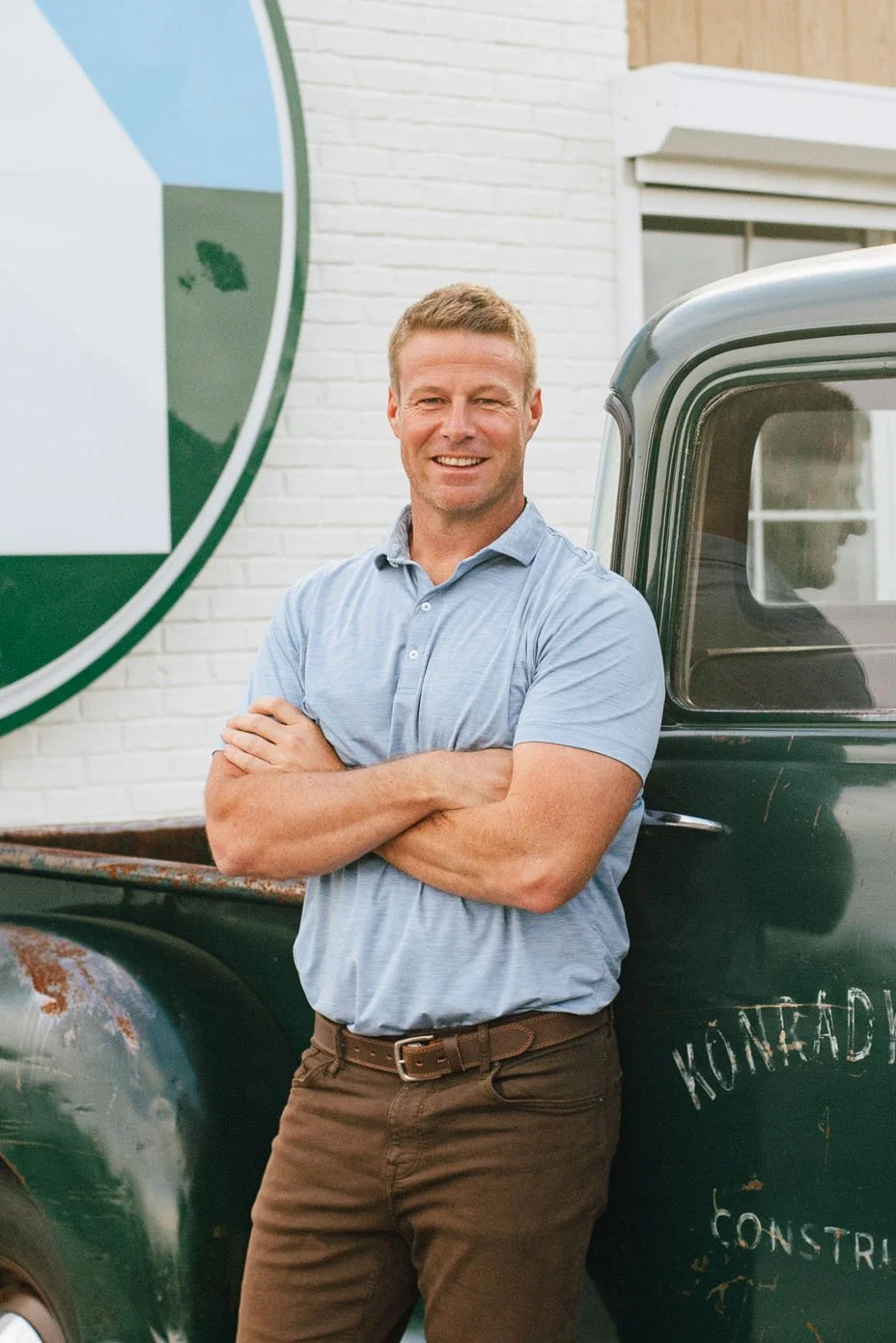
About Tanner Konrady
Tanner Konrady is the owner and president of Konrady & Son Construction, a fourth-generation luxury custom home building and renovation firm based in Wrightsville Beach, North Carolina. Born and raised on the coast, Tanner stepped into the family business in his late teens and early twenties — not because it was handed to him, but because he made a deliberate decision to earn a place alongside his father's reputation and then build one of his own. He started his career in the teeth of the 2007-2008 housing collapse, kept his team employed through small jobs and rot wrangling when other firms were folding, and has spent nearly two decades building Konrady & Son into one of the most recognized luxury builders on the North Carolina coast. He holds a BS in Business Administration from UNC Wilmington and is a licensed NC Unlimited Building General Contractor with LEED Silver, Energy Star, and NC Healthy Built Home certifications to his name.
Konrady & Son operates across three divisions: custom homes and renovations, a property services arm that maintains and manages client homes long after construction is complete, and a storm preparation program serving the coastal market they've built in. Tanner works exclusively on projects that include a designer and a formal pre-construction phase, and he has walked away from opportunities — including spec builds and developer-driven volume — when the work would require him to put his name on a product that falls below his standard. He currently chairs his Builder 20 peer group, is a founding board member of multiple Wilmington nonprofits, established a scholarship in the business school at UNC Wilmington with an internship component, and served as a volunteer firefighter at Wrightsville Beach for over ten years.
Resources:
Visit the Konrady & Son Construction Website here
-
Tanner Konrady 00:04
I'm generally an optimistic person, and I'm generally going to give somebody the benefit of the doubt, and so I'd probably think every candidate is awesome, and so and so I really have to I really have to delegate that role to the people that are going to be working with this person on a daily basis.
Mark D. Williams 00:22
Like I literally feel like you're. I'm like you right now. Today in the Future Builder podcast, we had Tanner Conradti on from the East Coast, and we had a great, great episode. Fourth generation builder, lots of really cool stuff. I really like towards the end of the interview. We kind of go into some of the nonprofits, and there's some great just mantras to run your company by. So, without further ado, here's Tanner Conraddy. Welcome to the Curious Builder Podcast. I'm Mark Williams, your host, as opposed to zero other hosts we've ever had. Today, I'm going out to North Carolina. I've got Tanner Conradti on Conradt and Sons. Thanks for coming on, Tanner.
Tanner Konrady 01:05
Yeah, Mark. Thanks for having me.
Mark D. Williams 01:07
So you, I don't know North Carolina very well. You're in Wrightsville Beach, I know, but it sounds like you're also in the surrounding areas. Is that right?
Tanner Konrady 01:14
Yeah, Wrightsville Beach. It's it's southeast southeast Wilmington southeast North Carolina. So Wilmington is is the city off of Wrightsville Beach, I guess you could call us a city. We've grown enough to be qualified as a city. It's like an hour north of Myrtle Beach, hour hour and a half north of Myrtle Beach, so southeast corner of North Carolina, right there on the bottom. I love
Mark D. Williams 01:34
it. So you've been in the business for quite a while, but I think what's kind of interesting about reading your bio a little bit is that you knew growing up. Correct me if I'm wrong, but that you wanted to be a builder is that right?
Tanner Konrady 01:45
No, honestly, I didn't really want to be a builder. Opposite, yes. That was
Mark D. Williams 01:50
just like me. Okay, I thought I had that laugh.
Tanner Konrady 01:52
No, I mean I grew up in the business. My dad was a builder, Conrad Ian Son Construction. I took over the business from him, and growing up, I was an athlete. I loved being on a field, being outside. Every time I went to the job site, it was picking up trash and moving lumber and materials, and so it was not a very glamorous, fun place to be. It'd be summer vacation. It'd be hot. All the things, and so I didn't want to be a builder until really my freshman year of college,
Mark D. Williams 02:22
And what changed?
Tanner Konrady 02:25
I got a taste of actual construction work. I came home at Christmas break. I went to North Carolina State University my freshman year. I came home at Christmas break. I had been at NC State with the intention of going into turf grass management. Again, being an athlete, wanting to be on a field, thought that would be a cool, interesting direction. Got into some science classes and other things, and was just like not not interested at all in all the things that were involved in that. So I remember coming home for the month and was like, Dad, can I just work for you for the month, make some money to go back to school next semester? Like I don't know what I want to do, but I don't think it's this. I just I can do anything for it. I can grit my teeth and do any job for a month. Like it's not that big of a deal. And he put me on one of his crews with one of his young carpenters at the time, the early 20s guy, and it was like just follow him around for the month and do what he says. And I remember we were putting cedar shakes on the side of a house, and I was up on the walk boards with the guy. We were running shakes. He was teaching me how to bend flashing and install shakes and back caulking, all the things. And one of the things that attracted me to it the most was the instant results. Right, you walk in in the morning, you put all this siding up, you walk away at the end of the day, and you're like, all that stuff just got accomplished today. Like that's awesome. Rather than you know watering this plant that I was learning about that takes months and months to grow and maybe grows and maybe doesn't and I was like this is cool like and so I got really excited about it and when I went back to NC State my sophomore or my second semester my freshman year I I inquired with some of the advisors about what offerings they had they had they have a big engineering school which I wasn't great at high level calculus and physics and all those things, so I didn't think engineering was the route that I really was interested in. Overkill for building houses, also it felt like business felt like just a checkbox for a college degree at the time, and so I decided after my after my freshman year, I moved home, and that's when I started working full time for my dad.
Mark D. Williams 04:22
It's funny. Mine was very similar. I had zero interest in being a builder. You know, you see, my mom was a designer, my dad was a builder, and it wasn't. I loved the lifestyle, so I thought when you're surrounded by entrepreneurs, you just think that's how everyone's lifestyle is. And then I got into the real world after I was. I went to college and then one year of sales, and I loved it. But I was like, man, working for someone else is a drag. And so I also think having a high level dose of ADHD, it's like I think construction sort of attracts people that like to do a lot of things quickly, and the variability of it that is always changing. I, I. In living in Minnesota, we have four seasons. I could never live in San Diego where this-it's the same season year-round. It would drive me bananas. I need, I need the changing seasons, and I-I sort of like new homes. I like remodels, and so it just-I think construction has such diversity of clientele and interesting. I just everyone I talk to on the podcast. I had Gabe Norcross on recently, and he said a little bit like what you said about walking away at the end of the day, and you'd see, hey, I did this whole side of a house. His is like, he goes, I love it when he's like, it's adult Legos. He goes, the lumber truck will drop off a whole load, and he's like, a month later, a house will be there. He's like, that's crazy. And so, anyway, it's it is sort of it is as I talk to my framers and electricians, and like you see them walk away from a job site and take pictures. There's something very validating, especially in the world where we're going, where it's more and more digital and AI and all these other things. Having something tangible that you can do and to to show yourself, but also your kids. You know, I don't know if you have a family yet, but like you know, as you bring your family and you show them what you've done. There's something pretty cool that a lot of industries can't do. That,
Tanner Konrady 06:04
yeah, it absolutely is. It's it's rewarding, and I love seeing guys working on the job site, no matter what the trade is or manager role or whatever they are. Like they get really proud and excited about things that they've accomplished and that they've done, and like it's just fun to watch and see people grow like that.
Mark D. Williams 06:20
You had mentioned just your athletic background. What what sports did you play
Tanner Konrady 06:25
through high school? I played football and baseball. Okay, and stay active today. I do a lot of gym workouts and running, tennis, golf. I do have two young kids, an eight year old and a five year old. And my eight year old boy, he's just like me as a kid. Like constant sports, like whatever season it is, is his favorite. And just like he's outside from sun up to sundown, and my daughter's five and a half, and she's very active. Not so much into sports, but she just like is always dancing around and tumbling and like all the things.
Mark D. Williams 06:54
That's so funny. My daughter May. I don't think she. I don't think she can walk across the house without doing a cartwheel or backflip. Yeah, like gravity does not work on my daughter. It's kind of wild. One of the things I want to talk to you about is we can talk a little bit about your operations and what you found valuable. But I'm I'm kind of curious about the part where you're part of this. It says NC Healthy Built Home Certification. Tell me a little bit about what you've been pursuing there. I mean, we're seeing it across the country. I mean, I'm loving what you know, our pursuit of it over the last couple of years. But tell me a little bit about how wellness is making its way into your company, into the homes that you build, and about and the clients that you're attracting.
Tanner Konrady 07:32
That's that's super fun. I mean, I'm a I'm big into that as well. I mean, I do sauna and cold plunge and all the things I've got all at my house, and you know, it's a big part of my routine, and more and more and more we're having clients that are interested in that and wanting to find spaces where we can plug and play saunas and cold plunges and you know gyms. That's been a really fun thing to see, and and they're so unique and they can be so widely variable depending on what the person needs. We found a couple kits that we can order that we can like customize the size and shape of the sauna and build it out with different materials on the inside. And we're basically just buying the panels from a company, and that's been really cool to build out some like really unique, interesting, like and attractive type spaces.
Mark D. Williams 08:14
One of my designers recently had mentioned when we did a spec home, they said, you know, if wellness is a big part of your personal life, it should be a big part of the architectural life of the home. And one of the things that we've noticed is that for so long, the exercise room, or we call it the wellness studio, it was the leftover bedroom basement. It was dark. Yeah, it was like you were lucky, and so it's like more and more people are asking, and I mean, we're driving those conversations as we're sort of putting the team together to design people's homes. But more and more, it's becoming on the main level, or outside, or access to natural light. How are you leading those discussions, and what are your clients saying? How important it is? Is it more than just like the sauna and wellness? Like we'll talk maybe about other products that go into the home, but I guess for right now, let's talk about sort of the fitness aspect of it. Where is that showing up in your design, and how early is it a high priority?
Tanner Konrady 09:08
I think the design piece is always interesting because we're always we get involved at all different levels of the design process for people. You know, when they're actually designing the physical architecture of the home, one thing that is crucially important. I mean, above and beyond the wellness is just the overall health of the home. I mean, we live in a coastal environment. It's hot. It's humid. We've got major environmental constraints that we need to consider in people's homes and how we build them so that not only are the homes efficient, but they're sustainable for their lifestyle, and so the the types of windows, the types of doors, to the insulation, to the HVAC systems, like all of these things, are crucially important pieces to the health and wellness of how somebody is going to be able to live in their home effectively. And then, yeah, it's always fun to talk about where you've got these add-on spaces for wellness and where you can use. Those corners, and it's not just this damp, dark basement that you've got a treadmill down there in. And so, you know, trying to take into consideration that's kind of ultimately where that North Carolina Healthy Built Home program started. Like when I was starting in my career, like that green building phase was kind of like becoming a big thing. People were starting to use different. People were starting to consider different styles of insulation and air handlers, and how they were going to, how their home was going to perform overall, whether it's solar and tankless water and all these different things, and so that was, I think it was really fun being early in my career as that was like getting going because it kind of just established that as my as the standard of where we go to start with in those conversations for a client, whether health and wellness is a big priority for them, there's education to be had for every client to understand why certain systems are unique to the house and how they're going to benefit them overall in the long term living in their homes.
Mark D. Williams 10:55
I mean, I think one thing that builders are really good at is asking questions. Where I think we're sort of trained to ask our clients about their lifestyle because obviously we're trying to get out of them what home we're supposed to build for them and the architect and designers are as well. But I think one of the successes that we've had recently, I'm curious to see if this has resonated with you. But like I've never done triple pane windows in 22 years, and we live in a climate where we need them. I mean, it's minus 20 here in the winter, and our humidity is 80 some percent in the summer. It's nasty up here, and I'm in our spec home right now, where we did triple pane windows, and now I have three out of four clients with triple pane windows. But like you, I started in you know 2005 and went through the whole oh eight 910 era and all that kind of stuff. But for and that was when all the green energy and the we always said there was two kinds of people. There are green back greenies, like it made financial sense, and then there was green people that wanted to do it because you know it was environmental friendly, or so they were led to believe. And but just my clientele has not, at least in Minnesota, it has not been a huge movement. You know, I know in California, as I've interviewed people, you know, solar and geothermal when you're off the grid. There's just certain things that make more sense, and but my clients have not asked me personally for them. However, when I've switched the narrative from triple pain to being energy efficient to being wellness, comfort, quiet, now everyone wants them, and so I wonder if it's just that has been a trick for me that I've had to change the. It's the same product. It's just I've changed. It's not even selling. I'm changing the narrative and the story around what I'm. And I think we do that on a lot of different products. I'm curious. What are some things that you've sort of maybe had in your career here over the last 20 years as you look around and say, "Well, man, I I changed what I thought, and the narrative is different now. And now my clients, they like this product or they like this thing in a way that maybe before it wasn't hitting home.
Tanner Konrady 12:49
That I mean, we similar to you. Unlike your cold winters, we've got crazy hot, humid summers. Right? It's 100,000% humidity, and it's just hot and everything sweats, and one of the conversations we have early on when we're talking about the functionality of the home is the windows and doors. You mentioned triple pane windows. I mean, for us, it's impact glass windows, right? And and in some areas on the coast, like impact glass is technically code required, and sometimes there's a little bit of a misunderstanding from a client is like what exactly impact glass does from a benefit standpoint. Of course, it's made to prevent debris from a hurricane flying through your window, but at the end of the day, it adds insulation value. It certainly buffers noise, and so there's more conversation than just what can this glass provide you, and then similarly functionality. You talk about so many of these houses have expansive door units that open to the open to the porch, which looks over the water, and people want 20 foot wide doors. And the conversation becomes what kind of door? And so you know you're like, well, how often do you think you're going to use this door? How are you going to use this door? Do you expect yourself going to have this thing wide open for parties, and you're entertaining in and out? Well, let's make sure that it's got really solid functioning rollers and the mechanisms, and it's easy to service, and it's not too heavy. Let's have all those conversations about how this can benefit your lifestyle overall.
Mark D. Williams 14:17
Yeah, I mean, I I think like it's funny. Remember, I don't know if you went through this, but I went through a period where you know people wanted every window to operate, and then we went through a period where every window was stationary. And I'm like, how about we talk about how you're going to use it, when you're going to use it, and how much you're going to use it? To your point about the doors, like a lot of people, again, I think this is where we have to be good question askers and really talk the people through their use. And sometimes I like to-I'm a visual person, so I like to use a lot of examples and analogies to kind of get people thinking about their thing because we're building something that has never existed before, right? I mean, you're doing spec homes or sorry, custom homes. You know, it's not a set. Model unless you do that, it's a prototype.
Mark D. Williams 15:02
Yeah, it's a prototype. So one off every single one. So you're like thinking like, I I can't tell you how many people have brought me double opening doors like six feet wide, two three footers that open up, and it's probably a picture from somewhere in the south or California, Arizona or whatever, or those big bifold doors that you see that are super cool. I'm like we can do that, but should we do it? So let's talk a little bit about how is this door going to seal when you've got a 40 mile or straight mile wind, and also it's minus 20 or in your case 120 degrees hurricane and like, and I'm not saying we have to build a steel bomb bunker shelter to live in. Like you can still do it esthetically beautiful, but I don't know. I wanted I want something that's going to last a long time. Like I have this new thing that I'm sort of obsessed with. I really want to build homes that last 100 years. My lawyer hates that I say that because you know it's like implied. You can you know I think you can override your state statute warranties, but to me, I less care about the fact, and I care more about the intention. Like I'll be, let's be honest, I'll be dead. So it doesn't really matter. So, but I still, and I'm not doing it for legacy. For me, that's not that important. I shouldn't say that. It's just that I want to do it for the craft. Like, why shouldn't we build a home that can last that long? And if you and I are asking our clients the right questions, like what do they want and what do they value. I think when we bring out that narrative in them and in the design phase, I think we build a better home, and I think they understand how much we care about their home. Because if you're asking those kinds of questions, most people don't talk like that, and so I think it it makes your client trust you, and it also is just you build a better home.
Tanner Konrady 16:43
Yeah, yeah. Windows are functioning. Windows is is always a conversation that we have so much, and it's like you know you've got six windows next to this gigantic sliding glass door. Are you really going to go open one of those windows? You're probably going to use this door. That's the whole reason you're spending all this money on this door. And so we have the same conversation. Like, how often do you open windows? We know we have to have a couple for egress in bedrooms and things, but outside of that, like I could go through a plan set of a house, and there's probably four windows in the house that by code need to be operable. The rest of them could be fixed, and maybe we want to add one over the kitchen sink or strategically in places if they've got a little reading nook or something. But so often we do that same con like kind of like hypothetically walking through the house two dimensionally on the floor plans. We're like, you're not going to use this window in the laundry room. Are you in the laundry room long enough to open a window? Probably not. Let's get them. Let's let the light come in, but let's not open this window. And there's a savings component associated to that, of course, and a maintenance component. But the end of the day, it's more about just understanding the functionality and being intentional about how we, you know, how we guide people through that process.
Mark D. Williams 17:54
This episode is brought to you by Pella Windows and Doors. I've used Pella for 21 years as the exclusive window company on every one of my builds. When people ask me who I trust for windows and doors, it's Pella. Every time, their craftsmanship, their innovation, the top-tier service make them a no-brainer for any custom home builder or designer who demand the best. Whether you're designing something bold or building something with timeless elegance, Pella has you covered. They're also the only window company that has a lifetime warranty on all of their windows. I've gotten to know all their people at Pella Corporate as well as locally here at Pella Northland. I'm proud to call them our partners and our friends. Visit Pella.com to learn more and connect with your local reps today. For more information, you can also listen to Episode One, where I interview the Pella Northland founders, as well as episode 109, where we talk all about their latest innovation with the steady set window. You know, when I say that comment about homes that last a long time, you were a firefighter for you know what over 10 years. You have you I don't know how many active fires you've been inside a home, but I've heard before from other firefighters that like the homes we build today compared to the homes that we built, you know, let's call it 100 year. I'd be curious from a burning standpoint. What do they teach you in fire safety? Like, if you went into a home from 1919 and you're combating fire versus if you go into a house from 2020, is this fire do differently because the materials are different that it's burning?
Tanner Konrady 19:19
Yeah, for sure. I mean, I think you look at a house from 19. It's more like it's built of kindling. Like you're probably not actually going in that house. You're probably just putting fire on it from the outside, unless there's somebody in it. In today's world, like these houses are built so tight, the house could be on fire, and you may not even hardly know it from the outside. Not to mention, you get back talking about triple pane windows and impact glass windows, and you know doors with multi-point locks, like you're not just cutting those open to access with a ladder, like you, like you trained for. Like it's a whole different method of entry. So a lot of different components in today's world.
Mark D. Williams 19:53
I would imagine too, from an air sealing standpoint, right? Like fire needs oxygen. I wonder how many the modern fires just burn themselves. Out because there's no oxygen because the home is too. Yeah, it's a good question. Does that happen? I
Tanner Konrady 20:04
don't. That's actually a really good question. I hadn't really. I mean, I I remember sitting through a seminar in my mid 20s, probably with a green building somebody somewhere, and and they were talking about a house that they had built that was so tight that something on the stove caught on fire, and they didn't even know that it was on fire until it like made its way out through like the hood vent because that was the only exit point to the outside. Like that's how tight the houses are being built, and I think we still build them tight like that in a way that it probably in some instances I could see that it could do that. But you're also mechanically bringing in fresh air at times, so it's not like it's got such little oxygen that you wouldn't be able to walk around in it either.
Mark D. Williams 20:45
Is there anything you learned from being a firefighter that you apply to your business
Tanner Konrady 20:51
on the construction methods side? I'd say less on the teamwork, accountability, do your job side. I mean, so many lessons.
Mark D. Williams 21:01
Wow! I mean, what are some that come to mind?
Tanner Konrady 21:03
I mean, you just you think about going in as a unit fighting fire. Everybody has a job. It's very specific what your job is, and everybody else is relying on you to do that job to keep them safe and put the fire out. And you know that you're only going to be as strong as the weakest link in that situation. Home building is very similar, right? You're you're not. It's not always a life or death situation. It's a dangerous job, but it's not always life or death. But the you know the expectation that you've got all these different people. You got an electrician. He's there to do the electrical work. You got the plumber. He's there, and they all have to do their job well, and they all have to do their job in the right order for the guy behind them to succeed at his job. So understanding that piece of accountability and teamwork as it pertains to to process and structure is something that's translatable across all industry.
Mark D. Williams 21:54
I was interviewing someone recently. Have you read the book by Jocko Willick, Extreme Ownership?
Tanner Konrady 21:58
Yeah,
Mark D. Williams 21:59
and so just what you're phrasing just reminded me of that a little bit, but just we all have separate jobs, but we're also all sort of responsible not only for our job, of course, which we're trained to do, but we're sort of in in charge. I think the most successful builders and ones that I know I try to be is that you kind of want everyone to have a common vision and a common goal, and I think that leadership starts at the top with you and I, of the owner of our company. It has to, but you you really want everybody to feel that same pull. I would hate for the narrative, and if they ever said this, they wouldn't work for me for very long. But if the electrician, and it's up to us obviously to to set the standard, but like rough ins are just a messy time of construction, and we always every GC has has dealt with this, and I'd be curious to know how you deal with it because I don't know anyone that knows how to solve it completely perfectly. But it's a team approach, you know. The electrician, we overlap our guys usually. If each guy has three, four days, you know, we try to overlap each one a day or two so they can work together. Because there are times where we have to chase something up, or they have to run parallel, or whatever it is. But you know, inevitably, someone's making a mess, and someone will be like, "Well, if that if they show up to a messy job site, they're less likely to clean it their work. But then, if someone messes up their job site, they get pretty pissy about it, and rightly so. But like, how do you actually get past it, where people stop only accounting for their own mess and not as a collective? Like, this is somebody's home; they could come by at any point in time and see this home. And if this were my home, how would I want it to look? And the problem is, is that everyone keeps their own house differently. I mean, you do remodeling, so it's like I've walked into pigsties, I've walked into hoarder situations, I've walked into homes. I'm like, wow, where we're remodeling this house? Like this house is amazing. But like everyone keeps their house differently, and I use as an example to our audience because everyone runs their jobs differently too. Some people run it like a surgeon. Some people run it like you know a beaver. Anyway, it's a pretty clumsy question, but I I guess my question is, what is your reaction to a? How do you provide leadership so that everyone is pulling in the same direction, and then two, how do you manage people that feel like that's not my job?
Tanner Konrady 24:07
I think the I think you said it already a little bit. Like it starts from the top, and one of the things that I know I've always done, and I vividly remember watching my dad do this, and remember him telling me this as a kid. It didn't really register then, but it does now for sure. I'm never too big for any task, and so a lot of growing up in the in the business and learning the business and having to be down in the trenches with the guides, you know, those guys that I worked with at that time, like that earned me a lot of respect. It wasn't just oh, he's the boss's son kind of guy like coming in here. That earned me a lot of respect, and in today's world, when when we've got a much larger company and you know a lot more jobs and a lot more people that we're dealing with on a daily basis, when I'm on a job site, one of the things I I do super intentionally, like if I'm walking around with a client or a project manager or a sub whoever it is, and I walk past and there's. Bottle ian on the ground, I pick it up, I throw it away. If I'm walking up and somebody's you know trying to carry some lumber, I offer a hand. Like I just try to lead from example in that way, with the expect, with the hope and the goal that like a little bit of osmosis will take on, and and the other guys will kind of follow suit, and they'll be like, oh well, he's doing it. Like then yeah, I can do it. Like, it's not that hard, you know. I've showed up to job sites many times where I'm supposed to be meeting a project manager or something, and I'm 10 minutes early, and you know, I'll walk around. Maybe I grab a bucket and start picking up some trash. I've grabbed brooms and just started sweeping rooms, like just doing those things. And they show up, and you know, at that point, I might be super sweaty, but like, it's all good. Like I'm just helping get the job done. I think that's that's really the way that I try to emphasize it. Like more so than just trying to like hammer it into people's heads.
Mark D. Williams 25:50
I I think that's really great. I how big is your team?
Tanner Konrady 25:54
We got about 26 or so. Oh wow,
Mark D. Williams 25:57
you've got a big team. Where I was going with this is I had an idea a couple years ago. It's been a while. It's been a year or two since I've talked about this on the podcast. It's probably still pretty fresh for people that haven't heard it before. Is like my dad was a builder, as I mentioned, for three decades, and he, I like you, I grew up on the job site, the unglamorous jobs of you know putting in the drain tile and clean digging digging holes in mud, breaking shovels, doing whatever you're supposed to do. But I had this idea that once a month, because my dad just you know like all dads they just want to spend time with their kids, and my dad would well it's not a limitation of my dad's limitation of me that one day a month I would go to all the job sites with a broom and my dad for like two hours at each job site we'd spend the day together we would have lunch we would just clean up houses and all the subs would just see us cleaning a house. It'd be amazing. It'd be. I mean, plus, can you imagine the social media marketing goal that you'd create? I mean, you could. I mean, it is. It's. It's. It's. A. It's good thing to do. B. I believe in it. And C. It would just be eaten up. But like, I. I. I'm. From the standpoint of financial dollars and cents. However, I still keep coming back to it that I want to do it. I just my schedule is so busy that I can't figure out a time to plan. Maybe I'm thinking too grand. Like I'm a little bit like you. Like if I show up at a job site, I'll pick up a few bottles. And like the thing that always annoys me is like when I see all the empty Mountain Dew or Red Bull or liquid death, you know, in the cavity spaces. I'm like, if I see one more bottle of water in a cavity space, I'm gonna lose my marbles. And so it's like I'm constantly throwing those things away, and half of the times they're empty, right? Or everyone leaves like you know 1/5 full at the end. I'm like, did do people not drink the end of their like? I don't understand why people aren't drinking the rest of this. But anyway, what's your thoughts on that? Have you ever? Is your dad still around?
Tanner Konrady 27:43
Yeah, my dad's still around. He's not really involved in the business much anymore. He kind of he's like he's there. He's like, call me if you need be. He still has an off a desk in the office. He he stops in and stops
Mark D. Williams 27:52
out. My point is, is would you is that something that you would ever do with your dad, just like a form of leadership?
Tanner Konrady 27:59
I think it would be cool. I think people, you know, whether I did it with my dad or I did it with my eight-year-old, yeah, that's true. Both think I could do it. Both three generations do all three. We could all get out there. Yeah, it's funny. We just, my wife and I, just bought a house back in February that we've been remodeling. And the first day we, the day, the day we closed, we went in there and put hard hats and glasses on the kids, and I gave my eight-year-old like a way too big sledgehammer, and was like these areas of these walls like have at it. And my daughter just like took some markers and like writing her name all over it. My son's just like sitting here like the sledgehammer swinging him into the wall. But every time we go over to that house right now, when we're remodeling, whether it's during the workday or after hours or weekends or whatever it is, like almost every weekend I'm sitting there with a broom, just sweeping up that place. And the other weekend it was so cool. They were like arguing over which broom the other one wanted to use, and they were just like following each other around the house in circles with a broom. And then they're like, "Do you have a dustpan? Do you have a trash can? And I was like, "This is awesome.
Mark D. Williams 29:02
That's so relatable. Ah, kids are amazing. Mine are 10, eight, and six. I just think the two boys just like arguing over which broom is better than the other broom. It's just like that
Tanner Konrady 29:10
was it. Like they had like five minute timers, like when they were going to trade brooms back and forth. This is so ridiculous. I
Mark D. Williams 29:16
remember you're going to love this as a kid. How were you? I'm guessing you were pretty young when you first came on the job sites too,
Tanner Konrady 29:21
yeah,
Mark D. Williams 29:22
yeah. So you're gonna love this. So my uncle was also a builder, and my cousin, so Jason, he's he was two years younger than me. So I think I'm guessing we're somewhere around. I don't think we could drive because our parents dropped us off at this house, and my uncle said, "I want you guys clean this house, and I'll get you guys some lunch later. You know, classic thanks for food. So we're up on we're up on the second level, and I gamify everything. Like, how can I turn this into a game? And so there was the dumpster out in the driveway, and there's no windows. It was just at before rough end stage, but it was still pretty mess from the framers. And Jason, I convinced him, who was two years younger, so I'm probably what 12, he's 10 or whatever. Doesn't matter the age. We started chucking. Stuff out the window to see if we could get into the dumpster like basketball for the next two hours. So my uncle comes back. He was so mad and rightly so. 80% It looked like a bomb went up. 80% of the stuff was yeah. Nothing was in the dumpster. It was all around the yard. And then it took us another two hours to clean it up outside. I'm sure. But I just think of like I think it was on a Saturday would be my guess, but I just think it's so funny, like it's indicative to kids. But yet, I don't. I mean, I'm thinking from his point of view. Like, he would love that story today, here, 40 years later. Versus, you know, in the time, I'm sure it wasn't very funny to him. But I, I think that's what's cool about construction is involving your family, you know, in it and all these kind of memories. I mean, you're building something that's pretty unique and cool, but you know you can have a sense of humor about the process too.
Tanner Konrady 30:43
Yeah, absolutely. My son does that all. I mean, I kind of still do it with him. Like we'll pick up bottles and like shoot them at the trash can in the middle of the room. Like that's just what people do. You like Kobe, you know? They just like shoot it at the trash can.
Mark D. Williams 30:54
I mean, wait, is there another way to clean? I thought that was the way to clean.
Tanner Konrady 30:57
That's it. That's how we do it.
Mark D. Williams 30:58
Did I read correctly? Tell me a little bit about your service company. I mean, you build, you renovate, and I believe you do service. Is that right? Do you do service only for your clients, or do you do property services for anyone with a home?
Tanner Konrady 31:09
It started for our clients, and the majority of our portfolio on that side of the business is past clients. That business kind of started as as a weekend job for me when I was in again in my early 20s, and getting started, and we had finished up a house on Wrightsville Beach for a family that lived in Charleston. And she called me as friends. We were finished, and said, "Hey, I need somebody who can help me take care of this house. And even when I'm coming to town, like maybe they can get me some groceries or something ahead of time. And I remember going home, and that weekend, like basically created an LLC, drew up a business plan and called her on Monday, and I was like, I can do it. And and so from then on, it was kind of just like this: Hey, clients, you know, we're always here for you post construction. Like anything you need, call us. We know your house and your systems and who we used on it. All the we know how you're supposed to maintain it. Any questions you have, just call us, and we'll we'll help you handle it. And over the last three to four years, I've really formalized that business. Now we have a team of six guys that are just dedicated to that side of the business.
Mark D. Williams 32:05
Six guys! Wow, how many homes are they servicing?
Tanner Konrady 32:09
It's a little more than 40.
Mark D. Williams 32:13
That's that seems like a lot of guys for 40 homes.
Tanner Konrady 32:16
Well, you know, it's partially supposed to be high attention. You know, that's that's kind of the idea behind it. Like we don't want I don't want these guys spread so thin that when a client calls they're unavailable because they're all over the place. So one of the guys is kind of the director of that division. So he's he's less involved in the day to day account management, more involved in the operations of how it runs as a whole. And then there's there's three account managers, so they've got those properties divided up amongst them, and really the majority of those properties fall to two guys, and one guy has just like three or five like really big clients that like need daily and constant attention. So his his client list will probably not grow beyond that. Like there, he's dialed in and focused on those people, and then there's one guy that's in the field, just kind of like as a maintenance sort of tech help out whatever needed.
Mark D. Williams 33:08
I mean, I have a lot of interest. I've long thought about starting a service company. We're a smaller company. We're six. We don't self perform, but we do you know really high end homes. And as we get you know as these homes get higher and higher end, they just take a lot of care. And most people they hire us for professional services, obviously, because they do great work. But they're busy; like they don't want to, you know, the simple stuff, filters and whatever. A lot of it is simple stuff, but they would rather have their time back. My question is: I know a lot of builders out there are like me, thinking about should I start a service company to service my clients? It's a great marketing tool. How would you go about setting it up? If you went back to the beginning, what did you do, and and how would what advice would you have either for me or for other? Was it out there to start a service company to make it profitable? Because I don't believe in doing things that you can't make money at, and so like I know as I've talked to others, I'm guessing it's a profitable part of your business as well. Is that right?
Tanner Konrady 33:59
Yeah, I mean it's it's not the main revenue source, of course, but it is a profitable part of the business. I view it as a mechanic shop, right? Like you, you know, your vehicle needs an oil change, and it needs tires, and your your house needs similar services. And so, having this company, having this division of our company, allows us to remain relevant to the client. You know, we're maintaining a relationship much beyond construction, and depending on the client and how frequently they're in their home, we basically build out a schedule for the year ahead of time. It says every month we're going to do these services, and you know, it's broken down month by month. So we kind of have an idea of like what the client should expect, but inevitably we get in there, and the the walkthrough we call it is our foot in the door. And you know, then they say, "Well, while you're here, can you also do X, Y, and Z? And so, and then their neighbor calls them and says, "Hey, I need something done in the house. Oh, well, I've been working with these guys for. Five years now, you should call them, and it just continues to keep us relevant. It keeps the brand in front of the clients. It keeps the brand relevant in the neighborhood, and a lot of them are are short, quick, easy type things. But it's just that it's that differentiator with the client to say, hey, we're not just going to stop being a resource to you post construction. We're going to maintain our relationship with you forever. We're building a home that we want to maintain because we know it's not going to be a problem. Like, yeah, building homes that were going to be a problem, I wouldn't want to maintain them. That's always problems.
Mark D. Williams 35:36
That's also a good point. I like. I don't know what your warranties are down there in Minnesota. We have to warranty it up to 10 years structurally, and Andrew Patterson's a builder out in Newport, and he often he has a very high end service that he does for all of his clients. You know they're on the coast, so they have to power wash the homes twice a year and all kinds of great stuff. And his point, all that stuff, yeah. And and his point is is you have to warranty the house once you also want to get paid for it as well, and it's such a simple. It keeps running rent free in my head. Like I need to get on this at some point. It's just like there's other fires that are more urgent than that. But again, do you are you charging a like a yearly fee, a quarterly fee? How how do you? Because I've had this idea that I would go to my 10 best clients, charge them like 10 or 15,000 a year for the list of whatever services we'd come up for them, and some would say no. But I would create, I'd give them a discount. They would seed it, and then we would start the service company with sort of that seed money. I'd be very open with it. My past clients are my best clients, right? I would tell them like, hey, I'm starting a service company. I would like the capital on the front end. I'll give you a discount to do this. Let's say you're going to charge everyone else 15, you charge them 10 for the first year. They save 5000. It's a win win for everyone. And you know, for this easy example, you just raised a million dollars, right? 10 clients had 100 grand. You get a couple employees and you start knocking it out. That's how I would approach it if I was to start one from scratch. How did you approach it when you started? Because you didn't start with 40 homes, you obviously built this up. We
Tanner Konrady 37:02
so we started it. All of our construction projects at cost plus, and so we've started it and approached it essentially the same way. It's an a la carte service. It's you know here's our schedule for the year. We're going to come through on a lot of secondary homes. We say we're going to walk through your house once a month. Sometimes it's twice a month, and we're just going to check sinks, make sure there's no leaks. We're going to check to make sure your thermostat's set on 75 and the air is actually on at 75. We're going to check, change your air filters quarterly, wash your house twice a year, all those kinds of things. We did sign a couple people up on the subscription, and what we found is that it got really complicated to differentiate what was part of their initial payment up front versus what we were just providing as a service in addition to that, and so because again, it's part. It's kind of like the oil change. You know, while you're here, we should change your spark plugs. You know, we didn't qualify that in that subscription cost, so now that's an extra. It's we construction lives in the gray. It's not black and white, and so it got it gets really complicated. So we found that the best, fairest way to do it is to say, "Hey, we're just going to bill you for the stuff that we do at the time that we do it, and if you ask us to do anything above and beyond what we've outlined for the year, and even some of those outside services that we're going to contract in. We'll get you some pricing for it before we do it. But you know, if you want us to paint three rooms in your house, we'll bring the painter over here. We'll get pricing for it, and we'll execute it, and then it's done. And you only have one person you have to call because for a homeowner to try to get a painter out to the job site to look at painting three rooms in their house, they're going to get charged a premium if they can get them to the house. Do they know they can trust him? Who's going to let him in and let him out and make sure he cleaned up everything? You know that's where that's where we bring value. We can get these people here. We've got leverage on them. We often get discounts from suppliers and vendors, anyways, because we work with them so much. So we're we're able to provide real real value. Plus, we know the home and we know the professionalism that's expected, and so we can hold everybody to that standard. If
Mark D. Williams 39:13
you're looking to level up your business in 2026 and beyond, the Contractor Coalition Summit is the place for you. If you've been a listener to the show, you know that this has been the single biggest factor in how I've leveled up over the last couple of years. It's had a huge, profound impact on my business, my personal life. It's what helped me launch the Cures Builder. In fact, our last one of the season will be another three, four day event in Charlotte, North Carolina. All the details can be found@contractorcoalitionsummit.com. So, are you running that on a cost plus contract per year? Like, because I assume you're going to charge more for that, like 30 40% on top of whatever you do. You bill them monthly, and do they sign a contract, or it's just it's just basically just a. They just pay the bill. You don't even do a contract.
Tanner Konrady 40:02
No, we sign it. We sign a property services agreement. We call it. And what we've done to really build that portfolio is, as we finish construction, you know, we talk about property services with our clients in the sales stage and the pre-construction stage, and we mention it during construction as as often as we can. But as we're wrapping up construction, we're getting close to you know, and we're moving them in. You know, we we tell our clients like, hey, I want you to live in the home for a month or so, and like build us a list of things you need, so that we're not just bringing the electrician over here every other day to fix things. Like, build us a little bit of a list, and we'll get the guys over here efficiently. And at the same time, we introduce them to the property services team, and those walkthroughs that I mentioned, you know, where we're coming through once a month or quarterly or whatever the situation is, we give them that service for a year for free. So we're gonna walk the account manager's time walking through your house, just checking on it, is a free service for 12 months. Anybody with
Mark D. Williams 40:59
contract building that in, I would assume on the front end, right? Like we we charge warranty, and so because I've had the same idea is that it's free, but essentially that you've already preceded it with the base contract, right? And then after that, it'd be year to year, month to month, in your case.
Tanner Konrady 41:15
I mean, we don't we don't take like a base contract deposit, but we do. You know, any any contractors that we're that we're bringing in a pressure washer or a service person or whatever, so you know we're charging a management fee on top of those costs, and so that's that's gonna that's gonna cover the the year and more of the walkthroughs, and then post 12 months, then now everything's paid. Now everything's a paid account, and if we do our job right in those 12 months, like they're going to realize how valuable of a resource this is. They're they're not going to say no. I don't want to renew this.
Mark D. Williams 41:48
Yeah, I completely agree. I love the idea that you're talking about it the whole way. I I um I had one of the builders, and we have a I don't know if you know this, the Curious Collective, uh well Curious Builder Collective here in Minnesota, and one of the builders in it, Nathan's his name. He has he's won salesperson of the year a couple times. He's a phenomenal salesperson, and I asked him. He's the king of getting referrals, and I asked him once, "How often are you asking your clients for referrals? And he says, "I ask them six times before I'm done with the house. I'm like, "Six times? He said, "I do a 15-minute phone call. That's the first time his homeowner ever. And the reason I'm bringing it up right now in the in the this interview is you kind of talked about how you're constantly seeding the service thing during the build. He does the referrals for his. He's not the owner of his company, but he's their lead salesperson, and he says, "Hey, I'll do a 15-minute phone call with a client. And when I'm done with that person, I'll say, Tanner, you call me, and maybe we work together, maybe we don't. At the end of the call, I said, Hey Tanner, I've really enjoyed this conversation. Is there anyone else in your network that you think would enjoy just a quick 15 minute phone call like we just had? You're literally asking them for referral on the first call, and I was like, Dude, you've got some brass balls, and and I was like, and then and then he would do a one hour meeting. He'd ask him after the one hour meeting. Then he'd do when they sign the pre-design contract. Then when they get, then they dig ground. When they do rough-ins, when they do, I don't know, cabinet install. And then when they move in, I'm like, buddy, you are incredible. And it's funny, but it's actually not crazy because it goes back to. I still think that contractors. I think this is a human condition. I don't think we as humans ask for help enough. And when you ask somebody for help, you're asking them to trust you, and you're also telling them that you trust them. And what better way to build trust on a two-way street than asking somebody else generally for help? And they're also going to tell you pretty quickly what how they feel about you if they say no. Because if someone, you imagine having that one-hour meeting, and then and you'd be like, "Hey, is there anyone that you would like to recommend us to? And like, "Why, Tanner? Why would we recommend? We're not going to build with you. Like, well, I'm glad we cleared. I'm glad we cleared that up. At least I don't have to waste my time, you know, trying to land you as a client. But like, there's a lot of wisdom to to that approach. And so, anyway, it just came to mind, so I had to share
Tanner Konrady 44:02
it. Yeah, that's crazy. That's that's cool. That's that is you're right. He's that's pretty impressive.
Mark D. Williams 44:07
That's pretty ballsy. What? Tell me a little bit about how you hire people. I mean, you have 26 people. You've got to probably have a pretty good process to bring on that many people. I've, yeah, I'm kind of curious how that happens.
Tanner Konrady 44:19
I try to stay fairly uninvolved in hiring. You know, structurally, organizationally. You know, I'm not the most most of our hires. I'm not working with on a day to day basis. I'm here and I'm obviously working with them all the time. But our project managers are are not reporting directly into me, and so I'm not the one that's ultimately dealing with them on a day to day basis. And so for me, it's more important that the people that they're going to be working with day to day are the ones that are doing the interviews. And once they get past a couple conversations, and they're like, "Hey, this is a great this is a great candidate, then I'm happy to meet them and have a conversation to just introduce myself and you know make sure that I feel the same. But I'm I'm generally. An optimistic person, and I'm generally going to give somebody the benefit of the doubt, and so I would say that I'd probably think every candidate is awesome, and so and so I really have to I really have to delegate that role to the people that are going to be working with this person on a daily basis.
Mark D. Williams 45:17
Tiana, how old are you?
Tanner Konrady 45:19
37.
Mark D. Williams 45:21
Okay, man, you learned that way faster than I did. I'm 45. I I'm laughing so hard. I don't know if the audience can see me laughing at you because, like, I literally feel like you're. I'm like you right now. I went through all. I am such an optimist that for years, and I've I've been lucky. I've had a lot of really good people. I've had a few stinkers, and no matter what, I think you you have to go through that no matter what, but I recently, probably two years ago, I decided I will never hire another person ever again for my company. My team will hire them because, like you, I just think everyone's amazing, and if and I think it make and I think it makes me a good remodeler because we can see the vision of what can happen. But if you're hiring somebody for who they can become and not for who they are, that's probably a problem. And I'm not saying people can't grow and evolve, but I don't know. I just find that I am far better at not hiring anymore. So kudos to you to figuring that out way quicker than me. Did you learn that because you saw in your dad's company, or how did you know to do that right away? How did you know that you were? No, I just think
Tanner Konrady 46:18
I just think I saw some I saw some challenges trying to trying to bring in people and then develop them into teams, and them not having the same buy-in on each other that I had from day one. It just took longer than I would have liked it to, and in some cases it didn't work, and we had to restructure teams. And it was just like these guys can't work together. Like I thought, maybe they could, but like these guys aren't a good fit. And so you know, it happened with a few of that. I mean, we grew really fast over the last three plus years, and we didn't always have a team of 26 people. I mean, my dad's company had it was like him and me and my sister and one other guy. His company was much much different than mine, and so as we've grown and as we've brought people in, I've just seen and learned and kind of had that experience of like, okay, and I would agree. Generally, we've been pretty successful with hires. We've brought in good people. We have a young team, which I think is a huge benefit of ours because all the guys that we have are really, really excited about the industry and learning and growing and developing, and they just want to be a sponge. And I can teach-we can teach somebody how to build a house. I can't teach them to want to learn to build a house. And so I'm looking for those kinds of guys that really want to be that, and on a leadership level, I'm looking for guys that have a lot of experience but want to be a mentor and want to help bring people along and grow and develop and aren't too proud to want to pass their knowledge on to the next guy.
Mark D. Williams 47:56
I like that a lot. As we kind of wind down the interview, one thing I really want to talk about is you know kind of your giving back. You have this great quote that our team found that giving back to the community is not about making a donation; it's about making a difference. I'm curious. I mean, you're involved with at least four or five nonprofits that I can see. Where did that come from? How do you incorporate into your business? Why is it important to you? And I guess I'd love to hear a little bit more about your process because I think most people would say they would love to help. Going back to time and money, both are very valuable resources. Sometimes it's easier to give your money than it is your time. Both are needed. A nonprofit can't really work without liquidity, so I'm not discounting people that give financially. But I still think that when time is your shortest asset, like it always seems like time is the thing that helps the most. I'm just curious how you look at foundational work and and what it means to you as a person and as a company.
Tanner Konrady 48:50
Well, I think part of it is understanding what the community has afforded us as a company to be able to do and supported us and provided jobs for us, and we've grown our presence in the community because the community has been so supportive. And in order to do that, we want to be able to provide and support those in the community in whatever way that looks like. And so, you know, for me, it started young. I mean, I think my my dad and mom have always been very generous people, and so that was instilled in me early. And I've just always wanted to be able to be somebody that offers the next person and the next generation an opportunity that they may or not have been able to have, but they can see that it's important. And I want my people to see that that's an important piece to me. I mean, I I want us to be out in the community, out having going to events, sponsoring different events, sitting at tables with people, and the other piece of that is the the backside of that, which isn't the intent, but it it does bring a lot of value to the business because again, it's it's creating visibility for you. You're in a a relaxed. Neutral environment with clients or potential clients or network people that are getting to see a non-business side of you and getting to see a caring side of you, where you're sitting there together trying to grow something. It just, I feel like it's super impactful and it brings a lot of value to everybody.
Mark D. Williams 50:16
I love that answer. I love the fact that you're focusing on the community in the way that you said it is really powerful. I I was thinking about as a dad, like if you don't know anybody, but if you're at a soccer game with your son and your daughters doing cartwheels in the bleachers, and another and another and another parent is like saying how great your son is or how talented your daughter is, like even if you don't know that person, I'm guessing you instantly like them, and right well because they're complimenting your children. Where I'm going with this is that if you show care for your community, and I'm not saying again, I think people need to be genuine and authentic. I don't. I think. I think you can do multiple things. I think you can be authentic and genuine, but it can also be a smart move, marketing and business wise as well. Like for instance, there's a local where this where Misa who's project is. There's this cute little Cottagewood store. There's 244 homes that are in the community, and I'll always be a sponsor of the store. A, these are where all my clients live, and the store provides like ice cream and sandwiches and all these amazing things that the kids can walk down to and get, and they do all these amazing things. But like my point is, is like I generally want these. Like, if I could afford to live in my work, I would live in this community because it's just. I feel like I'm at a resort town. Like, this is amazing. I vacation here, and like, they get to live here. This is their life. But you're basically saying, like, I care about you. I care about your children. I care about the neighborhoods that you grow up in, and that's just one thing. I anyway. I guess my point is, and sometimes having a podcast helps me articulate what I didn't know was in there. But like, I like what the way you said it. That if I if I focus on how I can help my community, it'll give me opportunities to figure out where I want to donate or be involved from a nonprofit. Like, what do I care about? Because what there's things that you care about, whatever it might be, and there's places you can give your time. I was a coach at one time. Like maybe at that time when I was freer, I could coach. Now I have three kids. I don't have that time to coach. Like you know, you were you found value clearly in being in the in the fire department. But you know, as your business grew and your family grew, like you had to take a step back. It doesn't mean that you weren't supportive. You just have to support it. I'm likely guessing in a different way today.
Tanner Konrady 52:21
Exactly, that's exactly right. One,
Mark D. Williams 52:24
one, maybe two final questions here as we wrap up. I can't remember. I forgot to ask you. Did you end up reading that book, Relentless, by Tim Glover, that's on our podcast right now, or not?
Tanner Konrady 52:34
I've read that book before. Yeah.
Mark D. Williams 52:36
Oh, you have read it. So perfect. Okay. Out of curiosity, how long ago did you read it?
Tanner Konrady 52:42
It's been a while, probably been a week. Yeah, it's been fine. I have read it.
Mark D. Williams 52:45
That's fine. So here is my question because it's been a couple weeks since I've had the question answer a question from the previous guests, and I left my notes at the office. So this is a question for me: What does the word relentless mean to you?
Tanner Konrady 53:06
I would say that in a lot of ways, relentless to mean means consistency, and I guess what I mean by that is I feel that there's it's a it's really hard to develop anything really, really well without doing it intentionally and doing it consistently. And when you're relentless about it, you it means you're passionate about it. It means you're going to go after it 110. But if you're not going after it in a consistent way, then you're not making the progress that you're probably expecting to make. And so I think being relentless means that you're going to show up, and you're going to show up in a way that's consistent day in and day out, and it's going to be able to be replicated by others because they're going to see that. But they're also going to-it's also going to provide the results that you're overall after, and in whatever area that is that you're pursuing.
Mark D. Williams 54:00
What would if I was to ask you right now? What is something that you're currently focusing your relentless energy towards, or do you not think about it in those terms?
Tanner Konrady 54:11
I would say one of the big things that I'm focusing my energy and leadership and growth on right now is being better at celebrating. I'm not a great celebrator. I'm that's the if that's a word. Yeah, I got you. I um you know as as a kid growing up in sports and everything else, you know you did something great. You made a great play. You scored a goal, a touchdown, whatever it was. It was always just all right. Here's the ball. Like next play, let's that's our job. We accomplished it, you know. In work today, we we do so. One of our team does something great, and it's you know it's it's easy to just be like, great, you did your job. Like let's move on to the next thing, and not have a moment to stop and say, man, you really actually did that. You finished that house. Maybe it was a hard client and you got through it. Maybe it was a. Easy breezy project, but you still got through it, and you finished the house, and you and we need to take a moment to acknowledge that and celebrate it. One of the best analogies I have for that is he's not with our organization anymore, but it was a guy I hired a couple years ago, and he was one of the first guys I had hired with like 20 plus years of field experience. Like I said, we're a pretty. We've always been a pretty young team, and so one of the things we decided as a team was we need some experienced people in the building. So I hired this guy, and we had a conversation about a carpentry detail, a trim detail on a house, and the conversation was around you get boards in 1216, foot lengths, right? The conversation was around the butt joint, and he asked me. He said, "What's your preference? Do you like to hide that joint with a miter, you know, like an open bevel, or do you want to butt them together with a route and celebrate that joint? That loses you. You there?
Mark D. Williams 55:55
Yeah, yeah, you're back now. You're just saying, do you like the butt joint or do you like the miter and then it cut out? Yeah.
Tanner Konrady 55:59
So, so he he would describe it as: Do you want to celebrate that joint, or do you want to try to hide it? And as I got to thinking about that more and more, I was always of the opinion, like, let's just hide that joint and try to make it disappear. And there's still applications where that makes the most sense. But in a lot of applications, it's hey, we should celebrate this joint because long term, this is going to provide a better look, and it's going to be a better quality product long term because this miter is going to open up over time. Wood's going to expand and contract, and it's going to look different if you do it intentionally and you celebrate that joint. It's going to give you a much better long term outcome, and so I take that analogy to leadership and growth in a celebration standpoint, and I'm like, I need to be better at celebrating and not trying to just move past these points that we all have in life, whether it's installing trim or something in your life. Like, it's not something to just move past it and hide it and pretend it's going to go away. It might pop back up later in a negative way. Like, let's celebrate it. Let's be intentional about that celebration, and then let's move into the next thing.
Mark D. Williams 57:11
I mean, I think that's extremely well said. I just forget who it was. One of these podcasters. I forget the Modern Wisdom. I don't know if you ever listened to his stuff because he's over in the UK. But he had something that just showed up on my algorithm the other day, and he was talking about how success. If you're a highly successful person, or you've been in sports like you have been, Tanner, or whatever it is, like you kind of you you there's things that you probably just pick up naturally, easily, and so that is. But that's no longer success to you anymore. That's baseline. You expect that. So then, if you do anything but that, it's considered failure. That's not true either. And so then, in order for you to have success or like a celebration moment is something like beyond your expectations. But I think a lot of us, especially owners and the Type A personality, we have a hard time celebrating because we're always sort of we sort of get addicted to the hustle. You get addicted to the consistency. You mentioned relentless. You are the grind that you have to figure out. And I don't. I think it's important. Like if you don't sort of love the grind, or if you don't. I don't know much about football. I mean, I know enough. But like if you don't love practice, if you don't love lifting weights, if you don't love this, well, like you're not going to make it in football. I got to be honest with you. Like game time is only a couple times a year, and so like you like you know running. You know, for me, it's I like racing. I love racing, but like I love the training, and so. But if you don't stop to, I love your advice. I think it's really you're wise beyond your years at 37. I'm I'm still learning these lessons at 45. I'm still not quite there. I'm curious. Are there have there been people in your life, your spouse, or you know other people that have approached you and said like, "Hey, you need to stop and consider. Like, how did you become self-aware enough to realize you need to celebrate these moments, either with your team or with yourself personally?
Tanner Konrady 58:53
I think I have gotten feedback about that in the past. Of hey, we need you know you're running 100,000 miles an hour all the time, and your head is down, and you're just you. We all acknowledge that you're getting the results of the job that you're looking for, but you, me, Tanner may not need that validation of celebration, but many others do, and they want to follow you, and they want you to lead them well. You need to acknowledge the value that they're bringing to the day of the day.
Mark D. Williams 59:26
There you go. Well, I don't know how you can end the episode better than that. Thanks for coming on the podcast. Thanks for being flexible with your time. I know we had a move as a client. I got a client meeting here in a 20 minutes to try to put a deal back together. So we'll get her done. Thanks for tuning in the Curious Builder Podcast, and we're going to be in Charlotte. I'll send you an email after this for the Contractor Coalition Summit. So if you're up in that way, I know we didn't get to touch into your Builder 20 leadership and some of the other stuff, but I'd love to meet you in person. And we're kind of on the East Coast, so maybe maybe we'll get to see you.
Tanner Konrady 59:56
That was great. Thank you. All right,
Mark D. Williams 59:58
all right. Thanks, buddy. Thanks for tuning in to the Curious Builder podcast. If you like this episode, do us a favor: share it with three other business owners. The best way that we can spread what we're doing is by word of mouth, and with your help, we can continue to help other curious builders expand their business. Please share it with your friends, like and review online, and thanks again for tuning in.
This episode is sponsored by: