Episode 184 - Nick Schiffer Did WHAT? The Business Decisions That Changed Everything
#184 | Nick Schiffer | NS Builders | The Business Decisions That Changed Everything
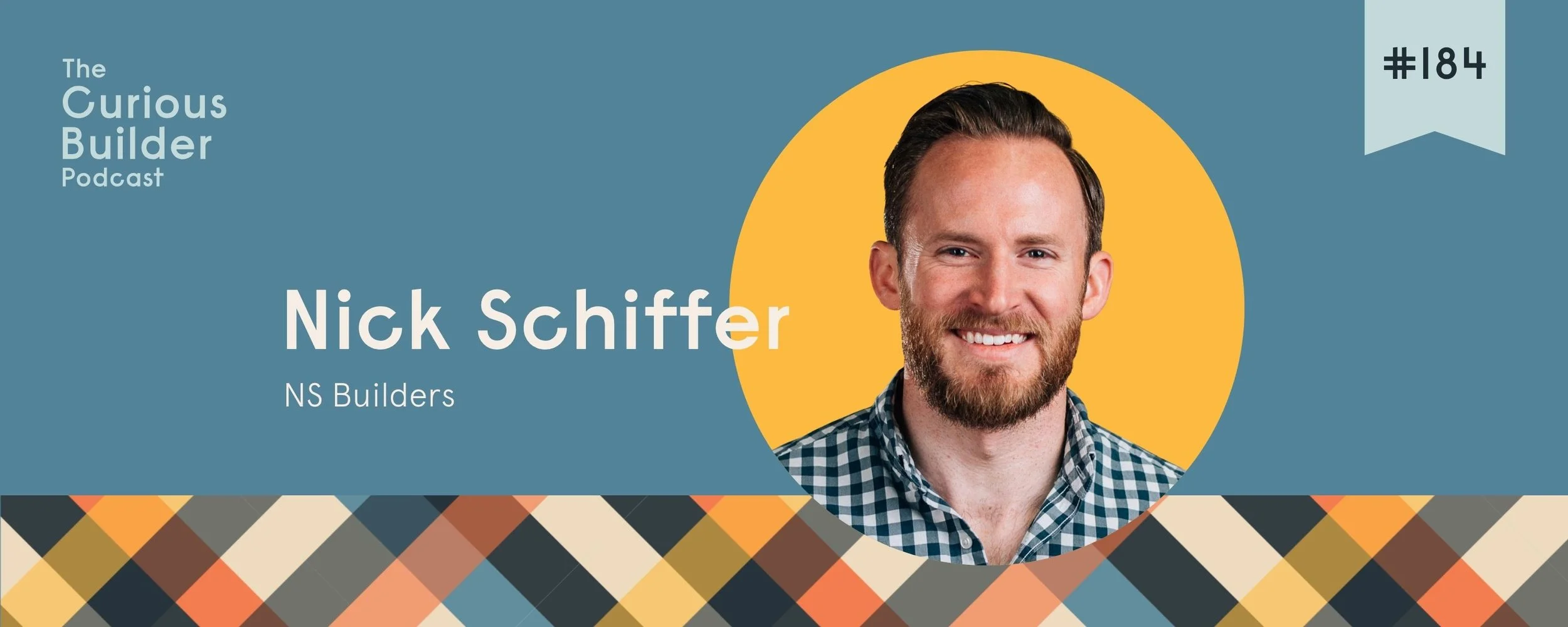
What happens when you put Mark and Nick Schiffer in a room with 12 unanswered questions and absolutely no plan? A Curious Builder variety show, obviously. The two builders riff on everything from social media and business growth to conflict, trust, money, ego, family, and the wildly questionable decision that became Nick’s 45 White Oak project.
Listen to the full episode:



About Nick Schiffer
As the founder and visionary behind NS Builders, Nick Schiffer has spent his life mastering the art of residential construction. His hands-on experience began in his father’s workshop, grew through formal training in carpentry and construction management, and matured over years in commercial and high-end residential construction. Known for his dedication to craftsmanship and forward-thinking approach, Nick leads the team at NS Builders with a commitment to detail, quality, and client satisfaction that ensures each project is an enduring work of art.
Resources:


-
Nick Schiffer 00:03
The problem with what is enough is that it is subject to the state that you are currently in. 10 years ago, I would have said today I have enough. Like all these luxuries in my life, I you know 10 years ago be like that's amazing. Today it doesn't feel like enough.
Mark D. Williams 00:30
Today in the Curious Builder podcast, we got a great variety show. We've got Nick Schiffer out in Boston, and rather than having a particular topic or a book, really we just go after some hard-hitting questions that previous guests have left us. So, without further ado, here's Nick Schiffer. Welcome to the Cures Builder Podcast. I'm Mark Williams, your host today. I am joined by Quick Nick, or also known as the Slayer Schiffer, out of Boston, Mass. What's up, buddy? What's
Nick Schiffer 00:56
up, buddy? How are you?
Mark D. Williams 00:58
I'm great. Yeah, it's. I was talking to Brad actually yesterday. I did a little small 20-minute segment with him, and I was just remarking that obviously we're partners on Contractor Coalition, and you and I chat, you know, when we can fit it into our crazy busy schedules. But I I look forward to Contractor Coalitions because honestly, well, I love what we do and I love how we educate. I sort of just miss hanging out with like you and Brad and Tyler and Morgan in person, I I think that what I think people can see it in our social media, but like we generally like each other, and we're also our personalities are so different. We're constantly giving each other crap on our deal, but like honestly, I just miss you guys, and so like having the podcast where I get to talk to your your brain and share to the audience, you know, all your wisdom that for selfishly I just enjoy talking with you because like when do you get like an hour with one of your friends these days is actually pretty rare.
Nick Schiffer 01:49
Yeah, it's usually over text,
Mark D. Williams 01:51
which I hate.
Nick Schiffer 01:53
I know we know Mark for anyone that it doesn't get a text message from Mark, he just sends video messages, which is more annoying than a phone call. Because I'm like, now I got to watch like a voice memo. Brad does a voice memo, but now you can read them. So it's like I don't even have to listen to Brad talk. I can just read it. But Mark comes in with a video. It's like cool. There's a three minute 33 second video I have to watch, or I'm just gonna not be part of this conversation,
Mark D. Williams 02:21
which is you know probably 5050 for you. the the best the the best is when you and I will be done with that because usually you know leading up to the contractor coalition we're we're spending so much time and effort getting new content things like that ready for it. But on the back end, you know we're just I'd say that first 10 days when we're done, like the harassment level is at like peak flow, and you know, I'm pretty much melting the polar ice caps with AI involvement, really for just making fun of Brad, which I think is totally worth it.
Nick Schiffer 02:50
Yeah, I would agree.
Mark D. Williams 02:51
So today's episode for the audience, we I think we'll save it for a future. At this point, most of our followers know about 45 White Oak. Nick has an incredible multi year project out in Boston, and obviously I have Misahu, and I think for a future episode we'll talk about lessons learned and all that. It's just not going to be today. I so each episode when I interview a client or sorry a guest, I let them leave a question to ask the next guest. Just kind of a fun way to create you know intrigue and totally random. So I've actually saved the last 12, and today is just going to be a variety show with Nick and I. I think we'll both take turns answering these questions and just kind of riffing off of them. So we don't really-I don't even know where this is going to go, which is pretty much every conversation I have with Nick. So here we go. What was your best decision, and what was your worst decision in business? Tell us a story about each
Nick Schiffer 03:44
best decision, worst decision. I think from the lens of a my best decision would have been leaning into social media, and obviously, I mean, I maybe it's not so obvious. It's obvious to me, but it rewarded me in a lot of different ways. It one of the first things it ever did is it opened my eyes up to the fact that I could do business through social media. People could see what I did and and basically decide whether or not I was a good fit for them by seeing you know how much I cared, but it also opened me up to this world of realizing that there's other people in this industry that are equally as passionate and oftentimes more talented than I am, and I could attract that audience and ultimately build my team around that. So I think about when I first started social media. It was you know I was on my second project, and I was doing a whole house renovation solo for this. Architect and I started. I just started sharing what I was doing on there, and there was no thought. Like there was no thought around it. It was just me being proud of something I did and like, hey, check this out. But I think when I look back at the last 12 years in business, that was probably my most pivotal Moment when I decided to just really focus on it and use it as a tool to grow my business. I remember thinking about if I'm going to grow and compete with some of the best builders in Boston, then I need to I need to move at a faster speed. And how can I move at a faster speed? Then then it was all right. Well, no one else is doing social media. Why not use this marketing strategy to really position myself in the marketplace? And that you know, it continued to reward me in a bunch of different ways. You know, we started our podcast. We I I built this you know great personal brand. It on one hand, it's it's been really fun, and and it's really cool to be a face for the industry, or or a thought leader, as they call it. But on the other hand, it's also completely destroyed my ADD, and my focus is totally. But you know, it it allows me to, it has allowed me to do things that I don't think I would have ever thought I would have done in my career, and even in my personal life. You know, it's even silly things like traveling to different parts of the world for events and things like that. But I think for me, the the underlying thing is that it it has allowed. I'm not unique here, but it has completely allowed everyone to be exposed to so much more in their life in such a short amount of time. And for me, it was the world of architecture and architects and just homes, and and that is what really started cementing my love for great architecture and going after architectural projects. And I don't think if if that was a a resource, I don't think I would have been the same builder I am today. The worst decision I ever make made. That's hard because I think that there's a lot of things I can that come in my mind. You know, taking on a project that I knew was going to be a nightmare, not signing a contract with a client that I thought was a friend. You know, I I would say that the worst decision I ever made in business would probably just come back to hanging on to people for too long. I was thinking about that today. Not that there's anyone on my team that I'm considering getting rid of. I feel very fortunate right now that I have a great team, and that would be a wild way to let someone know that. Hey, you know I am. If you're on my team, one of you guys is going to go watch your
Mark D. Williams 08:13
back, Jack.
Nick Schiffer 08:15
But when I think about, it's just a very difficult thing. I don't deal with it well. I don't deal with conflict very well. I, you know, I I try to avoid it, and you know, I'd rather I'd rather just like move away from it. But that that put me in a lot of positions with people that it's not even some of them stuck around for too long, and it's not even that it was expensive or it was bad for the team's morale. Like all of that stuff is true, but I also just think that when you when I flip the script, I think it's also just disrespectful to that person. Where it's like you're on my chopping block. I don't have the balls to let you go, so I'm just going to ride this out until I physically have to get rid of you, and it's just not fair. And I think as I've grown as a business owner, I think I I try to slip out of the emotional mindset around people in the sense that I owe it to them to keep them employed. To I need to respect my business first, and if it if this isn't working, then I need to have a very direct and honest conversation in a respectful way. Very few people, if any, I'm not even sure that I've ever just like, hey, get get the hell out of here. You know, it's like you know, hey, this isn't working. Try to have a conversation and and make it fair for everyone involved. And that doesn't always happen. Like I think we go into it with the right intent, but some people are immature and don't handle that situation well, or and plenty of people have a completely misunderstanding of their actual value. You know whether it's in my company or other, you know, or just in this in this career in general.
Mark D. Williams 09:57
I'm actually really surprised to hear you say that. Not the topic, because I agree with you. That was actually going to be mine as well. After listening to you talk, that was my first reaction. Was a thing, but sometimes the thing is like, but would I be? It's hard to to say what your bad decision is because without the learning experience of that scar, would you be who you are? So it's almost like you become. I actually remember more of the things I'm thankful, the scars that I'm thankful for, because I've learned more from them than the quote successes, of course, which is why we have a podcast to share all those things with other people to make it relatable. But I'm a little surprised because I always think of you as very matter of fact and straight, and like you know, you'd bite a bullet in the teeth like Ace Ventura, like you know, out of the car. It's like I've
Nick Schiffer 10:35
become that. Okay,
Mark D. Williams 10:36
but you weren't like that originally. You had to learn that behavior.
Nick Schiffer 10:39
No, not at all. I mean, and I find like I'll give you a great I'll give a great example because someone was like, "Do you really just say that? We picked up my daughter from from camp last week, and they had this big speech after the camp, and they were like letting all the campers go. And I've never met the guy that runs the camp, and he walked up and like he clearly knew who I was. He like kept referencing the fact that I owned a business and all this stuff. And he pulled me aside. He goes, "What'd you think of my speech? And frankly, I didn't think it was a great speech. And he's like, "No, be honest. Like, was it too long? And he's like, "I really want good feedback. And I'm like, "If you want honest feedback, you yeah, it was too long. You spent way too much time trying to sell us on the camp. We've already we're already sold. The kids are the kids came. We are excited. They're all happy. You you don't have to reiterate that the kids had fun. The kids are gonna get in the car and tell us how much fun they had, and it was like very nice. But a buddy of mine was like, I can't believe you said that. I'm like, he asked. He asked. Like, what am I? It was great, man. That's not helpful, and that's not a good example of like when I get like. There's plenty of times I I want I want to be matter of fact, and and then I just my anxiety like spikes, and I'm like I can't say that right now. As much as I want to, just be like, dude, that's wrong. I I bottle it up, and I do have, I do have a tendency to go think about it and then follow up. And we have this internal slack with our team where it's like I'll walk a site, see a handful of things. They always know I see something. Like, what'd you see? I'm like, no, no, everything's good. And then I'll follow up, be like, hey, I'm reconsidering, you know, the powder room. I don't like the way that the sink fit. Can you guys adjust it? And so I try to balance it where it's. I've also had a lot of my previous team be like Nick. You like you come on site and just tear apart. And I try to balance that where it's like I'm not trying to kill the morale, but I also just want you to be like I want this to be great, and I don't want to just accept everything for what it is. If it can be better, let's make it better.
Mark D. Williams 12:48
I would push back in a positive way on you on that one. You shared a story with me when I went out. So I was in I think November when I came out to see 45 White Oak, and you'll remember the story better than I will. I just it just came to me right now was you? I can't remember if it was the handrail or what it was. It was the
Nick Schiffer 13:04
planter and how it aligned with the stairs in the front of 45 window.
Mark D. Williams 13:08
Yeah, and and you said, "Oh, it's fine, and you left, and you came back the next day, and your PM had ripped it out and redid it, and you said, "Patrick, why did you do that? And he's like, "It wasn't. How did he say that again? It wasn't. I was like,
Nick Schiffer 13:21
I just knew that wasn't up to our standard. And I like that he said
Mark D. Williams 13:24
"our. That's the part I want to get. I like that. And there's a verse that I've been using a lot in Proverbs, and I just like it. And it's what I think is one of the few things. Well, I've done a lot of things well with Misahu, but for me specifically, I don't have your talent set in terms of knowing how to do stuff or the ability to do it. So what I think I did really well. I was just talking to Melissa Olent about it from Ohio Interiors. Was I set the vision, and there's a verse that says, "Where the people perish where there is no vision. And what you and I have both done fanatically with our respective projects is we set out a vision maniacally of what we want to achieve. We were very clear in communicating what the goal was, and we allowed and empowered other people on the team in the design community. Like I asked my HVAC guy, you know Lennon, famously on a camera. I don't know if I told this story. I was having everyone sign their work. Did I tell you this story? And maybe I said I'd love to get a video of you signing the plenum. So he's signing the plenum. He's like, "This is awesome. This is only my second week on the job. This is the coolest job I've ever done in my life, and I was like, "Oh, this is. But like, I can't be out all about encouraging people to get into the trades and then not live it. So I had this internal dialog of like, I called the the owner of the company. I'm like, someone's watching out over what Lennon's doing, right? But then I I sort of chastise myself. I'm like, no, if I'm not going to give him an opportunity, and I'm like absolutely bandwagon. Like people coming to the trades, like who is? And so I, I that was a great lesson for me. Anyway, the point was he was thrilled that he got to be on camera and talk about Misahu's on the second week in the job. But anyway, I guess my point was it when it becomes their job or our mission, and I. Love. That's what Patrick's response was to you. So I think you can't escape who you are, and so just being authentic and open about it, which you obviously are. Yeah, I love that story. When I heard that about Patrick, I've told that story a number of times, although his name keeps changing in my version because I can remember Patrick.
Nick Schiffer 15:16
Yeah, I mean that's at the end of the day, we've talked about this plenty of times, but you know, I think about the fact that you know we we all die. Like I have no idea how long I'm going to be doing this, and I think about you know when you have kids. It's like I don't know what it is about photos of kids, like of my kids, where I see a photo of my daughter. I'm like, you are so much older and more mature in a photo than you are when I'm with you. So like that scares out of me, and it's like, man, like I wanted to have this done in life before you got to this point of your life, and you know it just like and it's it moves so quickly, but I try to bring that back to like what's happening, you know, in in you know my 30 day sprints in business where it's like, you know, does this matter? Like, okay, what's the risk? What's the risk? Like, all right, if what's the reward? You know, I just I play out all of this stuff in the sense that if I'm not just brutally honest and chasing the vision and communicating the vision, then what am I like? Who am I making these decisions for? I'd rather be the guy that's always on top of the detail and and constantly pushing and getting everyone on board with it, and the people that can't handle that kind of criticism or feedback, than bounce. Go work for someone else, and you know, and it's a balance because it's like some people are sensitive, and more sensitive than like you would give credit to, like man, it's like you know I was just kidding with you, but you seem to be pretty bent out of shape about that. And it's a real thing, you know. It's like I, you know, then I get the back, I get the back door comment, like, yo, you know, you said this to this guy, and you know he's been pretty upset about it. I'm like, what the hell, man? I, I'm like tell him to punch me in the face next time he sees me. Like, what are we talking about? I think as a business owner, most of us have to
Mark D. Williams 17:09
get over our feelings. It's not that we don't have feelings or that we don't take stuff, but I think you. I think anyone who's been in business very long. Correct me if I'm wrong, but I think you. I think you become. You have Teflon. I think you have to be able to like the Matrix. I think you sort of have to like dodge those bullets and that criticism. Even and you just were really good at multitasking and moving on. And even like think about I'm thinking of course my spouse or interpersonal communications. It doesn't have to be about business. I'm always surprised at what people get offended by, and I'm always kind of it's a little bit like worry. It's like rocking chair. What good does it serve you? Or or like resentment is like I've heard this great analogy that resentment is like holding a hot coal and expecting it to burn somebody else. Like that that it's such a visual representation of like you're mad, but you're holding onto this hot coal and it's just burning you. Like let it go. Like just move on. We're happy to announce our latest sponsor, Real Wood Floors. What made them to be an ideal partner is the fact that they align so well with our high-end custom homes. They're located in 25 cities across the country. They're probably pretty close to you. And what really drew me to them is the fact that they're vertically integrated. So many times when you're dealing with wood floor, you know procuring it from different companies, having it go through middlemen, you're either short material, it's the wrong material, and so we are looking forward to leveling up that and buying direct. The other thing that I really love is their floor made perfect match. I can't tell you how many times I've had a beautiful wood floor, but the vents don't match, or I love the wood floor, but it doesn't match my treads and risers. Knowing that they can perfectly match that is something I'm really excited about. Go check them out at realwoodfloors.com and sign up for an RW Pro account. Tell them you heard about them from the Curious Builder. When it comes to quality, craftsmanship, and performance, Pella sets the standard. Whether you're building custom homes or designing a timeless space, Pella offers innovative window and door solutions that blend beauty and efficiency. With showrooms and experts around the country, Pella makes it easy to find the perfect fit for your next project and their team to support it. Build with confidence. Build with Pella. Visit Pella.com to explore products and connect with your local rep today. For more information, you can listen to episode one or listen to episode 109, where we bring on Pella owners and founders at Pella Northland, as well as their innovative team behind the SteadyStat innovation. And so, I think business owners, because we're so trained with doing that with our clients and and people, I want to think that I would imagine that most businesses are probably really good at that, and I don't know if it's circumstantial training that we learn to get better at it, or are we naturally better at it because we're business owners? I don't know the answer. Do you agree with that statement?
Nick Schiffer 19:53
I I do. Yeah, I think relating it to spouse, I think that's probably why I take a breath before I communicate. Something
Mark D. Williams 20:01
you're better than I. I don't. I mean, I just play and gun.
Nick Schiffer 20:05
I know. I live life
Mark D. Williams 20:06
very dangerously.
Nick Schiffer 20:07
I I feel like I do as well, but when it comes to that, I just you know when it doesn't pay off ever, I'm just like, all right, like does this actually need a response, or does she just need to be mad at me? My like anyone that knows my wife, like I love my wife, but she is spicy. That is just you know she's that's her personality and like and she's been authentic to that since the day I met her. So sometimes I'm like she's just gonna be mad at me and let it let her be mad. Like I'm not you know, unintentionally trying to make you mad. But if I tell, if I defend myself, be like, I'm not trying to make you mad. She's like, Well, you are making me mad. It's like
Mark D. Williams 20:48
this escalates. You know, if I was to answer those two questions, I'll go shorter, best and worst. I think my best decision. I mean, I know it sounds self-serving, but it truly is. I think the best decision I ever made was listening to my wife when she said, "Go to Contractor Coalition Summit. I didn't know who you were. I didn't know who Brad was. I mean, we had a pretty strong social media game, but I had no idea what Contractor Coalition was or any of that stuff. And she said, "I think
Nick Schiffer 21:12
to be fair, it was the first one.
Mark D. Williams 21:15
I know, I know, but even so, and I've mentioned it many times that while I have a very large personality and I'm very social. I was so narrow. Even challenging your premise, I think, is always really important for anybody. And for me, I was so blinders on, head down in Minnesota. I thought, man, why would I? I hadn't even been to the International Builder Show before because I'm like, well, what am I going to learn there? I'm not a product guy. Like, I'm not going to go look at glues and guns. Like, that doesn't interest me, and it's not my forte anyway. And and so I needed someone to sort of shake up my paradigm a little bit. And so I look back now, like my career is so different. I mean, I I couldn't possibly. I did great work before. It has nothing to do with the work I did, but more like elevated, of course, brand and the podcast and all the things I've created since then. But it was really I like what Doug Dougie Fresh said. He's like you always had it in you, but I give Contractor Coalition like that was the match to my fuse that just absolutely exploded all the things and ideas. And now it's like there's nothing I can't think of that I can't do, and I owe it really all to just expanding my mind from you and Brad. And that was before, and Morgan too, before Tyler was there or I was there, and so I that will go down as one of the best decisions I've ever made because of the ripple effect that it's had on my career. And so
Nick Schiffer 22:31
I would just yeah, I'll add to that. Like any of the events, you know, whether we've hosted or I've been to, those have been always pivotal to business, and it, you know, I went to one recently and it was just like it's so structured on business and it's like the fundamentals, and especially in building, like we tend to make things so complex, where it's like if you just break it down to the fundamentals, and a lot of it has to do with getting acquired or building your business to sell, and whether you sell or not is besides the point. But creating the value in your business by following like a framework, you start to realize just how much shit you do that doesn't matter, and it's like you get obsessed with it because of the brand or because of what you want or what your ego wants where it's like if you're trying to build a successful business, like you got to play into what the shit that works, and those have been huge strides in my business where it's like I just continue to shed the weight, all the extracurricular activity. I mean, you know, I get asked to be on podcast con like it just Caitlin's my assistant like just it's no just it's no to everything unless it's you know it's it's helping one of either of these buckets and that's it and it's like as much as I want to do everything it's just it's not actually moving the needle
Mark D. Williams 23:56
yeah I mean it's funny I I don't know if you've noticed this with 45 white oak I balancing all the balls that I have in the air right now between the podcast and the collectives and contractor coalition and Mark Williams Cousin Homes and my personal life and training and all these other things. Tyler asked me, I think, when I was on your podcast a month ago. You know, he was skeptical if it really does give me energy, and I was honest, it does. And I feel like I am doing the best I can to balance it. And everyone's balance is different, what they can handle. I mean, your ability to handle stress is prodigious. Whether it's healthy for you or not, it's not really the point. You can you what you you know you're like made out of Kevlar. Your blood is made out of like Kevlar liquid. But anyway, the point being is like I found what my stress point was where I couldn't keep up. You know what it was? Oh, being a real estate agent on top of everything else that was the straw that broke. So when I was choosing to story tell Misahu, and I'm very happy the way I did it, but I it was that last, which tells me I've basically maximized my individual not potential my individual capacity. That being a real estate agent on top of all the other responsibilities. I have. I couldn't do it anymore. Now I was. Now I was going against my boundaries. I was working at night. I was working on the weekends, which I never do. And I talk a lot about it because I feel like it's super. I don't want to be a hypocrite, and we all go through seasons of life where we might have to just dig in and do it. But like, I don't think it's a healthy long-term strategy. You can't run your car in the red for long periods of time without breaking down, and I think that's true of the human too. And so, anyway, we just listed it last week. Now that doesn't take the stress away because I still want to sell it. But I just thought it was an interesting self-reflection for me that that was the one that was I finally figured out what my quote breaking point was for time. That was the thing that pushed me over the edge. Anyway, just side note. Any comment on that before I go to my worst decision?
Nick Schiffer 25:44
I could talk for hours, but let's go to the worst decision. All right, worst
Mark D. Williams 25:46
decision. It's probably one of two. One is causality, which I don't even know. So I bought a house that was in foreclosure in 2007. I spent too much money in it. It was my first. It was my last spec home before Misahu, so it was 16 years ago or 18 years ago or whatever the year was were, and I finished it one month before the stock market crashed. That's why I don't know if it was really my worst decision or just terrible timing. But here's why it was my worst decision.
Nick Schiffer 26:11
That's terrible time. That that's something you couldn't control.
Mark D. Williams 26:13
Agree, 100. But what I could control, I did. I made a number of mistakes. One is I put too much money into something. I fell in love with it, and I went too far. I should have torn it down. So I did a remodel that was too big. I didn't know my market. I was too young. I was 28 years old, and I I picked a tuck under in a retirement community. Well, what 70 year old wants a tuck under garage with stairs? So it was. I just that's just not. I mean, that was a painful lesson. It's the only house in my career I've lost money on. How
Nick Schiffer 26:43
much money did you lose on it?
Mark D. Williams 26:44
Like 120 grand. I know it's laughable now, but it wasn't very laughable back then. I've learned. I mean, I've talked. We won't talk this whole podcast on it because I've done a number of others. But my dad did say it when I came out of it. He goes, "You got your master's degree in business in half the time and quadruple the cost, and I've always liked that succinct. So that's why I say it's my worst decision. Not really. I learned so much through that experience. Yeah, I would
Nick Schiffer 27:09
say that's not. I would say that's not your bet. No,
Mark D. Williams 27:11
agreed. So mine just not copy yours. Is really people. Same deal. I had two or three people that I just kind of like you. I was not willing to have the conversation. I said, but basically outsuffered them. I basically said, I'm not going to fire them. I'm going to wait till they just quit. They can't handle the stress, and they did. The funny part is, they went to one of my competitors in town, and and they called me and said, Hey, this person's coming to work for us. Is that okay? I said, Well, thank you for asking. Yeah, and it was like, yes. And that he only lasted four months. They were not nearly as afraid to let people go for not performing as I was.
Nick Schiffer 27:44
I would say, like on that note, I since I struggled with it, I started like really digging into better ways to do this, and people were like, "Why don't you just put them on a pip? I'm like, "What's a pip? And they're like, "A performance improvement plan. It just basically says, like, "Hey, this is where you're lacking. You need to improve, or you're gonna be let go. And I did, and both of them were like, "No thanks. This says I could be fired at any time. I'm like, "You could be fired at any time, anyway. And they both quit. And they're like, "I don't like the fact that this is like structured improvement. I'm like, which is why you're you're being like, "I want to fire you.
Mark D. Williams 28:21
That's so amazing. That's like that's like hiring a coach for like like running or like strength and be like, I but I don't want a plan on how to get stronger. I just want to be stronger. Like, what are we doing here? What are we? This doesn't make sense.
Nick Schiffer 28:35
I was like, I guess, yeah.
Mark D. Williams 28:37
Wow, we we didn't even make it past one question. It's already 28 minutes. Wow, you and I, we must both have podcasts. Okay. Second question: What are some things you've seen that could have prevented that you could have prevented if you would have built more trust upfront? I think the spirit of it is basically to re paraphrase it is like: What are things you could do in a relationship with your client or a team members, that would have built more trust, so that when the project got difficult, you know. Oh,
Nick Schiffer 29:06
this is easy. Okay, pre-construction. It's it's it's literally I beat I beat this conversation up every day. You know, you want I will I'll build your house for what it cost like what I'm telling you it costs for how long it's going to take if you let me go through pre-construction. Period. That's it. We we understand the pre-construction process. We have a process. It is three tiers of pricing. We are working with the team. We ultimately should be able to say sign a contract. You sign it. I will turn around. I'll issue POs and approve shop drawings, and the house is in construction.
Mark D. Williams 29:47
I love it. Yeah, I think that's a great response.
Nick Schiffer 29:50
Yeah, it's because that is where all the expectation is set. Otherwise, oh, we're just going to sign a contract. Great, let's sign a contract. We'll figure it out. I'm going to ship some raw materials to the. What the job site, and then we'll take those raw materials and slice and dice them, and assemble a house. And when there's if there's a beam in the the hallway, ah, we'll figure it out. It's like I
Mark D. Williams 30:11
like that. I think that provides a ton of trust. This one, this next question is going to be a. I think I predict it's going to be a tough one for you, but I don't know. This was actually Casey from Raycon gave me this question: What is enough? What does it mean to you?
Nick Schiffer 30:26
In what way?
Mark D. Williams 30:27
I think it's open ended. He left it. He said you can apply it however you wish.
Nick Schiffer 30:41
I believe the the problem with what is enough is that it is subject to the the state that you are currently in, right? Meaning, like what I think is enough today will be very different than what I think is enough tomorrow and the next day, because your state, your state of mind changes. Your your you look back 10 years ago, and I would have said today I have enough. I have a house. I am fortunate to have a small log cabin up in New Hampshire that we can escape to, aka a second home. Right, like all these luxuries in my life, I you know 10 years ago be like that's amazing. Today it doesn't feel like enough. So my answer today would be the ability to look at my life in longer than 30 to 60 day sprints, and I think a lot of that relates to cash flow and just financials, meaning that right now there's a lot of investment out, and with all of that investment out, you're basically waiting in these 30-day tranches to see if any of that comes back, and my thought is that when and if and when they come back, I'll have this sense of like calm. But we know that that's historically not accurate. It will be something else, whether it will be the the outcome of those investments, or something entirely different and new. On the personal side, I think enough is the ability to be with my family as much as I want, Meaning, I'm getting a random phone call. I don't know why that rang through. As much as I want, in the sense that I want to work and I want to be at work and I want to do work and I need to be away from my family in order to work, but I want the ability to pivot and take a day and not feel as guilty as I do now, where you know when you have this this glooming responsibility of those investments out now, when you are away from work. At least for me, I feel this sense of guilt that you know until those pay back, I should be working relentlessly until they come back, which is not you know, which is not healthy for a human being. Like you need rest, you need the ability. Like you can argue that without that, you will diminish the ability to do that, you know, over the course of working 1214-hour, days. So I think for me, that that's what enough would be today. I
Mark D. Williams 33:52
think it was a beautiful answer. I love what you said. At first, when you said state, I was think I thought you were referring to like state income taxes or death taxes. That's like because if
Nick Schiffer 34:01
I was in Florida, if I was in
Mark D. Williams 34:03
Florida, but no, I, Amen. I think your answer is very applicable, and I think as we go through life, I think enough and balance to me they kind of go hand in hand, and I think balance. You and I both suck at surfing. When we were in Huntington Beach surfing with Patterson, you know you're in the water. It's tiring. It's great. You get up for two seconds, and you're excited about it. Yeah, but like the point being is, I think balance is just a moment in time. I think enough is just a moment in time. I think I think just getting to the place where we have peace, and I think there are a lot of things that take away our peace. I think financial stress takes away our peace. I think health. I mean, I think life gets real simple real quick. Like if your kids are sick, like I'm talking serious sick, like cancer or something serious. Like man, financial stuff. Like I'm not saying it's not stressful. That's stressful as f. But like compared to like someone's life, like well. I mean that's like a rainy day, big deal. And so, but when you're healthy, it's just funny how the human condition in our mind is so. I have such I have such a respect for. I was asking this question recently about at our collective actually last week about mentorship. Who are you know who who do you consider mentors in your life, and I think most people felt this way. The people that I find either mentorship or leadership that I feel worthy of of sort of embodying their personal traits or things like that, they seem calm, and they always seem to have time. We all know we have the same amount of time. So how is it that they always seem like they're more available? And anyway, I I remarked, and actually I should ask this person this question because maybe he's not as calm as I perceive him to be. But I, as you just mentioned with the podcast, or I just mentioned previously about how like being a real estate agent was the last straw that sort of broke my time back. Like I just didn't have any more time left. I was just maxed out. These people that are very successful, way bigger businesses than you and I-they have time, and like, how is it that they do that? And I think that's admirable. Yeah. Anyway, I don't. It was just more of an observation. I don't really have more to say about it than that. And for me, it's like I do want to have time, as you know, with your kids of your choosing, or to be able to someone calls you and say, do you have time for me? I want to say yes. And now we know we're busy, and we have things we have to protect our time. I think what you've done with the podcast is great. Meaning, like other people imposing their time on your time. Like we've set up things to protect that. But there is something about just, and maybe we-it's the human side of me, where it's like someone calls you. Maybe it's your childhood friend. Maybe who knows? Maybe it's just a stranger. I mean, maybe it's someone from a contractor alumni, and you hear it in their voice, like they need you, like now. And like I have a feeling that you and I would cancel whatever we're doing because, like, they need help. Like you could, you can almost kind of like your sixth sense, like you hear it in their voice, like they need something. And I know that you would respond to that because that's just kind of person you are. And sorry, I'm not even sure why I went down this road, but that's just my reaction to enough, I guess. All right, begin with the end in mind. What does it look like for you? And when, and like, I'm whether it's your business, whether it's a home, whether it's like your year, you know, I think it's a, yeah. Anyway, I'll just leave the question be that. What does that mean to you? The
Nick Schiffer 37:23
end.
Mark D. Williams 37:24
Well, begin with the end in mind. It's a common saying, right? Like if you're going to start something, begin with the end in mind. But I think a lot of us make business decisions without the end in mind, and that gets us into a lot of trouble. So, what does that mean to you? Begin with the end in mind.
Nick Schiffer 37:41
Um. On a project basis, I think that that's a pretty easy thing for me to to to like an easy way for me to approach a project. My in my life and in my business, I don't think I really think about the end and work backwards from that. You know, when you first ask the question, like thinking about my life, or if I choose to work backwards from when my life ends, I don't know. Like that's not something I think about. It's not something that I'm like, all right, these are the things I want to do before I die. Like I don't have this list of like I gotta skydive. I gotta, I gotta you know sell my business. It's I am more along for the ride of life and business than I am for the way I in which I run my business. Where it's like I think about my business in the sense of, all right, what do I want to accomplish? Like, what is my personal salary goal? Let's work backwards from that. That's an exercise I will do, but it's not. It's not everything. It's just an exercise for you know that moment in time. In the sense that, okay, I'm looking at one the next one to three years, what does my salary look like? Let's work backwards from that. How does that? How does my NS Builders tie into it? How does modern Craftsman tie into it? You know, what other responsibilities or opportunities do I need to either consider doing or not doing? But other than that, I'm I'm very much along for the ride.
Mark D. Williams 39:22
Yeah. This episode of the Curious Builder is brought to you by Olivin Vine Socials. If you're a builder, a designer, or an architect looking to grow your brand without dancing on TikTok or spending your whole life on social media, listen up. Olivinvine Social specializes in Pinterest marketing, blogging, and email strategy for luxury home brands that help you turn your beautiful work into a strategic SEO-driven content that drives real traffic and connects you with your ideal clients without burning you out. Ready to grow smarter and not harder? Visit Olivinvine. Socials.com and tell them the Curious Builder set to you. Just so you know, I've been working with Alyssa over at Olivin Vine for three years. She helped us launch the podcast. She's helped us grow our brand at Mark Williams Custom Homes. I could not do what I've done without her help. What is something that you believe today that you didn't believe five or 10 Years ago, that's hard. Maybe I'll go give you a minute to think about it. Just because this one react, I'm reacting to it. I think, well, I've always been a very collaborative person. I didn't realize how freeing it was to share everything, and how the obviously the whole point of contractor coalition and collaboration over competition. If you went back 1520, years ago and said, "Hey, Nick, you're going to share every business practice that you've done, every mistake that you've done, and not only are are you going to feel better about it, you're going to have a business about it. You're going to make money doing it, and it's going to empower you to be a better version of yourself. You you would have told yourself like what this guy needs mental help. There's a clinic down the street I can help check you in to commit you to, and so but now because we do it so often, it's just the currency of like our daily life. So that for me, that's how I would answer that question.
Nick Schiffer 41:17
Okay, I feel like a lot of my answers have been swaying to a negative place, or just like in that side of the brain, and not like gloating. And I think in this case, I'll answer it here, where I'm a better builder than I thought I was 10 years ago, and I'm better at I'm better at things than I thought I was 10 years ago, and that fear that I had 510, years ago, or that consideration of it's kind of like when you become a parent and you look back at your parents and you're like, dude, they don't they didn't know what the hell they were doing. That's how I, you know, where I definitely get in this this trap of, or this belief that I'm still figuring it out, and like I'm so early and I'm so young and like there's so much to figure out. When the reality is like, dude, no, you've pretty much figured it out and surpassed some people in doing in doing what you're trying to do. Plenty of people don't make it to the where you're at. Never mind well above it, and I don't mean like I mean that in a you know in in a little I'm a little bit cocky about that, but at the same time I'm also I'm very confident in being able to answer that. I
Mark D. Williams 42:34
think it's self realization. I think you know you're running a marathon, for example, and while you're running the race together. Everyone's running their own race, and you have your. Everyone has their own potential locked into their DNA to a certain degree. But you also have time and training and circumstance. There's a lot of other things that you can affect that. But like, no matter how much you and I are trained, we are never going to break the two-hour barrier. Just simply not going to happen.
Nick Schiffer 42:56
Break the four-hour barrier.
Mark D. Williams 42:57
I think you could
Nick Schiffer 42:58
too. You
Mark D. Williams 42:59
could if you wanted. But anyway, that's not the point. The point is that we all are in a race against ourselves, and while we compare ourselves to other people, I hope it's in a positive way. Like I, there are times where I look at, let's just say, modern craftsmen or NS builders, and it's an inspiration. Sometimes it's a competition. Sometimes it's like, oh, hey, I'm better at that. But like, none of it's for me personally. It's never viewed from a negative point of view, it's either aspirational of what I want to achieve, or encouragement. Because, like, if you know, maybe mile 20 really sucks for you, but maybe I'm feeling great at mile 20. But guess what? You passed me at 25 because you're like sucker. I just took a Red Bull, and like, you know, you're you're flying by. Like, it doesn't matter. At the end of the day, we both crossed the finish line in our race, and our journey was our own, and when I hear you say what you just said, I actually commented on you recently on a podcast with somebody about Mike Weaver has that great line that I really like about compressing time and like relationships help us compress time, just like I think these podcasts help us compress time and lessons. But I'm always amazed. I always forget how young you are compared to me. Now you just made it how like you you feel like you've actually achieved a lot, and you have. But that's kind of my point. I think every like there could be a part of me that like man, I've been building for 22 years, and there's a vast part of my career that I just was on a merry-go-round going in circles compared to like you. Like you've been on a fricking rocket ship. You were like SpaceX before SpaceX, but so
Nick Schiffer 44:21
you're, but that's your perspective.
Mark D. Williams 44:22
100% No, I 100% agree. It doesn't make it wrong or right. It just makes it my perspective. And yeah, I'm
Nick Schiffer 44:28
just saying, like I've definitely been on the merry-go-round.
Mark D. Williams 44:30
Yeah, but
Nick Schiffer 44:31
year after year, and it's like when you, you know, I think what's to to kind of build on that. I also feel at least for me, there will be times in my career, professionally, personally too, but like professionally, that I will tap into something that I didn't realize was a potential, an opportunity to grow, to make money, to build. Whatever it is, and do it, and see how successful it is, and then like freak the hell out and and move away from it. I'm like, what? That was just working. Why'd you go away from it? It's like, man, that was scary. Like, this is like internal dialog, right? Where it's like, I never realized I could do that, and now I'm. And what if I just keep doing it? And it's you know when you zoom out, it's like whatever. Like in business, say you do something and realize, wow, that I made 100 grand doing that. It's like okay, what if you put double the amount of effort into it? Realistically, or or historically, maybe you won't double, but you will increase. You will now make 150. Like there, there's always the opportunity to continue to scale that, and especially all like the you know building included. But when you break it down and really just understand like input versus output, it's almost always the same numbers. Meaning like if you put in 10 you're getting one, and if you just historically look backwards at like every 10 people I talk to I convert one, it just it's always the same. Where it's like okay, what if I talk to 20 people? It's like you'll convert 230, I'll convert three, and it's just that that input versus output. The more you look back and recognize that, the more control you I think you have, especially from a business perspective, looking forward.
Mark D. Williams 46:33
I mean, my reaction to that is a saying that my dad told me, and I've given this you know conversation about Boundaries Create Freedom Act Contractor Coalition about the you know the rocks and the pebbles and the jar and all that with the water, is it's not about priorities. It's about priority singular, like what you put. I mean, I think I'm guessing you have similar issues that I do. Mine are just more outward in terms of like we have a lot of interests and we have a lot of talents, and the problem is, is you can only, you know, you only can push so many rocks uphill at one time, and if you devoted all of your attention to one thing, like you would be just a fricking dominate. Totally,
Nick Schiffer 47:14
like it's stupid. Like I, when you remove the emotional and the ego, dude, like all of us could be just like monsters, and you know, and like violent in business.
Mark D. Williams 47:28
Okay,
Nick Schiffer 47:29
but we, but ego and emotion. It's like you want this because it feels good. You, you want you have people like. I know personally that if I can, I could make more money faster if I didn't build, and I did. I tapped into the personal brand side of what I'm doing. It's just that is not an opinion. That is straight facts, because the opportunities that present themselves. If I put any, that's putting the little amount of effort into it. Now, if I double, triple, or put all my effort into it. It's like it would be so much more.
Mark D. Williams 48:04
Here's where I
Nick Schiffer 48:05
and
Mark D. Williams 48:06
yeah, go ahead.
Nick Schiffer 48:07
Well, I was gonna say I could make that same amount of money building, but it's just a slower climb. If you were to draw this as a graph, building is gonna be really flat, and then it's gonna slowly spike up over time. Doing the the personal brand stuff, it spikes really fast and then it will flatten out. So it's just like the complete inverse. So it's a lot of money really fast or a lot of money really slow.
Mark D. Williams 48:32
I well, I like your most of your scenarios are very optimistic. Both are a lot of money. I like where you're heading with that. The only thing I would push the
Nick Schiffer 48:38
potential potential right
Mark D. Williams 48:40
right. The only thing I would push back on that, because I, I think in a vacuum, you're right. And we both have read the psychology of money. You know, goes back to your earlier comment about the state of mind, where we move the goalpost a little bit too. I think that the problem is, is we're dynamic, we evolve, we change, and so I know I couldn't do just building because I I would get I'd either
Nick Schiffer 49:02
imagine if imagine if you didn't change and you just kept showing up where it was working over and over and over and over and over
Mark D. Williams 49:10
again I I like I like this argument so let's let's see where it goes because I the problem is is can you do something you don't want to do can you do something that's against your nature can you like I know, I'm a gifted marketer. I'm not great at making money. Lily, my first reaction when you were saying that was, I wonder if Joel on my team, who he's my healthy tension, he's my controller. You met him at last one in Denver. He says no to everything. I say yes to everything. What if I told Joel, you have a 51% ownership of all decisions regarding money. Make here's the money. Make me money when I spend it, you have to. I'm giving you power to stop me. That was my first reaction because I have historically proven that I'm amazing at spending money, and so yeah. But I can't. But I can't escape my own personality. But here's the problem, and this is the where I'm going with these other things. If you lose your interest, if you lose your spark, if you lose your. Desire to be creative and do the things that make you do, then you can't do the thing that you were trying to do anyway. Like I can no longer just show up every day and be a builder. I can't do it because I'm. It's not enough for me. It's not enough for my personality. It's not the whether it's the dopamine hit or whatever it is.
Nick Schiffer 50:16
Again, but like this is where like that's because ego plays a role. I disagree.
Mark D. Williams 50:20
I disagree. It's not ego, not not
Nick Schiffer 50:22
totally is.
Mark D. Williams 50:23
No, it's not. I get in. I get. Well, you tell me how it's ego. I enjoy having a conversation with you. Just because I enjoy it doesn't mean I can't make money doing it. I enjoy lifting up other people through the collectives. I'm
Nick Schiffer 50:36
saying the the inability to just show up and do the the one thing that would also-I'm talking about making money.
Mark D. Williams 50:43
Okay.
Nick Schiffer 50:43
If if you were if if one thing is making you the most amount of money, and you were to only do that, if your goal was strictly to make as much money as possible,
Mark D. Williams 50:55
which is not everything else is not my goal. Is that your? I know. I'm. I'm saying in the
Nick Schiffer 50:58
no, no, not necessarily. Yes, I want to be wealthy. Like there, like I do want to be wealthy. I want to be wealthy enough to just afford whatever the I want and have the life that I want. I don't know what that number is. That number has consistently changed in my mind, but the the inability to only focus on that is driven by the fact that like there is ego that is involved in that, in the sense that I. But I still want to build. It's like it. Okay, I'm not saying I don't make money building, but if if that was impact, if that was not like that was preventing me from making money, why are you building? Well, because I like it. Like that's just that. That's me. That's that. That's I'm not looking at this from a business perspective. This is a personal decision. Sure, I get enjoyment out of it. Like, yes, I'm good at it. But if the soul, like, it depends on what your soul focuses. The reality is, most people aren't driven by one singular outcome.
Mark D. Williams 51:55
I agree with that.
Nick Schiffer 51:57
Like, it's just not. It's just most humans aren't. So they have to have multiple things going on. I mean, I
Mark D. Williams 52:05
agree with that. I don't buy into your other statement. I don't mainly. I don't predict. I don't understand the ego. And maybe just speaking for yourself, but I I would predict knowing you the way that I do. Let's just say you just said, "Mark, money is my priority. You would do the social media. I think you would last two to three years, and I think you would one of two things would happen. Either one is you would feel that you are either a hypocrite and that you're no longer true to your roots, which is a creator, and because one thing informs the other. The reason you have a platform is because you are a builder and you were a builder. If you shut that down, there's a part of you that would say, "Am I really what I'm saying anymore? Am I hypocrite? Am I fake? Sure, I'm guessing. You tell me if I'm wrong. No, no,
Nick Schiffer 52:46
it's and and that would have a limited life. In this very moment, in this very moment, I feel like I could step away from building and still speak as a builder.
Mark D. Williams 52:54
Agreed, 100% agree. Oh, I 100% agree with that. But for how long? My question. But that
Nick Schiffer 52:58
is very much a real thing, where it's like you know, then you become the imposter syndrome syndrome. It's like, oh, he's teaching because he can't do it. Like that, I remember hearing that all the time. It's like, yeah, anyone that can't do it just teaches. But I'm like, you know, like as I grow older, I'm like, it's actually harder to teach it. It's way harder to teach it than actually do it because you have to understand not only how to do it, but also then how to communicate to do it. A lot of guys can do something, but few of them are able to turn around and point to the the guy next to them, like, "Here's how you do it, and actually teach someone in a way that makes sense.
Mark D. Williams 53:36
I think so. I mean, to to piggyback on that, I think some people are good at teaching. I think some people are good at leading, and I think they're and I think they're two different skills. I mean, you can be both. I'm a better
Nick Schiffer 53:46
leader than I am teacher for sure.
Mark D. Williams 53:48
Oh, funny! I actually think you're a very, I think you're a fantastic teacher. I think the way when you break when you break down information and complex like how linear you do it, I think you have a real gift to getting from A to B. So
Nick Schiffer 54:01
I'm sure. I'm sure I've improved. I mean, I'm building a small little cabin up on our property, like basically a bunkhouse, and I'm just like, I'm gonna do this. I'm, you know, I got a handful of tools, and I'm just gonna do this and and just enjoy it. It would be my hand driving all the nails in my joist hangers the other day. I'm like, I could get a pneumatic gun, but I'm not gonna. I'm gonna get blisters and I'm gonna bleed and I'm just like, this is. Let me bring it back. And my son, my older son, he's eight. You know, he came out and he wanted to do it. And I have to consciously like slip myself into. All right, Nick, he's eight. He's literally never. He doesn't even know what a joist hanger is. Slowly walk him through it, and don't get frustrated. That's that's a real like dialog I'm having internally. And he slams his finger, and I'm like, deep breath, you got it. And then the tears come. I'm like, it's all right, dude. Trust me. I look at my hands. I'm bleeding. Like this happens. You got. Though, and he's very impatient and gets very frustrated. I was like, "I'm here. You do do one, do 100, whatever you want to do. He did a couple. He's like, "I don't want to do this anymore. I'm like, "No problem. But it's like I have to like physical. I have to consciously tell myself that I have to slip into that mindset and be okay with the fact that joist hanger is going to take 48 minutes to install.
Mark D. Williams 55:23
I think the fact that you realize that makes you a good teacher. I don't. I know. Yeah, maybe. But anyway, yeah. I still agree to disagree on your first part, but we won't belabor that. We got one last question. There's so many good ones. What's a decision you made that looked wrong to everyone else, but ended up being right for you?
Nick Schiffer 55:46
45 photo. I mean, it looks wrong quite literally to anyone else. That period. It's just not. It's just not what how you go and get into development. It's not you know the math doesn't math. You know you're working. You know you're not. We didn't prioritize the biggest buyer pool. Like there's so many things that looked wrong and continue to look wrong to many people, and the outcome of that property, no matter how it shakes out, will always be kind of a stake in my journey as a success. And that's sometimes like there's days that's very hard to recognize. Trust me, like there's very difficult conversations, and just like, hey, you know, what's our plan if this happens, and you know, and I'm constantly thinking about that. But you zoom out; it's like, man, like I've met some really incredible people. I've introduced our firm to some really incredible architects and and agents and wealth managers and just people in general. I have established the fact that we can build at this this level of quality and and craft, and I just and I proved that I was able to build this with the trust of building a brand for a decade. I've chatted with a couple people about writing a book about this and just like how we got here, it's like, and I, I think about it constantly. It's like people always ask me, like, how did you raise money? How did you do this? How'd you do that? I spent a decade building a brand. That's how. That's it. 10 years showing up. This is who I am. This is what I do. Over and over and over and over, and people were like, "Hell yeah, hell yeah, hell yeah! That's it. I didn't just show up one day and be like, "Hey, I need $10 million. It was a decade, and that that's why it worked. That's why I raised the money. That's why we built it. That's why the trades invested more effort and time into this. That's why brands showed up to be part of the build to build the project. Nothing else. Not because I had a good pitch deck. Not because the math math. That's it. Was just because we built a great brand behind who we are,
Mark D. Williams 58:22
I think that's great. I I saw a quote, and I'll butcher it, but basically, on your deathbed, the thing that you know, what experiences will you remember? And we can't predict that. Obviously, we don't know our clarity of thought if we have Alzheimer's or halfheimers, as my mom calls them. But she always she always says, "Oh, I have halfheimers. I forgot about that part. I, you will remember 45 white oak, you know. And to your into your point, it's like I often I like inspiring quotes. I just like quotes in general. I've always loved quotes. This probably won't surprise you. This would so annoy you. You wouldn't and I. I'm not sure we would have been friends in college, but I. This was way before. I think email had just come out. This is like early 2000s. I had a. I would research. I would find the quote of the day, and I would email it to every single person I knew. And
Nick Schiffer 59:11
I
Mark D. Williams 59:12
told you, I knew you'd hate it. Tyler would have killed me for sure. He would have put on a ski mask and slit my throat in my sleep. And Tyler
Nick Schiffer 59:19
would have been the guy that invented the spam folder.
Mark D. Williams 59:22
But here's what's funny: I did it for four years before there was automatic settings or any social media. I just I got a lot out of them. I love doing it. A lot of people said, "Please take me off your list. I took I took great satisfaction of not taking them on my list. Did
Nick Schiffer 59:40
you have one of those calendars that like on? I remember they were yeah, be like the four inches, yeah, and you rip it off. Yeah, I mean, I
Mark D. Williams 59:46
had that. I had my Bible. I had I had a number of inserts, or I just whatever. And so I just I just loved quotes. I still love quotes. If I hear a good singer, I have an app on my. Oh,
Nick Schiffer 59:55
I I'm with you on that. Like no no, I'm I mean. I probably actually would have enjoyed, to be honest. I probably would have been on that list. I love a good quote. I mean, Chris Williamson, Modern Wisdom podcast. Like I was talking with Doug yesterday about it. It's like you any clip he has of his podcast is always him reading a quote, and that and and he interviewed Alex Hermosy, and they had like a three hour podcast. But it's literally Chris reading back Alex's tweet, and then Alex explaining it, and he had like 33 of them, and they just for three hours just he would read, "Hey, you tweeted this, and it was just in the. It's always these like really hard-hitting quotes, and like yeah, I mean sometimes they're lame or like, yeah, dude, like cool with the quotes, but it's like, yeah, but sometimes that hits, and it makes you it like unlocks something that you're thinking, dude, like Goggins, you know, like him or hate him. I mean, he was literally the reason why I ran the marathon, because in his book, he basically like I remember reading that book and getting to a point in that book. I'm like, dude, I'm a pussy. Like this, like this is nuts. Like I can't believe how little of effort I've put into my life. So I signed up for the marathon, and then I remember being at mile 20 and being like, I can't. Like this is dumb. I don't even want to do this anymore, and in remembering his quote in there, where he was like, "When you think your body is tapped out, like you're only at like 70%.
Mark D. Williams 1:01:29
No, it's 40%
Speaker 1 1:01:30
or 40% quote.
Mark D. Williams 1:01:31
Yeah, it's 40% And I
Nick Schiffer 1:01:32
was like, "He's full,
Mark D. Williams 1:01:34
definitely.
Nick Schiffer 1:01:35
But it's so it messes with me all the time. Like I mean, that quote and Jeff Sweeney, the builder in Rhode Island front mine. It's not his quote, but he always says, "How you do one thing is how you do everything. And it those two things will literally drive me insane some nights. Where it's like I'll do something and realize it's like not great. I'm like,
Mark D. Williams 1:01:58
Jeff.
Nick Schiffer 1:01:59
I'm like, all right, I gotta go fix that, and I go fix it. And it's like, what? Like, why is this my life? But it's you know, to your point, sometimes those quotes, you know, they poke where they need to poke to to encourage you to go take action.
Mark D. Williams 1:02:14
It's funny when I stopped doing it, I got I got people would say I sort of miss that. It was just sort of funny when you get used to something. I was just talking to Melissa Oland before this interview. I had I interviewed her, and we were just talking. You spend two years with a designer who are very close in that regular cadence of biweekly meetings, and then you know you have all of a sudden it could be a great client, it could be a team, and it's like it kind of like all of a sudden it ends, and you're kind of like, what did we break up? Like we, it takes a while to reorientate your world, kind of back to what your normal is. It'd be true of coming down from like a contractor coalition high, if you will, or just different events that happen. You know, Christmas. You know, there's there's lots of things like that in our life. Well, thank you for the variety show. I hope the audience. I enjoy that. You know, what's funny is we I still got like 20 more questions. You and I actually only made it through like six questions, but it was enjoyable. Thank you for coming on.
Nick Schiffer 1:03:02
Thanks for having me.
Mark D. Williams 1:03:05
Thanks for tuning in to Curious Builder Podcast. If you like this episode, do us a favor: share it with three other business owners. The best way that we can spread what we're doing is by word of mouth, and with your help, we can continue to help other curious builders expand their business. Please share it with your friends, like and review online, and thanks again for tuning in.
This episode is sponsored by: