Episode 181 - Wilson Harwood on What Builders Get Wrong About Soundproofing Every Time
#181 | Wilson Harwood | SPYS Designs | Soundproof Your Studio | What Builders Get Wrong About Soundproofing

Wilson Harwood has thought about nothing but soundproofing for six years, and Mark gave him a full hour to prove it. They cover why the quietest room in the world makes people fall over, how a perfectly square tile shower becomes an acoustic disaster, and what builders can actually do to make homes meaningfully quieter without going full recording studio. Mark even brings up Mysa Hus and gets his work graded live, which takes some guts.
Listen to the full episode:



About Wilson Harwood
Wilson Harwood is the founder of SPYS Designs (Soundproof Your Studio), a Nashville-based design firm that produces construction-grade sound isolation plans for recording studios, home theaters, and high-performance living spaces across the US and Canada. After years of watching beautiful, expensive rooms get quietly ruined by noise nobody planned for, Wilson built his business around a simple idea: isolation has to be designed into a home from the start, not patched in after the walls are closed up. When he's not helping builders and homeowners solve the one problem almost nobody thinks to ask about, he's running SPYS Designs from Nashville with his wife and two young daughters, trying to keep the house at least reasonably quiet himself.
Resources:
-
Wilson Harwood 00:04
By sealing the perimeter of all of our floors, our walls, and our ceilings, we're actually creating a really airtight home, which is ironically what high-performance homes are all about, right? So there's this beautiful overlap between high-performance homes and quiet homes that I think needs to be talked about more
Mark D. Williams 00:28
today's builder podcast. We had Wilson Harwood on from Soundproof Your Studio. We are going to get super nerdy pretty quick. Actually, it's awesome. I totally geeked out. We used Misahu about halfway through the episode, as basically just trying to relate to the audience of like, what should builders consider in terms of how do you basically reduce noise to an acceptable level for your clients? If you want to go full soundproof, you need to hire Wilson. In absence of that, you're going to hear all kinds of practical ways to make your homes quieter for your clients, without further ado, here's Wilson Harwood. Welcome to the Cure Spirit Podcast. Back on a Monday, I've got Wilson Harwood from Nashville, Tennessee, from Soundproof Your Studio. Welcome to the podcast, Wilson.
Wilson Harwood 01:13
Yeah, thanks for having me. Appreciate it.
Mark D. Williams 01:15
So I am very excited. I've had two back-to-back, just very unique, unusual guess. I mean, typically it's builders, architects, designers. But as I was just mentioning, because I was late to this interview, I was just interviewing Lauren all about home health and wellness, which I'm just really passionate about. And it actually dovetails into what you do with sound. And I'll maybe we'll start that with one of our first questions, which is I think that quiet is really important to wellness, and I went down this whole wormhole with our Misahoos project in trying to stop sound because for me, who has likely ADHD, like I need a quiet space that's calming, and I went so far as to get triple pane windows, not for energy efficiency, but I was seeking quiet. So anyway, when I found out that you-I can't remember if you reached out to me or someone on your team or however it came about-I'm like, oh man, did this guy hit the jackpot for me? Because I want to know more. That's where my head is at right now. But let's back up. Let's introduce you to the audience and let's talk about soundproofing your life, your homes, and whatever else you want to soundproof.
Wilson Harwood 02:21
Yeah, the thing you said about reaching out and then you being like, "Oh yeah, I want to talk about soundproofing. I'm like, "I love that because it's like the nerdiest topic ever. And so when I reach out to people, like, and I'm like, "Hey, let's talk about soundproofing, they're like, "No, I don't know about that. And I was like, "Yes, how fast can we get
Mark D. Williams 02:38
you on?
Wilson Harwood 02:38
Yeah, exactly. So I appreciate that. That's like where I've lived the last six years. Is like okay, all I just think about is soundproofing now. But yeah, no, it's it's been quite a journey. Do you want to know my backstory? Yeah, I do.
Mark D. Williams 02:50
I do. I mean, I want. Let's go all into it. Let's start at the beginning. Yeah. Well, let's start. I mean, start. No, people don't know your story. We'll save kind of my geek out for later in the episode. Let's set the foundation. Let's talk about what drew you into this. I mean, obviously, there's got to be a lot of music going on here, but let's start your story. Let's hear it. Yeah,
Wilson Harwood 03:06
yeah. My story is probably a little atypical from your usual guess. I started out in music. You know, went to music school, played in bands, wanted to be a musician, moved to Nashville in 2016 when I was 28, and was kind of you know still trying to pursue the dream, trying to do music. At that point, though, I was a little bit past the like 25 year old like, yeah, let's play shows all the time. I was I was a little bit on the burnt out side of it, and I started getting really into what we call music production, which is where you are more in the studio, and I started doing recording and learning how to make you know records for other artists, and then that dovetailed into starting a business in Nashville around producing other artists, other singer songwriters here. So they would come to my house, I would record them, and turn give them records, you know, make songs with them. Flash forward a little bit to where I bought my first house in Nashville a couple years after moving there, and I had always wanted to build a recording studio in the backyard. That was like the dream, and I don't know why. It's like you know, people like us. I'm supposedly ADHD too. It's like we just dream, we think, we're like, I want to do this, and then you just do it, and then five years later, you're like, whoa, that's crazy, I did that. And essentially, I read this one book called Home Recording Studio: Build It Like the Pros, and I read it like 100 times because I had never read a set of construction plans before, had never done construction really, and I hired a contractor. And this was like right as the pandemic hit, and me and him, we just went out once a week, twice a week. Eventually, it was three times a week, and started building this thing from the ground up. So we poured a slab. I told him we needed. Double stud walls with a one-inch air gap. I was like, we need this, and I told him all the things we need, and he was like, okay, I'll teach you how to do the actual construction part, and like how to frame it, and how to frame a wall, and how to cut wood, and how to use a nail gun, and how to you know nail a roof, and like everything. So every day on the job site, he was like, "It's funny because every day is new because we're progressing through the job, and so he's like, 'You never get to like practice the thing I just taught you.' But it was an incredible experience. Long story short, that led to me being an entrepreneur and a musician and always being like, "How can I make more money? You know, I was like, I'm gonna make a course on how to build a soundproof studio because no one's doing that, and like that would have been really helpful. And I did that, and it was you know okay. It was kind of starting making YouTube videos, trying to sell this course, and then a few years after that, I had a business coach who said, "Wilson, you should abandon the course and you should go into consulting. So just charge more and and do consulting. And then from there, I started getting consulting clients, and then they were like, 'Hey, can you like draw something for me? Can you draw a set of plans? And I was like, 'Yeah, for sure. Of course, I can.
Mark D. Williams 06:21
Does every entrepreneur just like me do this? No, but I'll figure it out. Yeah, exactly. Like this guy sounds like he'll pay me for whatever he wants me to do. I'm in
Wilson Harwood 06:29
exactly. It was like, of course I can figure that out. No big deal. I figure everything out. Okay, that was a bad idea. You know, it was a good idea, but it was like, oh my gosh, this is taking me now like four years of drinking out of a fire hose, and and now you know the level of work we're doing on our plans versus you know four years ago. I'm like, oh my god, I can't believe it. But you got to start somewhere, right? So that that's how the business was born. And once the plans started happening, it's like it just kept going up. We were getting better. The clients were demanding more. We were getting better clients. We were raising our prices, and everything just kept on like getting higher, higher tier. And now it's it's kind of interesting. Where like from that original days of just teaching and and trying to sell a course, we're like now we're trying to tell people no. We're like these are 30 sets of plans. We have checklists. We're offer. You know, we're making sure everything's right. We're working with your architect. We're working with your builder. I know how to speak the language. You know, I'm talking to everyone. I'm communicating, and it's. I couldn't even imagine six years ago where I'd be now. So that that's the story in a nutshell.
Mark D. Williams 07:39
I mean, I think that's very succinct. How big is your team now?
Wilson Harwood 07:43
We are four of us total. So I've got
Mark D. Williams 07:46
that's a pretty good size operation for a very niche. I think that's what's interesting is I interview people that get to be very specialized. Obviously, nobody's reaching out to you for water slides and pools. They're reaching out for you for sound, and so it's like you you now become an expert in that funnel. I do think you know there's that old adage, riches in the niches. Yeah, you know when you are specific like this, people gravitate towards you know to to what you can do, and it's awesome to see that you've got a a burgeoning business with four employees. And I also like that it's not just. I think I was reading on your website. It's not just generalities. Like, hey, best luck. Here's some best practices. You hear, you see a lot of that. I love that it's specific. No, like we're drawing your plans. This is what you need to do if you want the results that you came to us for. Do this. I like that even better because it's not even than an architect. It is a collaborative relationship. Obviously, I would imagine at this point, I'm definitely going to work with you on some future project that has not materialized yet, mainly because I'm really intrigued on how to pursue sound deadening. And for me, soundproof is a pretty high mark. Someone tell me you might know these stats. Long time ago, I had a client that wanted a basically he talked about soundproof, and we realized at that time how almost impossible it was to do number one. Yeah, and so we actually got in touch with a military expert for we were. This was like 10 years ago, and I said I basically got to the point where I asked the client like I'm willing to do this, but how much money are you willing to spend? Oh, I know what it was. It was two homes that were attached as a remodel. He wanted sliding walls between the two spaces, like big spaces. Like he had just call it a 20 by 30 great room on each side, and these sliding walls were supposed to slide behind you know a chimney and a fireplace. But they're sheetrock walls, as you can imagine. Even idiot like me is going to be still be like sound is going to go right under the bottom. These walls have to move, so if it can move, sound you don't think sound can get around or whatever can move. And so, and anyway, I got a hold of this. I don't remember now. This military expert that built like bunkers for like the you know the CIA or NSA or something pretty baller, and he was like, he let me to the stat. He's like. 2% break in seal leads to like 98% of sound transmission. I don't know if I have those numbers right, but essentially the way he explained it to me that makes way more sense. Is if you are driving down the highway and your window is closed, compared if you just crack your window just a little bit, that really annoying vibration that happens. Everyone who's been on a road trip is like, "Hey, guy in the back seat, roll up your window. That's annoying, and like that window is not down very far. And I was like, oh yeah. And so as I try to build a quieter home now for our clients, I will often tell them like, we're not going for soundproof. We're going for sound dampening because unless you want me to put a gasket on the bottom of your door, like you you have a half inch hole on the bottom of your wood floor. You don't think the wood's going to go bouncing down and through? So anyway, that's where the majority of people are at. I'm guessing you're smiling because you're like, "Oh yeah, been there, done that. So I don't know. I guess what would your reaction be to that story that I told you?
Wilson Harwood 10:56
Yeah, that story is like on the extreme end of if I got that client right now, I would probably pressure test them hard and say like, okay, what's your budget? Because there is a point where you're like anything's possible, but what you just described is like completely custom engineering. You would have to partner with a door company at military grade level, like you said, to design something like that, so I have the theoretical knowledge of how to do it, but the actual pulling it off, like that's next level. So that would be challenging. But what you talk about with the idea of-I've never heard the idea of turning the window down on the highway, but it's a pretty good example for that understanding of just a small gap lets in a ton of noise. Totally, everyone can understand that. And when you're in a soundproof room, the biggest thing people will notice is the door. That's going to be your weakest point always. Yeah, even windows is doors and windows, right? Because the walls actually, let's be honest, it's not that hard. Two layers of drywall, decouple. Everyone kind of gets that, but the door-if you have like even small gaps around the edge of it, sound will come in, and you're like, man, why am I hearing stuff? Like I just put all this money into my wall, and or like the HVAC. You know, it's like, man, I didn't think about the HVAC system that's shared with the room next door, like I hear everything, you know. So it's all systems, and it's all thinking about all the little critical details. And at the level we're at now, it's funny. We'll have a lot of it is systematized. We're like, okay, this routine, you know, we know what we're doing. We got our plans, but we always get almost every week. We're sitting down at a design meeting and like looking at a problem. Okay, sound could get in through there. Okay, that could touch that, and we're like literally getting so minuscule down to the studs and the gaskets and you know every little detail.
Mark D. Williams 12:57
You actually bring up a lot of good points. I'll maybe just ask. I was gonna have go back here and pick like whatever, like three levels of like sound pursuit because what you just opened up was Pandora's box because I've actually never thought about in those terms before. Like I get the decoupling of the walls, the airspace, the density, rubber mats, you know, J channel rubber, whatever. But like you're right, if you if you have an air supply, yeah, how do actually now? I'm just really curious. How do you stop sound if it needs air supply? How how do you mitigate around so a sound going to and from that that duck chase?
Wilson Harwood 13:32
Yeah. So let's back up a second because those two questions are perfect paired together. Okay. But I'll answer the duck chase thing first. So the level of isolation we're typically doing at our firm is hi-fi listening rooms, home recording studios, and home theaters, and like rehearsal rooms for drummers and and bands, kind of like a home recording studio, and then occasionally like a soundproof office if someone's like really wants a quiet space to work, but typical soundproofing like wanting to decouple an apartment below and a room above, especially like a lot of people come to us for hey I have an Airbnb in my basement and I really want you to do that. Usually we won't take on those projects just because that's not what we want to. That's not really our specialty, and it's not doesn't require the level of expertise that we have. I guess is what I'm trying to say. But that said, and the ventilation of the air is at that higher level. If you're really worried about sound traveling through a duct, like you're probably also thinking about everything else. The way you do that is what's known as a baffle box. So on the back side of the duct, you actually build a custom box that has duct liner in it, and it has two. We usually just do two baffles. You can do as many as you want, but the air travels in an S through that box. With the duct liner that's absorbing sound and comes out the other end, and the box is very heavy. It's built out of plywood and drywall, so it's three-quarter inch plywood, five-eight inch drywall, same as your walls. So sound gets lost in there. It just gets-it's a maze. It's-it gets lost. That's the best way to describe it. So on the other end of that box, you're getting very little, if almost no transmission. So that's how you do it. To ask your question though about the three levels, level one is like we're just going to add an extra layer of drywall, no decoupling, right? Or we're going to throw some product we found on the internet and call it a day. Might get good results, might not. I think level two is where your architects and most building people live of like STC ratings. They're looking at okay, I need to fulfill STC 50 for code, or SDC 55 for code. What what what system literally will satisfy that? Like say a party wall in a duplex or something, and then level three is where we live, where it's like we are looking at the whole room and the whole system, and we don't just do one wall, we don't just do one ceiling, we don't just do one floor. We always look at everything because sound travels through everything. So that's kind of where we live, and I think it's important for people to understand those three different levels because they kind of happen. A lot of people come to me. They're like, "I just want to do half soundproofing, and I'm like, "It's kind of like a light switch. You can't really go halfway. You kind of can, but you're you're messing with like luck or like who knows if it's going to work, and it's hard to design that way.
Mark D. Williams 16:47
We're happy to announce our latest sponsor, Real Wood Floors. What made them to be an ideal partner is the fact that they align so well with our high-end custom homes. They're located in 25 cities across the country. They're probably pretty close to you. And what really drew me to them is the fact that they're vertically integrated. So many times when you're dealing with wood floor, you know, procuring it from different companies, having it go through middlemen, you're either short material, it's the wrong material, and so we are looking forward to leveling up that and buying direct. The other thing that I really love is their floor-made perfect match. I can't tell you how many times I've had a beautiful wood floor, but the vents don't match. Or I love the wood floor, but it doesn't match my treads and risers. Knowing that they can perfectly match that is something I'm really excited about. Go check them out at realwoodfloors.com and sign up for an RW Pro account. Tell them you heard about them from the Curious Builder. I've 22 years never built a soundproof room like to level three. I think I've done a house to level two, which I want to talk to you about here in a minute. I've done I've done like media rooms, but not like dedicated theaters, just because it seems like the modern home has gone maybe in the '90s and the early 2000s that was more common in architecture. The big homes, 710, 1000 square feet. Like you might as well have a student, you know. But now with like online streaming and everything, and how people consume and watch movies, it seems like it's more either interactive or honestly almost on a smaller screen. At least what I've seen, the home, the clientele that I'm catering to doesn't seem to want home full-on home theaters. So not that I wouldn't do it, I'd be happy to do it. Just it has not been my experience to even have to go down that road. My question: I don't know if do you have any stats on that. Like, I mean, I know you'd be biased, but do you have any sort of national stats in terms of like our theaters getting more popular, less popular? You're biased, and I'm biased in the negative. You're biased in the positive. But do you have any stats on that?
Wilson Harwood 18:42
I do. When you said that, I was like, "That's so interesting. So I did a bunch of, you know, as part of my marketing, I tried reaching out to architects all over the country, and especially the ones up in Washington State. For some reason, told me the same thing. They were like, "Yeah, we used to do those back in the '90s and the 2000s, but no one wants those home theaters anymore, and you know it's right. Like you look at these beautiful, you know, I was reaching out to these top tier architects, you know, $2 million plus homes, right? Custom, and they were all glass. They're all like triangles. You can imagine in your head, right? The like triangular glass. It looks at trees. Everything's open. When you think of it sonically, it's like you walk in. It's like a reverb chamber. It's just like glass and concrete and wood and tile floor. So I immediately realized you were right. I was like, "Oh, this is like a very niche thing. It's not like the popular thing. It's like there's still people that love their movie theaters.
Mark D. Williams 19:38
Oh yeah, and I
Wilson Harwood 19:40
have worked with several of them, but I don't think it's like everyone on the block, and so yes, to your point, not very common. And the riches are in the niches as long as there's people in the niches, which is really kind of where I'm sometimes in this business. I'm like, are there enough people? They want this, and I'm like, I think they do, but you question it sometimes, right? It's so niche.
Mark D. Williams 20:05
Well, I'm sure you go and and I would imagine though you get into communities. And my my brother in law is a professional musician, and so he's very talented. He's won some. He won like a Asian Grammy. Honestly, he was just in Taipei, and he just played for Noah Khan or Cohen Conan. I don't know. Yeah, yeah. I didn't even know who he was. Now I'm listening to him every day. I'm like, I'm like, I love this guy. He was anyway. It's funny because he. I always have live music at my open house house events because I think it just sets a mood. It's great vibe, and he's my brother in law, so I love to support the arts. But I'm like, you went from Misuhu's playing to a couple 100 people to playing to 40,000 people. Like that's a pretty big delta. But you know, he has a honestly. I should probably put him in touch with your website because he probably just DIY it. But like you know, he has a drum set, and as a professional musician, he's got now he has a young baby. So I'm guessing playing at home with a baby sleeping is not the easiest thing for him to do. The problem is an old home, not I mean a new home, we can chase sound a lot better. But man, an old home. Oh boy, you're retrofitting a studio space cannot be that easy. I would imagine.
Wilson Harwood 21:06
Yeah, it's not for sure. And you, you guys, this I love talking to builders because we kind of speak the same language, even more so than architects. It's like, oh, we get it. You know, like all the nitty gritty, the studs, the the depth, the openness of the old homes-we know all that stuff-and you're right; it's not easy and it's not cheap, which is always something that well have to swallow that pill.
Mark D. Williams 21:29
I mean, I would love to give you maybe two stories. We'll take 20 to a half hour to kind of go through this, and then we can kind of talk about entrepreneurship or things that more align with your business. But I think these stories might be helpful for the average person, at least our audience that's listening to it, one of them is I built a home for a couple, older couple. He was a big musician though, and but it was just the two of no kids, and it was a glass, metal, wood house. And he, after we built the house, we actually he said, "I'm not super interested in sound deadening. Or I said we had talked him out of soundproofing because I said it doesn't exist in a home of this size. But I said I, you know, I think we looked into like 16th inch rubber underneath all the subfloors, and then we put the wood the wood floor on. We put in you know like J channel for those you know I think the rubber gaskets on all the sheetrock, but that's about as far as we went. And he has remarked at how loud his house is. That no matter where he is in his house, you know, sound just reverberates. But he doesn't have soft. There's no carpet in his house. It's concrete, metal, glass, and sheetrock. That's his entire house. That is a tough ask to chase that sound. He realizes that, but he loved the way it looked, and again, with two of them, it's probably fine. Someday when they sell that house, I mean, it's going to be maybe a bit of a tougher house for a family, just because it's it's going to be. Who needs an intercom? You can just yell, and everyone in the house can hear you. I would guess, like, what would you say to a client like that? What are some basic things builders should be considering? Because that, you know, we still want to do what our clients want. They want the modern house. They want the glass, the wood, the metal. What are some practical steps that the build community could make on a home like that?
Wilson Harwood 23:12
Yeah, there's two things to be like really clear on, and I often have to like add this as a disclaimer. So I'm glad you brought it up, which is that soundproofing and room acoustics are two completely different things, but they're kind of cousins, which is why they get confused a lot. So let's use that client as your example. He had two things going on. One was the reverberation of sound in the rooms on the materials of the rooms, which that's room acoustics. That's sound bouncing off and in the room, but not coming in or exiting it. Soundproofing is keeping sound in or out of a room, so it's the transfer of the barrier that's the difference. So soundproofing, which I've kind of built my whole career on, we we do room acoustics as well for our clients. You can see behind me, like I've got these acoustic panels, and they're above me. I have an acoustic cloud, so from a you know recording studio standpoint, that's totally normal. And what that does is it reduces reflections in the room. So when sound hits drywall, it bounces back. It's what's known as a specular reflection, and it comes right back to your ear, and it's really like a pingy, harsh sound. Metal, even worse, tile even worse, glass bad. Pretty much everything but wood is not going to be great. So the the modern home that you're describing is a reverb chamber. So my advice would be that there's nothing you can do. You can't have your cake and eat it too. So you need to think about absorptive surfaces and reflective surfaces, and there's actually something that maybe we could start to bring into the build community. I just thought of as diffusion, because diffusion is a beautiful thing. Explain,
Mark D. Williams 24:53
explain that. What does that mean? Yeah,
Wilson Harwood 24:54
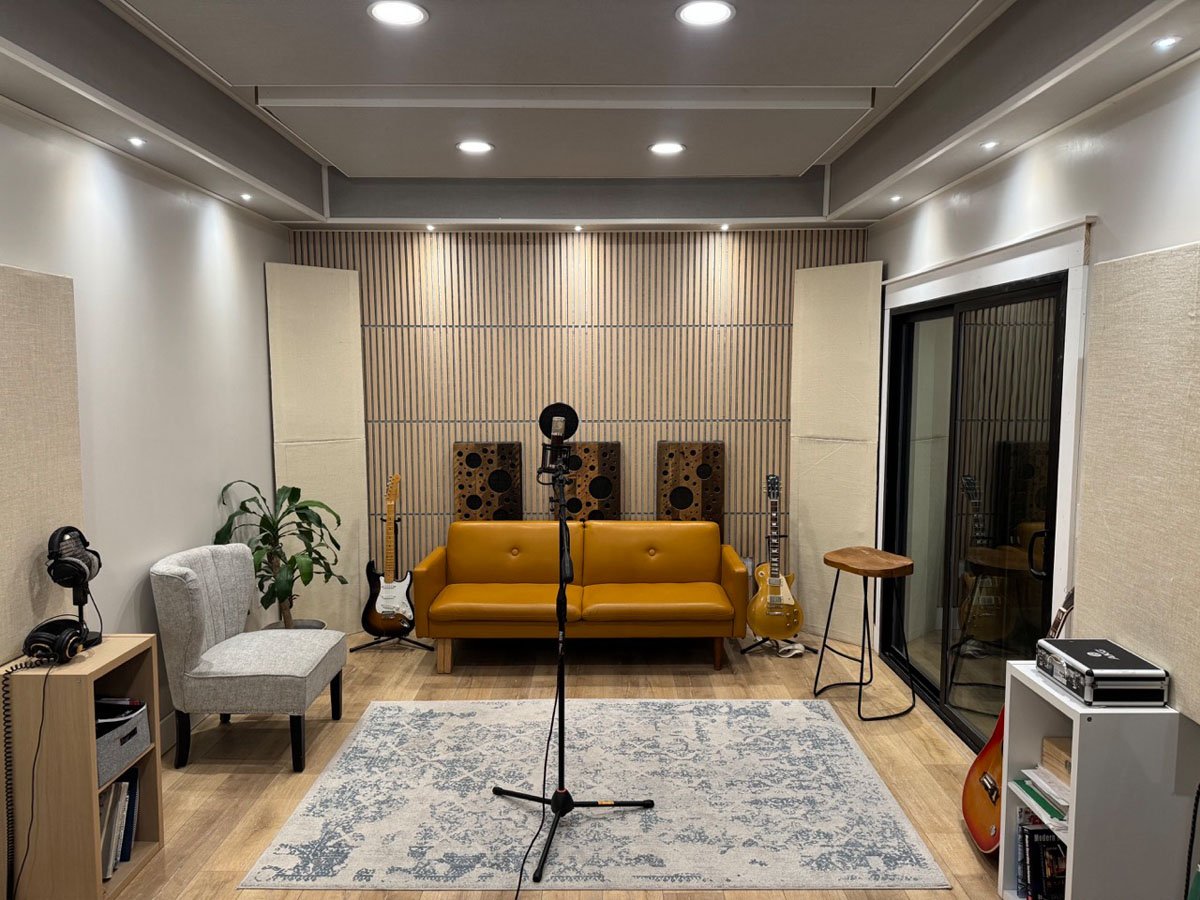
diffusion is like behind me. You see these for those people who are not. Is this on YouTube? It is. Yep. Okay, so the YouTubers can see it for the people listening. Basically, I have these wood these panels behind me that have a wood front that's got a kind of a funky design, and it slots, and then the sound can pass through it and get into an absorptive panel behind it, which is just fiberglass, really Nof Ecos fiberglass or mineral wool is usually what people use. So the diffusion is a wood panel that doesn't absorb; it just reflects back into the room. But it reflects in a more pleasing sound to the ear. So rather than that specular reflection I talked about earlier, which is like sound literally hitting wall and bouncing straight back at you, when sound hits a diffuse surface, it hits it and it gets shot out in a mathematically precise way that spreads it out into the room in a beautiful like bloom, is the way you can think of it.
Mark D. Williams 25:49
Interesting. Now, obviously, I can see the image behind you, which makes it. That's obviously I'm not going to say geometric, but like there's a pattern there. Yeah,
Mark D. Williams 25:57
yeah. So if I just took a board and I just cut 50 random holes. Wouldn't that also diffuse sound? It's just not creating a beautiful pattern. Would that not be just as effective or not?
Wilson Harwood 26:10
Technically, no. There, it's been studied a lot in acoustics. So the smarter approach would be to go to the acoustic playbook and say, "Hey, if we use a series of slats in a ratio that's common, we know mathematically that will sound better than just random holes. What I see on the market a lot now are those like slat walls. Yeah, like just
Mark D. Williams 26:33
everywhere. Well, they're cheap, and you can DIY them, and they take a ugly condo or apartment, and instantly make it just look a little bit nicer.
Wilson Harwood 26:44
Yeah, exactly. And those are super popular from acoustic standpoint. Questionable how effective they are, just from like pure physics. Like I would never specify them in a recording studio, but in a home, maybe you know. But it's still
Mark D. Williams 26:57
better than sheetrock because now better
Wilson Harwood 26:59
than sheetrock. Yeah, still better than sheetrock, but maybe not doing enough. What I think, what just happened in my mind, the epiphany that happened in my mind was like, oh, you could get like really beautiful, like what they call quadratic diffusers. They look like wood panels with differing depths, like slot depths. Something like that could become a a wall, like a feature wall in a home, and would actually do real, serious, beautiful sound work in a non non good way, and then hanging acoustic clouds in the ceiling, they could be white fabric, they blend into the ceiling sheetrock, and they could literally be right up against it, and they're just like rectangles, or they could be whatever geometric shape you want, and that would also work.
Mark D. Williams 27:42
You know, it's just thinking about that client I was mentioning, John and Leah's house. I'm thinking they have a two-story. Now the problem is all glass, so you couldn't do it there. But those those walls that you have behind you, could I? Let's say let's say now if it's a modern contemporary house, it's almost like a piece of art. Honestly, I could hang it, whatever. But let's say I didn't want to see it. Let's say this is a traditional home. What can I put in front of that perforated diffuser so that it optically looks attractive? Like, would I hang fabric in front of it? Would it be like? Is there a way to hide sort of that modern esthetic? If someone didn't want a modern esthetic in their home,
Wilson Harwood 28:17
yeah. So, in recording studios since the '60s, they've been hiding ugly acoustic material behind fabric walls. That's commonplace. It's just not done in the residential world. Fabric walls have their drawbacks. Obviously, you can push on them. You can't hang pictures on them. But if you put them in unique places, I could imagine a home where there's fabric walls placed in critical places that you know just sort of blend in, and that is something that totally could be done more in in these modern homes, just to kind of like control the reflections and make it so you can have a conversation and not feel like you're in an echo chamber.
Mark D. Williams 28:59
So one of the things I've often remarked on: most of our homes are all wood on the main, all wood on the second, for health reasons. I mean, it's just it's, but it's more expensive. A wood floor is usually more expensive than carpet. Carpet's great at stopping sound, however, but really also good at trapping mold and hair and everything else. But I've always remarked that wood floors are triple expensive because they cost more than carpet. But usually, if you're going with good designers, they also do whole home area rugs that are vintage. It's like you you spend all this money on wood floors, and then you now you also put in beautiful carpet. But the carpet, at least, or sorry, the rugs, I assume would help diffuse, right? Because now it's covering up that hard surface. Where I was going to go with this question are is more back to the question of like general quiet. So now, so we've talked about John and Leah's house, glass and metal. I've recently we the shirt I'm wearing right now, Misahu says it turns out. So we did a whole house based on wellness, and for me, I find that it's hard for me to be quiet in my head. That's pretty. Probably a neurological issue, not something you can probably solve. That being said, like that's why I like nature. That's why I like being away from my phone. I need those separations in order for me to feel good, to feel restored. I need to get rid of some of the stimulus. In sound, I feel like being in a quiet place. It's hard, and it's funny because when a room gets really quiet, man, your ears pick up crazy stuff. Like when I-I don't know if you're a dad, but like I'm a dad of three kids, and I live in a 1919 house. Like if I'm going to take a nap on the weekend after a long run, like I tell the kids you can't come upstairs because like I can hear everything. No, it's an old house, right? I mean, the top three stairs squeak in a certain way. So like when they're in high school, I know that when they're going to try to get out of the house, like I'll know it's like a built-in defense system, so that's actually a pro. But like during nap time, it's bad because just talk to us a little bit about vibration. I know sound is vibrations, but like, and you would know the technical terms. Like, there's sound waves through our mouth, but impact sound I found is actually way harder to stop and anticipate, honestly, than air sound. Am I articulating that correctly or wrong?
Wilson Harwood 31:03
You are, yeah. And I gotta say this because I am a dad, and I have a three-year-old and a nine-month-old, and I also live in a 1919 home, and I also have a top stop stair that squeaks. And I literally thought the exact same thing as you. I was like, I got two daughters, and like they are never sneaking out of this house, and like every night or every morning I wake up and I'm like, okay, skip this the top stair and don't fall down the stairs because it squeaks so bad. So, anyways, I I just had to share in that with you because that's hilarious. That is, but um, yeah. So impact noise is the worst. It's so hard, even for me. Is like I do this all the time. One of my least favorite things is having to design in basements because the client always tells me you can't touch the floor above. Like it's hardwoods, it's finished. Like we can't touch this floor above. So the only way to really do impact noise is to put some sort of underlayment down on the top floor, add mass, so add more subfloor, so like two layers of 2330 seconds OSB is like that's the gem. That's what we use all the time. I didn't
Mark D. Williams 32:08
think about that. Two layers of
Wilson Harwood 32:09
OSB. Okay,
Mark D. Williams 32:10
that's marks. That's
Wilson Harwood 32:11
mass. But impact is even trickier than that. Even with the mass, like the the underlayment, like they sell like mats. That's
Mark D. Williams 32:18
you mean like the 16th inch rubber? Yeah, it's
Wilson Harwood 32:20
like rubber or like I I like this company called ISO Store and they sell something called the Genie Mat. I think it is. I've never really spec'd them because again, clients never let me touch the floor above. But when I'm allowed to, I would probably put one of those mats and then two layers of OSB and then insulation and then decoupling on the floor below or the ceiling below. So I mean,
Mark D. Williams 32:44
think of how thick your wall assembly is. I mean, that's massive.
Wilson Harwood 32:47
It is, and everything's massive with what we do, and it's expensive, right? It's never, it's never like there's never a cheap fix that really works. But then it's also like, why skimp out and try to save a few bucks when you don't get anything like that. Well, and I think if you're building
Mark D. Williams 33:05
a studio, it's a little bit different because like it impacts their business or their you know they're actually recording for live music or you know recording studio as you're mentioning or video you need it. I I think in most applications, at least not your field but mine, is people are okay with not soundproofing. How do we generally just make the home quieter? And so I think that's kind of the nature of what I want to go with here. What I'm just going to tell you, maybe the easiest way is for I'm going to tell you what I did and my thought process, and then I'd love for you to tell me where I was right, where I was wrong, where I was above or below average because I didn't consult anyone. I just went with what I thought. All right, so Misa, who's so we got a 5000 square foot brand new house, and as I mentioned, sound being quiet is hard for me to do. So I picked. I started with triple pane windows because traditionally my clients have not spent money on triple pane windows because it's usually framed as like energy efficient, which is great. I have nothing against energy efficiency, but people that I've sold the homes to in the past have not been interested in spending that kind of money. For me, however, by changing the narrative to a quieter home, I knew I could sell that. So that was my first thing: is going a triple pane window. It's quieter. I have two inches of rigid foam to the outside of my home for sound, or sorry, for insulation. However, now that I'm just thinking about, I just increased the mass of my wall significantly. But I also paired it with I have nothing but rock wool, mineral wool, in all of my interior walls, including not only exterior walls, but every single interior wall, bathroom walls, laundry walls, in between the floors, everything has rock wool in it. Just because I know traditionally rock wool, mineral wool does an amazing job at stopping sound. So I did that for sure. Part of it was design, so I put the laundry away from all bedrooms, so that even if your mom or the or whoever did the laundry, if you ran a night run, it wouldn't wake up. Kids, I I designed it so that none of the bed walls. I mean, even if I had walls that separated homes, we designed it so that either a closet or there would never be a bed on a bed wall, except for one wall. In the one wall that did have it, I wish I had done decoupled it because I the room the house was too small, and so I that's the one mistake I probably should have done, but I did. At least I was aware of it. But what I did is I thickened the wall. I think instead of a two by four wall, we did a two by eight wall. I filled it all with rock wool. I trying to remember all the things that we did. We actually ran rubber membrane up the wall, at least one side. I don't know if I did on both sides. I did on one side rubber wall that we do underneath our wood floors, and then I put five eighths inch sheetrock, so a thicker sheetrock, and I put that on a J channel. So I think that's got the rubber gaskets on it, and then that wall got wood applied to all because the whole interior of the house was, or in the in that room was all five inch TNG wood. So I guess now that I'm thinking talking out loud, I didn't know what I was doing, but I've definitely increased the mass of that wall. There's a number of materials underneath all the wood floors. I have the 16-inch rubber mat that is for impact. So I was really trying to stop the impact. I have trusses. I always do blown insulation in between all of the floors to help deaden the sound, and then the ceilings between the ceiling between the main room and the basement, and between the main room and the upper, I added the J channel on the sheetrock so that there would be that rubber gasket on the nails.
Wilson Harwood 36:39
Okay.
Mark D. Williams 36:40
Okay. So that's what I did at the house. Awesome. Where did I go well? Where did I go poorly? And what's your what's your take on how we did that?
Wilson Harwood 36:47
Okay. So I'm going to do it this way. I'm going to start with the three pillars of soundproofing or sound isolation, and then I'll grade you basically. Love it. Oh, I
Mark D. Williams 36:55
like this.
Wilson Harwood 36:56
Yeah. This will help your listeners kind of understand the main ideas behind it. So whenever you're trying to do sound isolation at any level, like let's say you're at level two here, I like that. With the is the host, I looked out your website. It's the host Hausa house. Misa
Mark D. Williams 37:10
Hus.
Wilson Harwood 37:11
Misa Hus. Okay, it means
Mark D. Williams 37:12
cozy in Swedish.
Wilson Harwood 37:14
I saw that. That is such a cool house. By the way, everyone should check that out. The Misa Hus. Basically, your first line of defense is mass. So you you kind of were mentioning that, like okay, I had mass here, I had mass there. So we usually do that through five eighths inch drywall or through 2330 seconds OSB, like or three quarter inch plywood. You know, like that's my toolkit for mass. Is like I just use those. Then the next thing is decoupling, and I think the only decoupling I heard you talk about, and I actually looked this up as you were saying because I wasn't familiar, the J channel, which says it's a narrow trim piece shaped like the letter J. It's used commonly with vital or metal siding to frame windows, doors, or eaves. Is that correct, or is it something else? No,
Mark D. Williams 37:55
it is, but it's on the inside for sheetrock. So my understanding is it's it's like a Z piece of aluminum that hangs off the stud, so it creates like a little bit of air space between the sheetrock. And there's actually one thing I forgot. I think we used there's a I can't remember the t here is a sound deadening sheet rock where they actually weave in like rubber or some sort of membrane into the sheet. I think I did that as I recall. In addition to the J channel on the ceiling of the main level and the ceiling of the basement because what I was trying to avoid was, hey, when little Johnny is running upstairs to the bedroom, if I'm in the kitchen, I don't want to hear the pitter patter pitter patter, and vice versa. If I'm, I didn't care about the sidewalls, I cared about the. I was that I was trying to stop the impact noise.
Wilson Harwood 38:34
Yeah, totally. That makes perfect sense. So the J channel to me sounds a lot like Resilient Channel. Have you heard? Yes,
Mark D. Williams 38:41
I have heard of that.
Wilson Harwood 38:42
So basically, for our listeners and viewers, like J channel or Resilient Channel, as far as I'm understanding, is like a single channel of metal, but it decouples in the sense that you screw one end into the studs, and then the other end you screw the drywall into, and just that like metal sort of bend reduces or it vibrates, turning sound probably into heat is what's usually happening with any sort of sound isolation and pressure. Lots of things there. But what I'm going to talk about next is the air tightness, and this is the third category. So just to recap, we have mass, we have just had a brain fart there. We have mass, and then we have the decoupling, and then third, we have the air tightness. So the air tightness is really achieved through acoustical sealant, hands down. Like acoustical sealant, people call it acoustical caulking, but I I just use the term acoustical sealant because that's the like technical term. Same difference. What it does is it just remains flexible throughout the lifetime of the seal. So drywall, as you as we all know, can crack over time. It can move. The house breathes. The house house moves, and all of that breathing and moving creates minuscule gaps in the drywall layers that can let air through, therefore sound. So by sealing the perimeter of all of our. Floors, our walls, and our ceilings were actually creating a really airtight home, which is ironically what high performance homes are all about, right? So there's this beautiful overlap between high performance homes and quiet homes that I think needs to be talked about more. But coming back to your space, what you did well was thinking through the different layers, creating like airtight. I think by using triple pane windows and a higher grade window, it's naturally just better made. It's not drafty, so from a sound isolation perspective, that helps. Mass helps with windows, like just the fact that the window is heavy.
Mark D. Williams 40:39
Oh, it's Way heavier, yeah.
Wilson Harwood 40:41
Ironically, triple pain can be worse because it creates what's known as the triple leaf effect, and we'll talk about that later if we want. But that's like a if you line up three barriers with air in the middle, air in the middle. Even though you have all this mass, it actually creates a reduction in sound isolation, which is kind of weird. So we don't use triple leaf in our designs. We actually use two windows. So we'll use a window on the outside and a window on the inside, and an air gap in the middle, and two heavy pieces of glass, single pane.
Mark D. Williams 41:10
Wow!
Wilson Harwood 41:10
I know, crazy. We're nuts. So that's what we do. The insulation on your outside, rigid insulation, actually doesn't have much mass because it's rigid board, but it doesn't weigh a lot, probably. So, really good for energy efficiency. Probably helped with your air sealing, like monopoly framing, for example. I don't know if you guys did that.
Mark D. Williams 41:30
We did not, but I'm familiar with what it is.
Wilson Harwood 41:32
So, when you have a continuous outside seal, that's really good for weather, climate, vapor management. It's also really good for sound because it's airtight and it's continuous around the whole building, and if you turn that outside into more mass, like five eighths inch zip sheathing or two layers of 2330 seconds OSB, if you're crazy like me with a nice weather resistant barrier that's taped and sealed just like zip, you've got an incredibly awesome heavy wall that's also high performance. So this is what I'm starting to like design at this next level. Is like I'm thinking beyond soundproofing. I'm thinking like how can we take all these common build things and like take it to next level. So with your house, you did some good things there. The the rock wool. I have to mention this one. This is kind of like everyone is like, Wilson hates rock wool. The thing is, I love rock wool, but there's a big misconception that rock wool is the reason your walls are quiet, and the reason walls are quiet is the insulation in the middle to begin with.
Mark D. Williams 42:45
When it comes to quality, craftsmanship, and performance, Pella sets the standard. Whether you're building custom homes or designing a timeless space, Pella offers innovative window and door solutions that blend beauty and efficiency. With showrooms and experts around the country, Pella makes it easy to find the perfect fit for your next project and their team to support it. Build with confidence. Build with Pella. Visit Pella.com to explore products and connect with your local rep today. For more information, you can listen to episode one or listen to episode 109, where we bring on Pella owners and founders at Pella Northland, as well as their innovative team behind the steady set innovation. This episode of the Curious Builder is brought to you by Olivinvine Socials. If you're a builder, a designer, or an architect looking to grow your brand without dancing on TikTok or spending your whole life on social media, listen up. Olivin Vine Socials specializes in Pinterest marketing, blogging, and email strategy for luxury home brands. They help you turn your beautiful work into a strategic SEO-driven content that drives real traffic and connects you with your ideal clients without burning you out. Ready to grow smarter and not harder? Visit OlivinVineSocials.com and tell them the Curious Builder set to you. Just so you know, I've been working with Alyssa over at Olivinvine for three years. She helped us launch the podcast. She's helped us grow our brand at Mark Williams Custom Homes. I could not do what I've done without her help.
Wilson Harwood 44:07
Canada has done some of the best building science work on sound isolation out there for that level two, like normal STC ratings. So just a plug for Canada. But basically, the flow resistivity is the ability of air molecules to get through insulation, because insulation-think of it as like a woven blanket-and so the tighter the weave, the higher the flow resistivity. And actually, if it gets too tight, it's bad. Sound can't get through it, and it actually reflects back into the room and doesn't get absorbed. So when the flow resistivity is just right, which is kind of this like lower to mid range, it allows the sound to go through the fibers. They vibrate and turn the sound into heat. So it's transitioning sound molecule, sound waves in air molecules into actual heat. That is what's happening, which makes it so you don't hear it because. Literally, the sound disappears, which I think is fascinating.
Mark D. Williams 45:02
Because it kind of, yeah, I get it. It's like the end of it's just almost like whiskers, just kind of vibrating. Whiskers vibrating,
Wilson Harwood 45:08
yeah. So it's really fascinating. So technically, in the labs, I've never seen anything that says rock wool performs better than traditional fiberglass insulation. That's what could be happening is that the fiberglass is poorly installed? It sags. People think, "Oh, I had a wall with no fiberglass. I put rock wool in it, and suddenly it sounds so much deader. It's like you have fiberglass in it now, or you have insulation in
Mark D. Williams 45:31
it. I mean, to be fair, most I would imagine most builders in the United States are not putting insulation in between walls to begin with. So maybe one of the. I mean, maybe I've always used rock wool and mineral wool. A rock wool is one of our sponsors, so I've always you know just used a lot of their stuff. But it's interesting. We had Andrew Leggy on a year ago. He's with Havelock Wool out of Reno, Nevada. So they do sheep's wool insulation. Super cool. They also do sheep's wool acoustical panels. Yeah, but it's the same. It's a natural fiber, I'm curious. Like, would a natural fiber, like wool, like sheep's wool, be different than, say, fiberglass or rock wool in terms of sound deadening qualities?
Wilson Harwood 46:10
Potentially. Okay. And this is so. I want to back up a little bit because I spec rock wool now because of building science, moisture control more than anything, and fire control. Oh, it's
Mark D. Williams 46:23
amazing product.
Wilson Harwood 46:24
It's a great product, and I want to. My old self was like, I got a lot of clicks on YouTube by saying, "Don't use Rockwool to soundproof, which is still kind of true. But I also would be a hypocrite to say we never specify it because it can be the right product in the right place. Well,
Mark D. Williams 46:40
I realized recently that well, I don't know about rock wool, but I just figured out what I know. It's hydrophobic, so it repels water. But there are certain products that are hydroscopic, and I bet I bet I don't know if rock wool is, but I'm guessing because it's natural. I'm guessing wool is, and what I I was just talking to this the home health person before about clay paints and plaster hydroscopic for the audience, and I just was educated, so it's not like I knew this, but it is it absorbs humidity and moisture, but then it releases it at the right time, and so it's like a natural. It's a I want to be curious. I'll make a note. I'll reach out to Rockwell. I'm curious if their product is hydroscopic as well, because that would be an additional from because obviously from music standpoint, humidity levels are really important too. I mean, a lot of the wood instruments and things like that. You know, I mean, you're caring for your instruments. So anyway, no, no, you're
Wilson Harwood 47:29
you're right on my wavelength.
Mark D. Williams 47:31
Mini mini rabbit hole there. Sorry. No, no,
Wilson Harwood 47:33
you're right on my wavelength because this is huge in what we're doing right now. Is thinking a layer deeper from the sound isolation. Like in all of our designs, I'm constantly thinking about vapor control, vapor science, because it's so important, like you said. And these these structures we're building naturally change the typical vapor science of a room. So if you double your drywall, you've just doubled the perm rating of drywall. If you double your OSB on the outside, you've doubled the perm rating of your OSB. So what was a typical like, oh, this is the wall we always do suddenly becomes whoa we have to take a step back and see like what's the perm environment here in in you know Colorado versus Florida versus Arkansas versus Washington State it's different everywhere so you're right on my wavelength it's a tangent but it's important the wool question you asked a moment ago, I haven't looked into it or researched it a lot. But the thing I would tell everybody is, I'm a big science guy, and I don't like to recommend a product unless I have like lab researched results. Hence, my whole thing with rock wool and fiberglass is like, if you can tell me and show me on like a lab report that a rock wool wall performs better than a fiberglass wall. I will preach it all day long, but I just haven't seen it. So with with wool, if you wanted to go to wool, you would have to say, "Hey, have you guys gone to a lab tested a rock wool lab and tested it?
Mark D. Williams 48:52
I'm going to do you one better. I'm after this interview is over. I'm sending an email to my rock wool contact on a national level, as well as Andrew, and they can answer these questions for you. So they don't
Wilson Harwood 49:01
like me. I'm pretty sure they they're like, oh, Wilson,
Mark D. Williams 49:03
he's he's always
Wilson Harwood 49:04
ragging on us. No, that'd be really awesome because I would love to see it. And they they should do this. They market themselves as the sound brute. They have a baby on their advertising, like a sleeping baby. Like, oh, this is going to quiet your nursery, and it will. But I think it's a little misleading.
Mark D. Williams 49:20
Yeah, yeah. Okay. What else? What else did I get right or get wrong? I think we're at rock wall. The
Wilson Harwood 49:26
eight inch, the two by sorry, not eight inch, the the two by eight wall that you did was an interesting choice. When we increase the air gap of a wall, we are improving the sound isolation. The larger the air gap in our wall, the better. However, with that wall for the same amount of space, I
Mark D. Williams 49:44
should have done two two by four walls or two two by four
Wilson Harwood 49:46
walls with a one inch gap. You should. What what
Mark D. Williams 49:49
what what's the benefit of a staggered wall? So you see, so like,
Wilson Harwood 49:52
yeah,
Mark D. Williams 49:52
you know, I don't know. We don't do it a lot in our climate, but I mean, I could have done a staggered stud wall with that. Where where does that where is that in the higher. Of sound, so like a normal wall is let's say just it's a zero because it's not better. Then you have what staggered stud, then a wall with an air gap, and then a wall with air gap with like density applied to these. Is that about right?
Wilson Harwood 50:12
Yeah. So I would say it's regular wall is zero. I would say staggered stud is maybe a two, let's say, or a 1.5. I never use them, and the reason is space. I'm like, well, if we're gonna use up a two by six, why don't we throw a hat channel on it, and we'll have what's
Mark D. Williams 50:27
a what's a hat channel?
Wilson Harwood 50:28
Ah, yeah, yeah. So instead of J channel, I would have recommended acoustic clips and seven eighths inch furring channel, or hat channel as it's known. It basically is a channel that looks like a hat, probably used in commercial construction more than residential, furring strip, and then you buy these acoustic clips that you screw into the studs, and it decouples better than J channel and way better than Resilient Channel, and it's way easier to install in terms of not making a mistake that could ruin your whole system.
Mark D. Williams 51:00
And that's something that you'd put on before sheetrock. The sheetrockers put it on
Wilson Harwood 51:03
exactly. So you would put it on as the contractor. You would probably have a specialized team that would put in the spacing of the acoustic clips, and then the channel just clips right in. Not too hard to install. And then the sheetrock team would come in later, and they would screw into the actual metal furring channel, and that's going to give you really high STC ratings for the for the space you're taking up. Definitely the way to go.
Mark D. Williams 51:30
Without going to, and we'll go back to Misu in a second. We all these the rabbit holes I got to chase down. So like, if I did all of that, but then I just have a door to a bedroom. Does it really matter? Because isn't sound gonna just go down underneath that floor, or I'm not.
Wilson Harwood 51:47
Yeah, yeah. This is the danger. This is the dang the place I try to stay out of because it is a rabbit hole. You're like, well, if I put all this money in this wall, but I don't put any money in the door, is it all a waste of money? And that is the danger. That is a question you kind of have to ask yourself a little bit. But my question to you to throw it back would be: If you want it to be a sound isolated wall to begin with, why not just do the right wall? Or if you're going to do the two by eight wall, why not just do two two by four walls? It'll be better, you know. No,
Mark D. Williams 52:20
I I agree with that. I'm not trying to chase. I think what I'm trying personally trying to chase with this house and just with homes in the future. I want to tell people I'm giving, and people can noticeably tell. It's here's what's really fascinating. When I did have all the rock wool in all of the stud spaces before I put on sheetrock, when I when I walked into the house, it was like you know, shout out to Minneapolis in the Orfield Labs, which you probably know about, I was like, "Oh my word! It was like sound deprivation. I scuba dive. It felt like being under the water. Like it was like, wow, this is. And we actually did a video for Rockwall for the sound changing, meaning like we went downstairs and talked, and then I went into the room, and then I also went in, and you could literally see a 20 to 30 decibel change in that space. Now, I think what you're trying to say is that if that had been Rockwool or Fiberglass, that sound deadening would have been maybe the same. Hard to say. That was it.
Wilson Harwood 53:14
Would have definitely been the same.
Mark D. Williams 53:15
Yeah, yeah.
Wilson Harwood 53:15
And this is again, man, Rockwell. You guys, they're like little marketing geniuses over there. I'm going to go on that. They are marketing geniuses. They got that game figured out, but the reality is different. So the physics were. Let's go back to the beginning of podcast where we talked about acoustic treatment versus sound isolation. What you had there was acoustic treatment. All your walls were open. You had raw raw mineral wool fiberglass interchangeable in my opinion. The sound waves were hitting it. The little fibers were vibrating. Those sound waves were turned into heat and not reflected back to your ear. That is called absorption. That's called room acoustics. It's not the same as soundproofing in the sense that if you set up a drum kit in there, you would have heard the drum kit kind of throughout the house, and the reason is that we didn't have mass. Mass is what stops those lower frequencies, the really loud sounds, just people talking. Maybe a TV show, typical noise. Rock wool will do that. Rock wool in the way you had is like what we talked about the beginning. Like I was like, "Hey, hang acoustic panels on your drywall, but then tell the audience about when you drywalled it all and what it sounded like.
Mark D. Williams 54:27
Well, it sounded it was still you still couldn't hear through the walls like a normal house was. I mean, definitely was better. But when the sheetrock came back, and obviously the reverberation, as you were calling it, was like, "Okay, that's unpleasant. But you know, luckily, as we finished, we did plaster, which are like micro little. You know, it's changing it just a little bit, which helped. I didn't realize it at the time, but that probably the fact there's texture on all the ceilings probably helps. The fact that not not everything's symmetrical. Well, we're gonna run out of time, so yeah, I have four other questions I got that are really on. This is I didn't realize we're gonna go down such a. Wormhole on Misahu. I think. What's your thought on the rubber membrane that I put underneath the wood floor?
Wilson Harwood 55:06
That is probably doing a lot for impact resistance, and depending on how much it weighs, it might help a little bit with
Mark D. Williams 55:13
pretty light.
Wilson Harwood 55:14
Yeah, if it's lightweight, it's probably doing more with impact resistance. Meaning, one of the best things you can do for impact resistance is a carpet, like you said, and for the same reason that the rubber's there, but carpet might even arguably be better.
Mark D. Williams 55:25
It is, except that I'm never going to put carpet in a home if I can avoid it, just from the habit. Because I mean, I'm doing my to be clear, my goal is not soundproofing. My goal is quiet to the. But I, I'm prior to then I, I define this as wellness, and so, but I'm also that's why I do think mineral for me is the right thing because of the hydroscopic, the hydrophobic, the other things that it also does. It might not be the one you know super pill that solves everything else, but because it does like three or four other things as well that I'm also interested in, it's a product that I put in every one of our homes. And I think you know, yeah, you don't have an issue with that, obviously. But then the rubber was like I just wanted to be 1020, 30% better than just builder grade, if you will, or you know that's that's what I'm going for from my point of view. And I think that the average audience listening, I mean, if we're going soundproofing, they're just going to call you, which is the point. But if they're going for just sound dampening or just that, no one wants to walk into an echo drum, and so I think that's why I was trying to dive down, give people a practical example, and I actually felt like I went pretty far with it. Yeah, you did.
Wilson Harwood 56:30
Yeah, I don't want to be too harsh on. No, no, no, no. I don't feel bad at all. What?
Mark D. Williams 56:34
I no, and and there's things that I learned like that double stud wall or the air gap. It's like, oh yeah, I should have designed that. I didn't. The double subfloor thing is something I had not considered. Obviously, that gets pretty expensive, but it also, I mean, you have to do that architecture. I mean, that's way or that's trust design. I mean, you that's not something you can do on the fly at all. Exactly, exactly.
Wilson Harwood 56:54
That's a good point to bring up to everybody too. Is like I often get put in way too late in the game, and what we design is structural. We're always adding mass to systems.
Mark D. Williams 57:04
Well, and I didn't realize this at the time. I had a client one time that wanted to do in-floor heat on the main level in our climate. You know, it gets cold up here, but honestly, usually this the main and second floor is not a big deal because heat's rising. I always put hydromic heat in my concrete slab, of course, because that's easy. It's cheap. You already pour in concrete. You might as well bury tubes in it. But on the main level, we're usually doing wood on top of you know subfloor and trusses. There are people that will then pour you know an inch or two layer of gypsum or concrete or whatever, and it's really expensive. But someone had said, "Have you ever done that before? I said, "No. And they're like, "It's the quietest home you'll ever build. But now, after talking to you, I realize why it's density. It just made that's two inches of rigid concrete. That is heavy. That's really effective. I would imagine
Wilson Harwood 57:49
very effective. Yeah, concrete's the best for sound isolation. So heavy, so much pounds per square foot is how we look at everything in the U.S. and Canada. And so, like everything I'm looking at is like, what's the PSF? Am I getting the mass that I want for sound isolation?
Mark D. Williams 58:05
So I had a question about sound back to Misu. So we have a detached wellness center. It's so I built, and I'm going to give you the context of this story because it was kind of funny. So at my 1919 house with the squeaky steps, I have in the garage in the basement, which is attached. I have a a rubber plated deadlifting set, or you know, just a rack set. And so, like, my wife gets super angry at 430 in the morning if I'm doing deadlifts because you drop them, and that vibration will go all the way through the house into the set, and she'll be like, "WTF? What are you doing? So, anyway, I say that story because at Misa I designed a separated wellness studio, triple pane windows, rock wool, external insulation, and it's probably 20 feet away from the house. So that's my sound gap. So it's a separate building. If I was in that floor has a cork flooring, so the floor is rubber as well. If I was in, I've never tried this, but I'm just curious. If I was in that room and it was five a.m. in the morning and my wife was sleeping, as the angle would fly, it's probably 45 feet up to the second story. I'm just curious if I was dropping and doing like trying to be as loud as possible, would that sound a be able to leave the well in the studio, travel through 45 feet of air, and also penetrate another structure? Or that's I mean I I got to imagine that's pretty bulletproof in terms of sound deadening on the way to that house.
Wilson Harwood 59:24
Yeah, distance is one of the best sound isolators. So, like, I forget the exact math, but for every like 100 feet or something, sound levels drop a certain amount. Like, it's quantifiable. So, if you can get your space far away, obviously that's very cheap and the best thing to do. The next thing would be like how airtight is your room? So like that would be my next question. And if it's really airtight, which it sounds like it is, that's moving towards you. Then it would be like okay, what's the weakest point? Maybe it's the window, right? The windows. So and
Mark D. Williams 59:56
the door
Wilson Harwood 59:56
and the door. So then it's like okay, sounds definitely going to go through the window and the door. So once you factor in all those things, my guess would be your wife would not hear it, but that's what I'd be thinking in my head. I'd be like, okay, deconstructing, and then like you said, what's her barrier? And once you factor in all those things plus the distance, you know, you can't, you could maybe measure it, but it would all just no.
Mark D. Williams 1:00:18
You answered the question. Two more questions that I got to get through because it was interesting. We had a 2009 or 10. I built a home, and it was this is how it was explained to me. I'm curious if this explanation is true or not. So we had a all tile walk in shower, and the fan. I want to say the fan was dead center in the room. When I say dead center, I think you're going to get what what happened here throughout the day because it was on tour. So for like six hours a day, people come through the house. By the end of the day, the sound was so loud, like I couldn't believe it. And someone came in and said they were a sound expert, and they said the reason I was having so much sound acoustic because we had the client later had us like, hey, did the bath fan do it wrong or whatever? And the guy said, you just happened to be really unlucky. Like it was like dead center is what his thing. And because he said your room was perfectly also square, he said your sound waves were building on each other, and because it was all tile surfaces as well, he's like, you, I don't know. Is is that is what he said true? Is that
Wilson Harwood 1:01:23
what he said is true? So the worst room you can build acoustically is a square. Technically, it's a double square, which is like a king's room, like 20 feet by 30 feet. But with the square, he's right that the room modes just like kind of are are multiples of each other, and so the math works that like the resonances just keep building up, and like they build tones on top of tones. And so, if the fan was constantly going and the surfaces were tile, all reflective, I could imagine how the sound of the fan was actually like building on itself and almost creating a feedback loop.
Mark D. Williams 1:01:54
Yes,
Wilson Harwood 1:01:54
which is fascinating and terrible. So the fix to that would have been putting an acoustic panel on one in the shower.
Mark D. Williams 1:02:01
You wouldn't do it in a shower, but I would. Yeah. If I ever did that again, you would just move the the shower. Oh yeah, move the fan
Wilson Harwood 1:02:07
a little bit over, or not build a square. I don't know, but yeah, the fact that it was dead center probably had something to do with that build up for sure.
Mark D. Williams 1:02:15
If you you know the one house I mentioned, John and Leah's house earlier in the podcast. What I think saved us a little bit is nothing. No wall or ceiling was square in that whole house. Everything was built on slants and changes, which I imagine allows for some diffusion of sound because you're not getting that perfect square wall wall.
Wilson Harwood 1:02:33
Yep, exactly. Yeah, you're not getting the slapback echo, flutter echo that you get when you like clap and you hear the like ping back and forth. When you have angled walls, especially more than seven degrees, you have them angled enough that the specular reflection we talked about actually doesn't come back to your ear. It goes a different direction, so you don't hear that sound coming back to your ear. The
Mark D. Williams 1:02:53
last thing I referenced it. You're familiar with the Orfield Lads, I assume.
Wilson Harwood 1:02:57
Yes, I am.
Mark D. Williams 1:02:58
Have you been to
Wilson Harwood 1:02:58
it? I have, and I would love to go.
Mark D. Williams 1:03:00
If you ever come up, look me up. I'll go. So I've often wondered, you know, an extreme introvert. I've always thought that solitary confinement would be like the worst thing you could ever do to me. Yeah. But I was thinking about like the dep like true sound deprivation. For those aren't from Minnesota, my understanding is I believe the Orfield Lab is the quietest room in the world.
Wilson Harwood 1:03:19
It might be, or one of them, yeah.
Mark D. Williams 1:03:21
And so basically, it's all this, and it's it's a much more complex, multi-million-dollar version of what you have behind you. It's all these wood baffles or whatever they are. I can't articulate it very well, but basically, it's the whole room, and you can sit in it, and you can do sessions. Like if you can make it for more than 60 minutes or something, without people get disorientated, like fall over, like the lack of sound. Can you explain a little bit what I'm poorly doing?
Wilson Harwood 1:03:47
Yes, I can. So, what you're describing is what's known as an anechoic chamber. In anechoic chambers, there's several of them throughout the world. Orfield Labs is one of them, and they're the thing you're talking about. Are they these long, sort of like triangular,
Mark D. Williams 1:04:02
yes,
Wilson Harwood 1:04:02
almost pyramidal acoustic treatment, essentially, and they're really, really long, like three feet or more. And what they've done is they've literally created a room where there's no reflections. So when you talk, you only hear the sound of your voice, not as as it's getting reflected back to you, and as humans, we don't know what that's like. It's so unnerving to our nervous system, and so a truly dead room in the music world-it's like the holy grail to get like a perfect response from your speakers. An anechoic chamber does that. They test speakers in them. That's why they have them too. Is like when you build a speaker system. You put it in an anechoic chamber, and you put a microphone in front of it, and you get the pure response of the speaker, not the reflections in the room. That's why we do it. It's like a study experiment. It's not, but the byproduct is that you go in there, and I've never been in one, but I can tell you, I can imagine what it'd be like. People feel sick. They feel like they're going crazy. They're like, "I got to get out of here. And in my world, we have to be careful not to build an anechoic room, one that's so dead that it's uncomfortable. So we want a little bit of like reflection. Well,
Mark D. Williams 1:05:15
it's funny because I've heard an architect I know was in it, and she's like, after a certain period of time, like you can hear your heartbeat, you can hear the blood going through like your brain, like through your jugular. Like she's like your senses just go on hyper alert, and it's funny because not to that level, obviously, but I was sitting on a couch at Misahu's just enjoying it being quiet, and I could hear it felt like a blaring speaker. I could hear the airflow from the register.
Wilson Harwood 1:05:43
Yeah,
Mark D. Williams 1:05:44
and I was like, "Why is this fricking vent so loud? And I don't think the vent is that loud. I think the house is just so quiet.
Wilson Harwood 1:05:52
Is
Mark D. Williams 1:05:52
that is that a relative term that when things become really quiet, we become hyper aware?
Wilson Harwood 1:05:56
We do. So one of the cool things for when I live in this world where I build soundproof rooms for people, but as somebody who spent five years working in a soundproof room, it's got a plus and a con. One of the pros is it's really quiet; you can focus. The con is what you're talking about. You almost have this anechoic chamber effect in the sense that it's so quiet that any sound you hear is like pulls your attention. So for me, it was like if I heard anything through my door, because again, the door is the weakest point, right? I was like pulled to it, and I constantly was like, "Oh, that's so annoying, and and it would drive me nuts. I'd be like, "Ah, I wish my door was just a little more soundproof, and you know that's ridiculous because it wasn't loud, but because the rest of the environment was so quiet psychologically, we're so what you're describing is totally true. And the thing, just to dovetail off the register, because that's something we think about a lot as well. And it's so good to hear you say that because sometimes I'll design rooms for like an office, for example. I'm like, ah, we don't need to oversize the register. Like the sound of the air won't affect the recording, but it'll affect the psychological enjoyment of the room. Which
Mark D. Williams 1:07:10
oh, that's so that's interesting. So what we're maybe thinking if I heard that sound is if I had a vent rather than being eight inches by 12 inches, if it was I'm not going to do this because it looked ugly. But if it was like 30 inches by 20 inches, just a bigger, it would diffuse the air, so it wouldn't be so compressed. Is that what you're essentially referring to?
Wilson Harwood 1:07:28
Right. So the CFM is the cubic feet per minute of airflow required to heat and cool a room, right? And that can't change. That's like we have to have this volume of air, but the speed at which the air is delivered to the room doesn't matter, and for us acoustic people, what we're trying to do is we're trying to slow the the airflow down, but deliver the same amount of volume. And so to do that, you just increase the size of your ducts. So what you're hearing is the actual air rushing past the diffuser, and it's making noise because the speed is so fast. You know how if you had just opened it up, even 12 by 12 would have done it probably. You know, it's
Mark D. Williams 1:08:08
funny. Is I'm going to go next time I'm there. I'm going to take the grate off the floor because is it that you think it's the air pushing or is it the air pushing through the grate that's making the noise? I'm curious.
Wilson Harwood 1:08:16
Yes, probably the grate that's the number one problem because what happens is that you the grate is reducing the face velocity,
Mark D. Williams 1:08:25
right?
Wilson Harwood 1:08:25
So it's reducing the amount of square square footage, as I describe this, that air can pass through. So you're reducing it, constricting it, increasing speed, making yeah.
Mark D. Williams 1:08:36
Oh man, this is pretty fun,
Wilson Harwood 1:08:39
right? I
Mark D. Williams 1:08:39
want it is. I bet you're just. I'm like. I wonder. I would be very curious. I don't think we can track this. It'd be curious to know how. At what point did we lose someone? They're like, these guys are going way too. Because like, I'm just getting warmed up. Like, I mean, if this is another hour, I mean, I can't imagine how many more sound questions I would have. I didn't realize I was gonna. Took me a while to warm up, but right now I'm like, you're in it, man. We're locked. We are.
Wilson Harwood 1:09:00
We are in. Oh yeah. We are locked unloaded. It's the
Mark D. Williams 1:09:02
squeaky step dad thing that really bound us. It's funny because like I've you're gonna you're gonna well now you're really gonna relate. So like after a long run on a Saturday, I'm a big napper, so I like nap, and so like I'll lay down. The the house is supposed to be quiet, but it's like the fact that you know it's gonna be quiet, it goes hyper aware. Like if it's if it's if there's like a lot of noise happening. Like we have airplanes that fly over house all the time. I never hear airplanes because I'm used to it. So it's like it's too repetitive. Yeah. It's but it's funny. I've even got like Bose noise cancel. Like if I'm really irritated, like the kid is just. I'll put earplugs in the Bose noise canceling headphones over. I swear, if I really concentrate, I can still hear through if I wanted to. It's funny. I think you're right though. It's that uber quiet. You become hyper aware.
Wilson Harwood 1:09:46
You do. Yeah. It's it's like a double edged sword. You got to be so careful with it. You're like, I want peace and quiet, but you're like, but how much peace and quiet, or the right type of peace and quiet, you know? But anyways, yeah. It it's. A beautiful topic. It's nerdy as all get out. I think that's cool. I've had, but I think builders should know about this stuff, right? Like all the things you're asking. I'm like, like it's just it's not totally intuitive, and there's so much physics and science behind it that took me so long to understand, and I'm constantly learning more. So it's just like this crazy space that even if you're doing level one or level two isolation, just the foundation that I talked about today can help you think through it. At like the the the buzzword is first principles these days, right? At the first principles letter level is really what it is.
Mark D. Williams 1:10:38
The one thing before I close the episode would be my last question. Is I meant to talk about this a long time ago. Doors. You mentioned how doors, both in your studios that you build, but also just doors in general. Let's forget windows because I think they they do a good enough job for. How do you actually make a door not be the weak point?
Wilson Harwood 1:10:59
So I used to be like in my DIY phase. I was like, "Oh, this is how you build your own door, and you can do it. But I'll tell you a secret: we do all of our doors through this company called the ISO Store. They're awesome. You said the
Mark D. Williams 1:11:13
ISO store or ISO door?
Wilson Harwood 1:11:16
ISO Store. I mentioned them earlier. They sell the clips that we use. They and they don't give me any money. They should, but they don't. And so we just, I just like them. They're good people, and they've done really good work over the years. So they sell these doors. That the the I think the lightest one. I never spec the lightest one. I think it's like 145 pounds or so. The middle one is called the SD door. It's 240 pounds. I want to say, and we use that one every once in a while with two of them, and what's known as a communicating door system. So there's two of those 240 pound doors and an air gap. That's the best, and then a lot of times we'll just use one door, but their heaviest option, which is like 340 pounds, I know that one is the a beefy one, and that's how you stop sound. So just pure grunt mass. And then, sorry, you want to say something?
Mark D. Williams 1:12:08
Well, no, I think you're going to get there. I mean, I get the heaviness of the door. We use True Style doors that were like two and three quarters. They were beefy doors, probably 120 pounds apiece. So that was great. How do you stop the the the the 16th inch gap or whatever it is that the door, and then of course the bottom is half inch or whatever people have their bottom off the floor. If it's carpet, it's a little bit more. But
Wilson Harwood 1:12:28
yeah, yeah, yeah, totally. So you have to use a a really good threshold. I learned that the hard way. The threshold is so key because it goes the whole bottom of the door, like an acoustic threshold. It just puts a little bit of rubber up against the bottom behind the door, so it kind of closes into it, and then a drop seal on top of the threshold, and that's just like double duty killer, and that's what they do, and that that's all comes with the door when you buy it, and then around the perimeter. To answer your question, they actually sell this relatively cheap like rubber gasket with like three flanges, and I think they do two of them plus another gasket around the edge, so three gaskets on the door. And they swear obviously it works. We all use them, and it's that it goes into the doorstop. So your the door hits the doorstop, hits this rubber, and it's airtight, and that's the key.
Mark D. Williams 1:13:16
Often look at those doors. I mean, I'm not thrilled about. I mean, I knew this would be the case. There'd have to be something on the threshold to stop. I mean, that's your biggest weak point. But like, yeah, the homes that most the high end builders are building, like you know,
Wilson Harwood 1:13:27
threshold.
Mark D. Williams 1:13:28
And the Oscar can. There's probably no way to like recess it into the
Wilson Harwood 1:13:33
yeah.
Mark D. Williams 1:13:34
What? Because I'm guessing what you're depending on is the the reason the threshold works is no different than any other door for air and water. Is like it has something to press up against, and then that rubber is your seal. That's your air sealer, correct?
Wilson Harwood 1:13:46
Yeah, exactly. So the drop down though can be fully mortised. So it's got a little pin on the side of the door. When it closes, it drops a seal down underneath the door. That will look elegant and nice. The problem that I've found with those is that they have like a minuscule gap, like 16th of an inch on each side, because there's no way for that drop seal to literally close everything under the door. You know what I mean? That's
Mark D. Williams 1:14:09
what you need. That's belt and suspenders. But I mean, let's let's say you skip the the threshold and you did the drop seal better than no drop
Wilson Harwood 1:14:16
seal.
Mark D. Williams 1:14:17
Are we 90% of the way? 80% of the way? I mean, how much?
Wilson Harwood 1:14:20
You tell me, man. You in that quiet room, and then you hear that 16th of an inch hole, and like you hear like something coming through, and you're like, "Ah, we need the threshold, man. And it's like, be like
Mark D. Williams 1:14:30
Wilson,
Wilson Harwood 1:14:31
but I think that there's got to be a gradient to your right. The average builder, the average high-end home, like they're not going to want to do what I want to do because I'm the nerd. I'm like, you gotta do it all, man. We gotta do the whole package, you know, the whole kit and caboodle. But it's like, reality is that drop seal is gonna be better than nothing. And I think if there's anything you could take away from this episode, it's like, hopefully, just knowing some of the the truths will get you farther along, and that gradient. I would be really curious to know what builders find successful and not successful because for me the gray areas I try to stay out of, and that's exactly where you want to live. You want to live in the gray area. You want the like, I want to do this wall. I want to do the slightly cheaper door. I want to, and that's actually more. That's a bigger niche,
Mark D. Williams 1:15:16
right? I niche down from soundproof your studio is to. No, it's a
Wilson Harwood 1:15:23
bigger niche. Yeah, it's gonna. You get way more people that way.
Mark D. Williams 1:15:26
Yeah, yeah. Sorry for this being so long. I just had too many questions. Um, thank you very much for coming on the podcast. It was delightful to have you on. I forgot to ask you, and we definitely are out of time. Uh, so I'll let you ask. Then I we usually start each episode by having the previous guest ask you a question, but I forgot to ask the question. What question? It could be anything-life, business, anything. What question would you like to leave for the next guest?
Wilson Harwood 1:15:50
Yeah, I thought about this and I wrote it down. Luckily, so what's a moment in this business when something felt off, even before you could explain why, and what did you do about it?
Mark D. Williams 1:16:03
That's a great question. Oh, good. I'm glad. What's the moment in this business where it parentheses felt off? And what did you do about it? That's a great question, buddy.
Wilson Harwood 1:16:17
Yeah, yeah, and like even before you could explain why, it's like when really what it's getting at is like you know we trust our intuition a lot, right? We need to, and sometimes we go against it just to like succeed. I don't know curious about that.
Mark D. Williams 1:16:31
Yeah, thank you very much, buddy. We'll have everything in the show notes, and thanks for tuning in the Cures Builder podcast. Thanks for tuning in to Curious Builder Podcast. If you like this episode? Do us a favor: share it with three other business owners. The best way that we can spread what we're doing is by word of mouth, and with your help, we can continue to help other curious builders expand their business. Please share it with your friends, like and review online, and thanks again for tuning in.
This episode is sponsored by: